Elon Musk calls SpaceX blast a ‘most difficult, complex failure’

SpaceX founder and chief Elon Musk said on Friday he was unsure why one of the company’s Falcon rockets burst into flames on its Florida launch pad last week, destroying both the rocket and an Israeli communications satellite it was due to lift into orbit.

“Still working on the Falcon fireball investigation. Turning out to be the most difficult and complex failure we have ever had in 14 years,” Musk, the billionaire entrepreneur who is also the chief executive of Telsa Motors, wrote on Twitter.

A SpaceX-led accident investigation is underway, overseen by the Federal Aviation Administration's Commercial Space Transportation office.

A massive fireball enveloped the rocket on Sept. 1 as it was being fueled for a routine test of its first stage. The rocket was scheduled to blast off two days later.
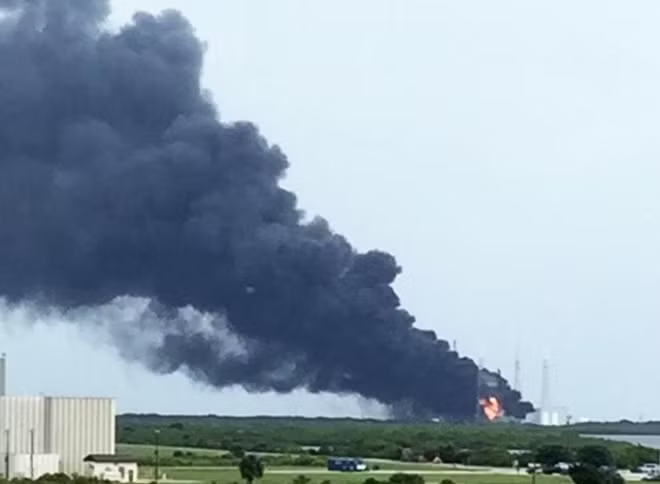
An explosion on the launch site of a SpaceX Falcon 9 rocket is shown in this still image from video in Cape Canaveral, Florida, U.S

The rocket’s nine engines had not yet ignited for a test firing when a fireball engulfed the upper stage. “There was no apparent heat source,” Musk said on Friday.

The accident destroyed the $200 million communications satellite owned by Israel-based Space Communication, which was going to be used by Facebook and Eutelsat to expand internet access in Africa.

Hawthorne, California-based SpaceX has not yet said how much damage was done to its launch pad, located at Cape Canaveral Air Force Station.

SpaceX has backlog of more than 70 launches for commercial and government customers, worth more than $10 billion.

The rocket that was destroyed was the second of 29 Falcon 9 rockets to fail. It took SpaceX about three weeks to identify the likely cause of its previous accident, which occurred on June 28, 2015.

The problem was traced to a faulty bracket, which was holding a bottle of helium inside the rocket’s upper stage. When the strut broke about two minutes after liftoff, the upper-stage liquid oxygen tank over-pressurized and ruptured, triggering an explosion.

SpaceX replaced thousands of struts throughout its fleet and had successfully flown nine times before last week’s failure.

"We remain fully confident in the results of (that) investigation ... The current investigation has no bearing on this," SpaceX spokesman Dex Torricke-Barton wrote in an email to Reuters.

SpaceX's next flight had been slated for later this month from a second launch pad at Vandenberg Air Force Base in California.

“We have confidence that SpaceX will resolve the matter and when they do we will be ready to launch,” SpaceX’s customer, Iridium Communications Inc, told Reuters on Friday.

SpaceX said last week it was looking to shift its Florida launches to a nearly completed pad at NASA’s Kennedy Space Center, adjacent to its Cape Canaveral site.
Reuters

Other News

AI offers both opportunities, challenges for Vietnam's growth

AI offers both opportunities, challenges for Vietnam's growth

Dr. Ho Duc Thang, a full-time member of the National Assembly’s Committee for Cultural and Educational, said productivity is the key to sustaining double-digit economic growth, and AI has greater potential to improve productivity than any previous technology.

Top leader unveils people-centred vision for new development model

Top leader unveils people-centred vision for new development model

Vietnam's growth model, long fueled by low-cost labour, resource extraction, contract manufacturing, expanded investment, and capital accumulation, has run out of road. The country now needs a sweeping reform agenda to shift from extensive growth to a model driven by productivity, knowledge, science and technology, innovation, and digital transformation.

First national semiconductor chip prototyping support centre makes debut

First national semiconductor chip prototyping support centre makes debut

Vietnam's semiconductor ecosystem now comprises around 60 chip design companies, some 7,000 chip design engineers and 166 universities offering semiconductor-related training programmes. Initial registrations from 12 organisations indicate demand for the prototyping of approximately 30,000 chips.

Vietnam targets at least 10 large strategic technology firms by 2030

Vietnam targets at least 10 large strategic technology firms by 2030

Deputy Prime Minister Ho Quoc Dung has signed a decision approving a plan to develop large domestic strategic technology enterprises in the 2026–2030 period, aimed at advancing digital infrastructure, digital human resources, digital data, strategic technologies and cybersecurity.

Protecting users crucial in building digital trust: Experts

Protecting users crucial in building digital trust: Experts

In Vietnam, digital transformation in the finance and banking sector is accelerating cashless payments, expanding access to financial services, improving market transparency and supporting economic growth and macroeconomic management.

Fostering skilled workforce for innovation era: experts

Fostering skilled workforce for innovation era: experts

Experts said close coordination among State management agencies, research institutes, universities, and businesses will improve training quality and serve the dual goals of quality education and practical research application.

Startup forum bridges Silicon Valley and local innovation ecosystem

Startup forum bridges Silicon Valley and local innovation ecosystem

The University of Economics Ho Chi Minh City (UEH), Saigon Asset Management (SAM), and Plug and Play Tech Centre co-hosted the “From Vietnam to Silicon Valley” forum, exploring AI innovation, venture capital, and pathways to integrate Vietnam’s startup ecosystem with Silicon Valley and global markets.