The move was swiftly criticised by news producers, politicians and human rights advocates, particularly as it became clear that official health pages, emergency safety warnings and welfare networks had all been scrubbed from the site along with news.
“Facebook was wrong, Facebook’s actions were unnecessary, they were heavy-handed, and they will damage its reputation here in Australia,” Treasurer Josh Frydenberg told a televised news conference.
Frydenberg said Facebook Chief Executive Mark Zuckerberg gave no warning of the news shutdown when the pair spoke over the weekend about looming laws that will force both Facebook and search engine giant Google to pay local publishers for content.
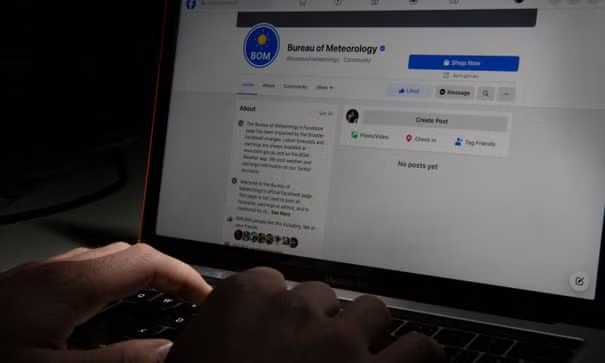 |
| Facebook has removed dozens of pages run by government departments, community organisations, charities and satire news outlets as part of its decision to ban Australian news. Photograph: Mike Bowers/The Guardian |
The two men had a subsequent conversation on Thursday morning which was “constructive”, Frydenberg said, adding they discussed what he called “differing interpretations” about how the new Media Bargaining Code would work.
Facebook’s drastic move represents a split from Alphabet Inc-owned Google after they initially joined together to campaign against the laws. Both had threatened to cancel services in Australia, but Google has instead sealed preemptive deals with several outlets in recent days.
Rupert Murdoch’s News Corp was the latest to announce a deal in which it will receive “significant payments” from Google in return for providing content for the search engine’s News Showcase account.
Google declined to comment on the Facebook decision on Thursday.
The Australian law would require Facebook and Google to reach commercial deals with news outlets whose links drive traffic to their platforms, or be subjected to forced arbitration to agree a price.
Facebook said in its statement that the law, which is expected to be passed by parliament within days, “fundamentally misunderstands” the relationship between itself and publishers and it faced a stark choice of attempting to comply or banning news content.
BLANK PAGES
The changes made by Facebook wiped clean pages operated by news outlets and removed posts by individual users sharing Australian news, three days before the country begins a nationwide vaccination program to slow the spread of COVID-19.
Lisa Davies, editor of daily The Sydney Morning Herald newspaper, owned by Nine Entertainment Co Ltd, tweeted: “Facebook has exponentially increased the opportunity for misinformation, dangerous radicalism and conspiracy theories to abound on its platform.”
The Facebook pages of Nine and News Corp, which together dominate the country’s metro newspaper market, and the government-funded Australian Broadcasting Corp, which acts as a central information source during natural disasters, were blank.
Also affected were several major state government accounts, including those providing advice on the coronavirus pandemic and bushfire threats at the height of the summer season, and scores of charity and non-governmental organisation accounts.
“This is UNACCEPTABLE,” tweeted Brianna Casey, chief executive of hunger relief charity Foodbank.
“Demand for food relief has never been higher than during this pandemic, and one of our primary comms tools to help connect people with #foodrelief info & advice is now unavailable. Hours matter when you have nothing to eat. SORT THIS OUT!”
 |
SOME PAGES RESTORED
By mid-afternoon, many government-backed Facebook pages were restored but several charity pages and all media sites remained dark, including those of international outlets like the New York Times, the BBC and News Corp’s Wall Street Journal.
A Facebook representative in Australia did not immediately reply to a request for comment on the situation. Facebook Australia’s own page was down for a period of time before being restored.
“This is an alarming and dangerous turn of events,” said Human Rights Watch in a statement. “Cutting off access to vital information to an entire country in the dead of the night is unconscionable.”
Communications Minister Paul Fletcher said Facebook had sent the message to Australians that “you will not find content on our platform which comes from an organisation which employs professional journalists, which has editorial policies, which has fact-checking processes”.
Health Minister Greg Hunt said Facebook pages of numerous community health projects had been shuttered and “the fact that the kids cancer project could be affected, is, frankly a disgrace”.