Hanoi orders closure of streetside stalls, religious sites

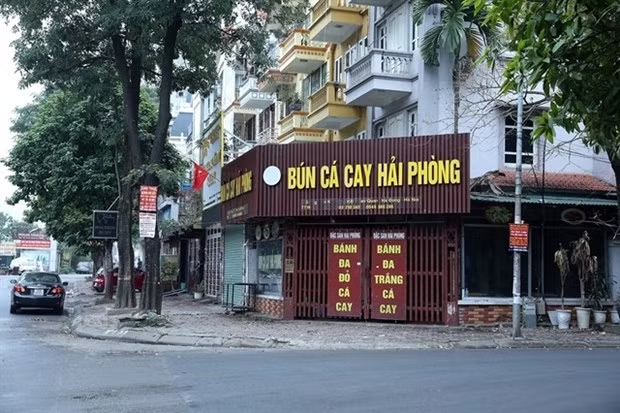
The capital city of Hanoi has ordered the closure of streetside stalls, monuments, temples and pagodas from February 16 to prevent the spread of COVID-19.
Businesses along Nguyen Khuyen Street in Ha Dong district close to prevent the spread of COVID-19. (Photo: VNA)

Businesses along Nguyen Khuyen Street in Ha Dong district close to prevent the spread of COVID-19. (Photo: VNA)

The capital city of Hanoi has ordered the closure of streetside stalls, monuments, temples and pagodas from February 16 to prevent the spread of COVID-19.

At a meeting of the city’s Steering Committee for COVID-19 Prevention and Control on February 15 afternoon, Vice Chairman of the municipal People's Committee Chu Xuan Dung ordered the temporary closure of all streetside stalls, religious and relic sites from midnight to curb the pandemic.

Dung asked that all schools in the city allow their students to stay home until the end of the month.

The new developments of the COVID-19 pandemic in Hanoi, with the source of infection of the dead Japanese man yet to be identified, his travel history causing difficulties for tracing, pose high risks for the community. 

He ordered relevant districts and townships to concentrate on tracing, zoning and mass testing to stop the spread of the pandemic. Along with the dissemination of preventive information through mass media, local pharmacies and private health facilities have been asked to report suspected cases.

Hai Duong province implemented social distancing throughout the province from February 16 and provincial police coordinated with concerned authorities to set up 170 pandemic control stations all over the province.

The stations are responsible for controlling people and vehicles, measuring body temperature, reminding and handling cases of not strictly complying with pandemic prevention regulations.

Colonel Le Ngoc Chau, Director of the provincial Department of Public Security, said people are not allowed to go out unless in special circumstances.

From February 16, people entering Quang Ninh province must comply with regulations. People coming from Hai Duong province and other outbreak hotspots will undergo concentrated quarantine which they will have to pay for, and enterprises welcoming workers back to the province after the Tet holiday must organise COVID-19 tests for them. They are allowed back to work only with a negative result.

People coming from non-affected areas must have a negative COVID-19 test certificate before entering the province.

In the absence of certificates, it is necessary to quarantine and undergo medical monitoring at home for 14 days.

For people from Quang Ninh who go to other localities, they are allowed to leave the province, but when they come back, they must comply with the same regulations as for everyone else.

At 12 control stations at border areas with other provinces and cities, electronic declarations are applied. People must present identity cards, citizenship cards or correspondence papers with their household registration books or temporary residence registers.

VNA

Other News

Hanoi ready to implement Capital Law 2026, unlocking new development momentum

Hanoi ready to implement Capital Law 2026, unlocking new development momentum

The effectiveness of the Capital Law 2026 will be measured not by the number of legal documents issued but by tangible improvements in governance and public administration, better services for people and businesses, faster administrative procedures, stronger investment attraction and higher economic growth.

Vietnamese students earn honours at ROBOG Asia Cup 2026

Vietnamese students earn honours at ROBOG Asia Cup 2026

Three teams from Chu Van An Secondary School in Vietnam’s Thai Nguyen province have earned First Prize honours and advanced to the quarterfinals at the ROBOG Asia Cup 2026, a regional robotics and artificial intelligence (AI) competition for students held in Hong Kong, China.

Hanoi sets out new investment blueprint with century-long development vision

Hanoi sets out new investment blueprint with century-long development vision

As of early June, Hanoi had attracted 74.6 billion USD in foreign direct investment (FDI) through more than 9,250 valid projects. FDI inflows in the first six months were projected at 3.2 billion USD, surpassing the annual target by 116%, while nearly 16,000 new businesses were established in the first five months, up 34.4% year-on-year.

Vietnam promotes legal cooperation and rule of law at global forum

Vietnam promotes legal cooperation and rule of law at global forum

Vietnam’s development and international integration have gone hand in hand with the improvement of its legal system, the incorporation of international commitments into domestic legislation, and legal reforms aimed at fostering development, openness and global integration. The country regards international law as an essential instrument for building fair, mutually beneficial relations among nations.

Hanoi to hold investment promotion event on June 29

Hanoi to hold investment promotion event on June 29

At the event, Hanoi authorities plan to grant investment policy decisions and investment registration certificates to 20 exemplary projects in the fields of transportation infrastructure, industrial parks, urban development, social housing, environment, science and technology, and foreign investment attraction.

Hanoi's Red River urban area development draws widespread attention

Hanoi's Red River urban area development draws widespread attention

Located south of the Red River and extending from the historic inner city to newly developing areas in the south and the west, the central urban area along Red River’s right bank covers approximately 45,317 hectares and is projected to accommodate around 6.365 million residents by 2045 and 6.455 million by 2065.

Hanoi's Red River urban area development draws widespread attention

Hanoi's Red River urban area development draws widespread attention

Located south of the Red River and extending from the historic inner city to newly developing areas in the south and the west, the central urban area along Red River’s right bank covers approximately 45,317 hectares and is projected to accommodate around 6.365 million residents by 2045 and 6.455 million by 2065.

Regional cooperation strengthened to combat cross-border drug crime

Regional cooperation strengthened to combat cross-border drug crime

Vietnam, China, Laos and Myanmar face common challenges as drug syndicates increasingly exploit the Mekong River, cross-border transport networks, e-commerce platforms, international logistics services, cyberspace and cryptocurrencies to organise drug transactions and smuggling operations.