Hanoi prepares detailed anti-flood master plan

A 500-year flood cycle scheme to protect downtown Hanoi is part of a detailed flood prevention master plan that municipal agencies are working on.
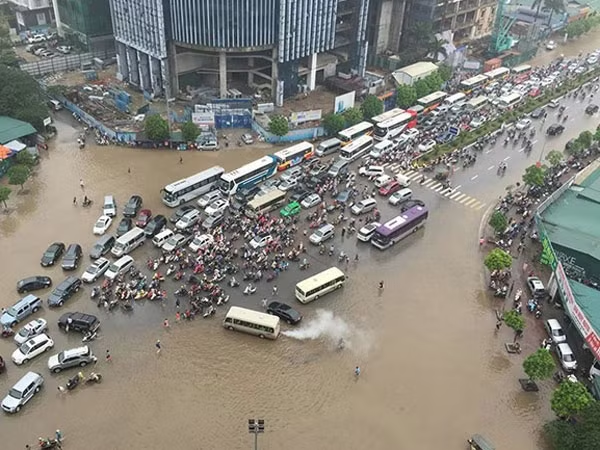
A 500-year flood cycle scheme to protect downtown Hanoi is part of a detailed flood prevention master plan that municipal agencies are working on.– Photo anninhthudo.vn

The master plan is being prepared in line with the Prime Minister’s Decision No.257/QĐ-TTg which approves anti-flood and dyke planning for the Red and Thai Binh river systems.

The Hanoi Department of Agriculture and Rural Development and Viet Nam Institute of Water Resources have been tasked with drafting the master plan, which is estimated to cost VND56.9 trillion (US$2.5 billion).

An estimated 1900 households have to be relocated from flood storage areas, which will cover 4,568ha on the Red River banks.

Caught in a bind

Over 6.7km of the Red River dyke runs through the capital city’s Thanh Tri District. Three communes in the district, Yen My, Duyen Ha and Van Phuc, covering 1,258ha and comprising 6100 households, are squarely located in the river’s flood storage area.

This has meant that several buildings in the communes, both Government offices and residences, cannot be built anew despite their dilapidated condition. Only repairs and maintenance work can be carried out on these buildings, said Dang Duc Quynh, Vice Chairman of Thanh Tri District People’s Committee.

Similarly, in Hoan Kiem District’s Phuc Tan and Chuong Duong ward, 45,000 people live in the Red River flood drainage zone. However, due to their location outside the dykes, the granting of construction permits requires compliance with special regulations, especially those that deal with construction in the Red River flood drainage corridor.

Many houses in this area are so badly damaged that they have to be rebuilt urgently, but owners are only allowed to carry out repairs. The legal complexities in obtaining building permits and requirements for rebuilding have made the lives of residents very difficult and are a headache for local authorities.

However, according to the deputy director of the city’s agriculture department, Tran Thanh Nha, slow implementation of the plan could see the population in flood drainage areas increase rapidly.

In the last eight years, it estimates that the population in the flood drainage areas has increased by about 30,000 people, creating many difficulties in relocating people to safe areas.

The situation is worsened by residents discharging waste directly into river and increasing encroachment of the flood plains, especially in Tay Ho and Hoan Kiem districts.

Deputy Director of the city’s Planning and Architecture Department, Bui Xuan Tung, also said that the delay in formulating and implementing the master plan on flood prevention will prevent city authorities from implementing urban development projects in riverside areas.

A current concern involves the proportion of flood plains on which infrastructure is allowed to be built. Decision No257 regulates the percentage at 5 to 15 per cent. Many urban experts have advised that the percentage be increased to allow maximum use of riverside resources.

Deputy Minister of Agriculture and Rural Development Hoang Van Thang said the ministry would review the plan in the spirit of creating favourable conditions for city authorities to manage and optimal use the floodplains.

Meanwhile, he urged city authorities to curb population growth in the floodplains and provide information on dyke protection to people living along the river.

The deputy minister also suggested that city authorities find ways to raise capital for flood prevention work in order to implement the master plan effectively.

Nha of the municipal agriculture department said drafters of the plan will consider and incorporate suggestions from the Ministry of Agriculture and Rural Development before submitting it to the city People’s Council for approval in November.

If approved, the department and the Water Resources Institute will start implementing the plan immediately, he added. 

VNS

Other News

Vietnam steps up implementation of ethnic affairs strategy through 2030

Vietnam steps up implementation of ethnic affairs strategy through 2030

To accelerate the implementation of the the Ethnic Affairs Strategy by 2030, with a vision toward 2045, the Prime Minister requested ministries, agencies and local authorities to continue thoroughly carrying out the Party and State’s policies on ethnic affairs, enhancing the effectiveness of State management and strengthening oversight of policy implementation.

Security preparations reviewed for APEC 2027 in Phu Quoc

Security preparations reviewed for APEC 2027 in Phu Quoc

The team examined the APEC 2027 Convention Centre, where main conference activities are scheduled; Sun Serenia Hospital, designated to provide healthcare and emergency medical services for delegates; provincial road DT.975, which connects Phu Quoc International Airport to the convention centre; and the area surrounding Phu Quoc International Airport.

Hanoi accelerates seven Red River bridge projects, many exceed 70% completion

Hanoi accelerates seven Red River bridge projects, many exceed 70% completion

According to the municipal Transport Construction Investment Project Management Board, the city is simultaneously implementing seven projects, namely Tu Lien, Ngoc Hoi, Tran Hung Dao, Thuong Cat, Van Phuc, Hong Ha and Me So bridges. Construction is being carried out on multiple fronts, focusing on bored piles, pile caps, piers and superstructure works.

Dien Bien battlefield legacy powers tourism revival

Dien Bien battlefield legacy powers tourism revival

Seventy-two years after the Dien Bien Phu Victory, its legacy still reverberates. The unity, self-reliance, and resilience forged in that historic triumph remain a powerful internal engine, now propelling Dien Bien toward fast and sustainable development.

Hanoi accelerates shift to green buses, targets 100% by 2030

Hanoi accelerates shift to green buses, targets 100% by 2030

In the 2027–2030 period, the city will accelerate the transition towards the complete phase-out of fossil fuel-powered buses. The share of electric and green energy-fueled buses is projected to reach 79–89% by 2029 and 100% by 2030.

36 fishermen safely rescued after boat breaks down near Truong Sa

36 fishermen safely rescued after boat breaks down near Truong Sa

At 8:00 the same day, KN475 began towing the disabled fishing boat toward Da Tay A island. The towing operation was carried out safely, and by 18:30 both the vessel and its crew had arrived at the island without incident, where repairs and additional support procedures were arranged.

Vietnamese language contest in Laos strengthens youth ties, bilateral friendship

Vietnamese language contest in Laos strengthens youth ties, bilateral friendship

Held in response to the launch of the Vietnamese Language Day among overseas Vietnamese communities, the event aimed to enhance the quality of Vietnamese language teaching and learning in Laos while contributing to the great friendship, special solidarity, comprehensive cooperation and strategic cohesion between the two countries.

Vietnamese language contest in Laos strengthens youth ties, bilateral friendship

Vietnamese language contest in Laos strengthens youth ties, bilateral friendship

Held in response to the launch of the Vietnamese Language Day among overseas Vietnamese communities, the event aimed to enhance the quality of Vietnamese language teaching and learning in Laos while contributing to the great friendship, special solidarity, comprehensive cooperation and strategic cohesion between the two countries.

Hanoi launches 10 electric bus routes from April 1

Hanoi launches 10 electric bus routes from April 1

By the end of April, the number of buses using electricity and other green energy sources in the city is expected to reach 822, including 683 electric buses and 139 compressed natural gas (CNG) buses, representing 42.1% of the total number of vehicles.