Huawei under fire over phone chips as tight supply bites

Chinese smartphone maker Huawei Technologies has come under fire from users for "cutting corners", after it said it used a mix of less advanced and powerful chips in its flagship P10 model due to tight supplies of the parts.

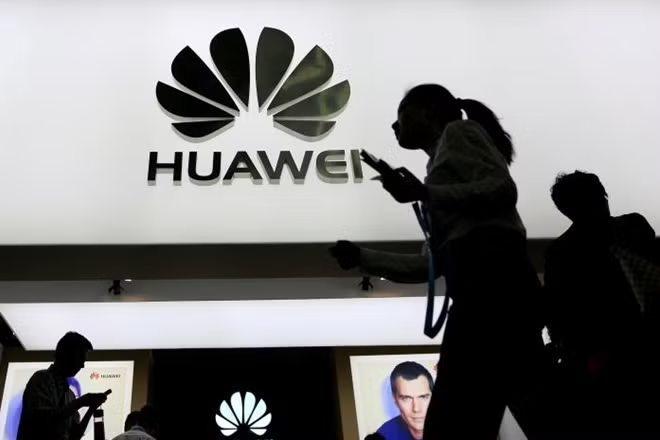
FILE PHOTO: People walk past a sign board of Huawei at CES (Consumer Electronics Show) Asia 2016 in Shanghai, China May 12, 2016. REUTERS/Aly Song/File Photo
FILE PHOTO: People walk past a sign board of Huawei at CES (Consumer Electronics Show) Asia 2016 in Shanghai, China May 12, 2016. REUTERS/Aly Song/File Photo

The company's mobile chief Richard Yu said on April 20 that Huawei used a mix of less efficient eMMC flash memory cards and high-performance Universal Flash Storage (UFS) cards in its latest P10 phone "due to severe shortage in the supply chain."

Yu said user experience shouldn't be impaired because of product design adjustments, but consumers took to online forums to counter that speed testing results showed varying performances.

Huawei has also had a marketing stumble over memory chip specification in its other high-end Mate 9 model - illustrating both how a global memory chip shortage is causing problems for smartphone makers, and the challenges Huawei faces in trying to overtake Apple Inc with its top-end phones.

Previously, Huawei highlighted the UFS feature as one of the stand-out specifications in its Mate 9 line, unveiled in November, saying the chip was 100 percent faster than a typical eMMC flash.

But, last week, it removed that UFS description from its official website, without explanation. It also removed from the Huawei app store a third-party speed-testing software called Androbench, which it used to tout the P10's performance at its launch.

That triggered more consumer ire online, with some users accusing Huawei of selling substandard products for the same price. Huawei reinstated the description late on Thursday, and told Reuters it had temporarily removed the description "to avoid confusion" while it checked to confirm that all Mate 9 phones support UFS 2.1 flash.

"How dare you cut corners on such an expensive flagship! Conceal the differences at first and then say the differences don't matter once busted," one user posted on Weibo, China's popular Twitter-like board.

The Shenzhen Consumer Council said on its official Weibo account that it received 32 complaints from users on the issue.

"WAKE-UP CALL"

In a letter to Huawei staff on Thursday, later posted on his Weibo account, Yu said the controversy over the phones' memory performance was a "wake-up call", and that he had previously reacted to consumers "in an arrogant way".

UFS boasts a faster performance than a typical flash storage card, and is crucial for playing the high-resolution games and media content popular among Chinese device users.

Samsung Electronics Co has used UFS flash memory cards in its high-end phones, including the Galaxy S8 that went on sale last week. Apple doesn't reveal what memory card it uses.

Memory chips are in tight supply due to production bottlenecks and strong demand from high-end smartphone makers.

Both Samsung and SK Hynix - which together control nearly half the global NAND flash memory market - warned this week that the tight supply will continue through this year. There are also concerns of potential supply disruptions amid rising tensions with North Korea over its nuclear and missile programs.

Any interruptions to their manufacturing operations could prompt large customers to trigger a contractual term known as an "allocation", to secure more of their suppliers' limited supply, industry executives say.

In his staff letter, Yu said Huawei set up a "customer listening taskforce" that will take a series of actions.

In reply to Reuters queries, the company said no decisions had yet been made on whether that could involve compensation for users or a product recall.

Mo Jia, an analyst at consultancy Canalys, said the issue had been overblown, though Huawei had been overly aggressive in its marketing.

"It's rare for companies to tout such specific details of flash memory, which is almost unnoticeable for ordinary users," he said, adding supplies of key parts had not kept pace with the Chinese smartphone market, which grew by around 10 percent in the first quarter.
Reuters

Other News

Vietnam targets at least 10 large strategic technology firms by 2030

Vietnam targets at least 10 large strategic technology firms by 2030

Deputy Prime Minister Ho Quoc Dung has signed a decision approving a plan to develop large domestic strategic technology enterprises in the 2026–2030 period, aimed at advancing digital infrastructure, digital human resources, digital data, strategic technologies and cybersecurity.

Protecting users crucial in building digital trust: Experts

Protecting users crucial in building digital trust: Experts

In Vietnam, digital transformation in the finance and banking sector is accelerating cashless payments, expanding access to financial services, improving market transparency and supporting economic growth and macroeconomic management.

Fostering skilled workforce for innovation era: experts

Fostering skilled workforce for innovation era: experts

Experts said close coordination among State management agencies, research institutes, universities, and businesses will improve training quality and serve the dual goals of quality education and practical research application.

Startup forum bridges Silicon Valley and local innovation ecosystem

Startup forum bridges Silicon Valley and local innovation ecosystem

The University of Economics Ho Chi Minh City (UEH), Saigon Asset Management (SAM), and Plug and Play Tech Centre co-hosted the “From Vietnam to Silicon Valley” forum, exploring AI innovation, venture capital, and pathways to integrate Vietnam’s startup ecosystem with Silicon Valley and global markets.

Experts call for stronger action against fake news online

Experts call for stronger action against fake news online

Experts have warned that fake news, misinformation and harmful online content are increasingly shaping public perceptions, particularly among young people, and stressed the need for stronger legal safeguards, technology tools and wider dissemination of credible information to tackle the problem effectively.

Protecting digital future in post-quantum, AI era

Protecting digital future in post-quantum, AI era

Participants highlighted the importance of building a proactive, synchronised and sustainable national cybersecurity ecosystem through closer cooperation among regulators, technology firms, research institutions and cybersecurity experts.

Vietnam attends SAHA 2026 defence, aerospace exhibition in Türkiye

Vietnam attends SAHA 2026 defence, aerospace exhibition in Türkiye

Vietnam’s participation in SAHA 2026 International Defence & Aerospace Exhibition in Istanbul reflects the country’s consistent policy of enhancing international defence integration and promoting defence industry cooperation towards self-reliance, self-strengthening, modernisation and dual-use development.

SK Group partners to build AI ecosystem in Vietnam

SK Group partners to build AI ecosystem in Vietnam

SK Innovation and SK Telecom signed MoUs with Nghe An province and the National Innovation Centre of Vietnam to advance AI ecosystem development and support the country’s long-term growth strategy.

Vietnam Research Excellence Fellowship for 2026-2030 approved

Vietnam Research Excellence Fellowship for 2026-2030 approved

Under the Vietnam Research Excellence Fellowship (VREF) for the 2026–2030 period, PhD students are identified as a core research force directly contributing to breakthroughs in sci-tech and innovation. Investing in top-tier doctoral candidates is more than workforce development, but a high-stakes strategic bet to forge a cohort of world-class scientists and technologists who can power Vietnam’s long-term economic ambitions.