- Vietnam makes efforts to minimize natural disaster risks
- Asia and Europe exchange innovative ideas on disaster management
- Phu Yen Police help local people overcome flood consequences
Bringing together different financial instruments to fund response and reconstruction, such a strategy should be one component of a broader disaster risk management and climate change plan.
This was discussed at a workshop on Disaster Risk Finance and Insurance, held in Hanoi on November 15 by the Vietnam Ministry of Finance and the World Bank in Vietnam.
 |
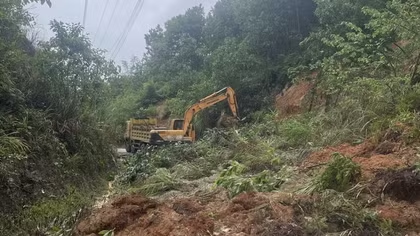
| Photo for illustration. |
“Vietnam is one of the countries badly affected by natural hazards and climate change, resulting in heavy economic losses mostly to the poor. A strategic approach to improve the country’s resilience to such shocks will help safeguard livelihoods, and sustain its economic growth and development progress,” said Sebastian Eckardt, Lead Economist at the World Bank in Vietnam. “Supporting the development of this strategy is part of the World Bank’s priorities in its engagement with the Government of Vietnam.”
According to the catastrophe risk model, presented at the workshop, Vietnam is likely to incur, on average, VND30.2 trillion (US$1.4 billion) every year in physical damages due to floods, typhoons and earthquakes.
Residential and public assets (buildings and infrastructures) contribute 65% and 11% of total damage, respectively. It shows that in the next 50 years, Vietnam has a 40% chance of experiencing damage exceeding VND141.2 trillion (US$ 6.7 billion) from typhoons, floods or earthquake. Provinces in the North Central region that experience higher poverty rates are more likely to face higher economic losses.
This model, developed for the first time in Vietnam, provides the Government with better assessment of the likelihood and severity of loss from catastrophes. It can also be used to plan for the financial impacts of catastrophes before they occur. The final model will be delivered by December 2016.
Participants at the workshop discussed disaster risk financing instruments currently in use by the government as well as international experience.
The government currently relies on a number of funding sources to finance disaster response and recovery, including contingency budgets at the central and local levels, specific budget allocation, in-kind state reserves, financial reserve funds, disaster prevention and control funds, risk transfer instruments such as insurance, and donor grants.
There is, however, a heavy reliance on state budgets at all levels to fund post disaster costs. Disaster prevention and control funds established at the provincial level are still subject to a number of constraints that prevent them from being fully operationalized across provinces, while innovative risk transfer instruments are in its infacy.
“Establishing a financial system for risk management and disaster risk transfer is essential for Vietnam’s development,” said Vice Minister Nguyen Huu Chi of Ministry of Finance of Vietnam. “Insurance in particular would be an effective solution, not only to ease the burden on the state budget and transfer risks to international markets, but also help raise awareness about the importance of planning to mitigate the effects of climate hazards and natural disasters.”
Participants at the workshop also discussed a number of options for the government to strengthen financial resilience, including:
Developing a cost-effective financial protection strategy that builds on an optimal combination of financial instruments, including contingency budgets, national and local disaster (multi-year) reserves, contingent credit, and risk transfer instruments (including insurance) to ensure that cheaper sources of money are used first, with the most expensive instruments used only in exceptional circumstances. This also helps to channel funding in an efficient and timely manner to disaster affected groups.
Making disaster risk finance an integral part of a broader disaster risk management and climate change plan, complementing investments in prevention and risk mitigation.
Reviewing the policy, legal, institutional and operational frameworks for the fund for natural disaster prevention and control to strengthen the financial resilience of the provinces.
Recognizing that the private sector is an essential partner as they can bring capital, technical expertise, and innovative financial solutions to better protect the government and society against natural disasters.