Let There Be Lumens: Researchers Link Photons to Create New Form of Light

Visible light is made of photons, special particles known to never interact with each other. But can they can be forced to interact or bind together? Looks like they can, according to the results of an extraordinary MIT experiment.

Previously, photons were perceived as exceptionally individualistic particles. They never appeared to interact with each other, explaining why beams of light intersect and do not reflect with each other. Researchers at  the Massachusetts Institute of Technology (MIT) asked: if photons are similar to atoms, can they be bound together into something like a molecule?

To answer this question, a team consisting of Ph.D. candidate in atomic physics at MIT Sergio Cantu; Aditya Venkatramani, a Ph.D. candidate in atomic physics at Harvard University, alongside several other collaborators, came up with a peculiar set-up: a cloud of chilled rubidium atoms, Smithsonian magazine reported.
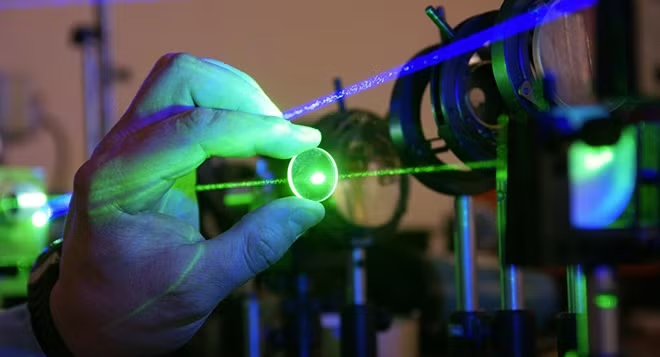
Photo: Sputnik
Photo: Sputnik 

Yes, rubidium — that alkali soft metal notorious for spontaneously igniting, particularly violently when coming in contact with water (explaining why it is kept either in airtight ampules or in kerosene).

The scientists evaporated rubidium with a laser, but kept the resulting cloud in an ultracold state. According to Smithsonian, this keeps the atoms diffused, moving slowly but in a highly-excited state, a decidedly abnormal condition from that found in nature.

After creating the strange substance, researchers again lit it with a laser, but so weakly that only a handful of photons entered the cloud. And here's where the real magic begins.

"Normally the photons would be traveling at the speed of light-or almost 300,000 kilometers per second. But after passing through the cloud, the photons creep along 100,000 times slower than normal," Smithsonian reported.

As mind-blowing as it may appear, the condition is plausible: the "slow light" phenomenon was noted in 2004 by researchers at UC Berkeley who slowed a beam of light to just 9.7 kilometers per second — almost 22,000 mph — still way below lightspeed, which, as everyone knows, is fixed at 670,615,200 miles per hour.

But the cherry on top of the MIT experimental cake came when researchers documented that the photons emerging from the rubidium cloud came out not as single particles, but as pairs, or, in some cases, triplets.

"These pairs and triplets also give off a different energy signature, a phase shift, that tells the researchers the photons are interacting," cited by Smithsonian magazine.

"We were not sure three photons would be a stable molecule or something we could even see," Venkatramani said. However, it turned out that groups of three photons were more stable than double groups. "The more you add, the more strongly they are bound," Venkatramani noted.

The team also found that the ordinarily weightless photons gained mass, albeit a fraction of an electron's mass, said a Daily Mail report, which termed the double-photon bond as a "new form of light."

Researchers now claim to have formulated a theoretical model for the process. According to this model, which remains to be proven, ordinary single photons interact with excited ultracold rubidium atoms and create a particle known as a polariton. Two polaritons can, and do, interact with each other. When these two interacting polaritons reach the edge of the cloud, rubidium atoms remain within the cloud, but photons tear away and go out — but as a pair or triplet structure.

Researchers note that there is still a lot of work to be done. Since the discovery has just been made, they do not know if they can make photons also repel each other. If proper tools are found, this would open a new world of photon manipulation, allowing for inventions and discoveries which are hard to imagine. Currently, researchers posit that this special form of light could be useful for quantum computing and the creation of uncrackable codes, ultra-precise clocks, unimaginably powerful computers and more.

In their more farout fantasies, researchers envision arranging photons into organized structures not unlike crystals, which are thought to be useful in quantum communication.
Sputnik

Other News

SK Group partners to build AI ecosystem in Vietnam

SK Group partners to build AI ecosystem in Vietnam

SK Innovation and SK Telecom signed MoUs with Nghe An province and the National Innovation Centre of Vietnam to advance AI ecosystem development and support the country’s long-term growth strategy.

Vietnam Research Excellence Fellowship for 2026-2030 approved

Vietnam Research Excellence Fellowship for 2026-2030 approved

Under the Vietnam Research Excellence Fellowship (VREF) for the 2026–2030 period, PhD students are identified as a core research force directly contributing to breakthroughs in sci-tech and innovation. Investing in top-tier doctoral candidates is more than workforce development, but a high-stakes strategic bet to forge a cohort of world-class scientists and technologists who can power Vietnam’s long-term economic ambitions.

Strategic tech must address practical challenges: PM

Strategic tech must address practical challenges: PM

Prime Minister Pham Minh Chinh on March 28 said strategic technologies must tackle Vietnam’s practical challenges, while chairing a meeting of the Government’s Steering Committee for science and technology, innovation, digital transformation, and Project 06.

Ho Chi Minh City sets sights on becoming semiconductor hub

Ho Chi Minh City sets sights on becoming semiconductor hub

Ho Chi Minh City is stepping up efforts to attract investment from global leading groups and companies in the fields of electronic components, semiconductors and chip manufacturing as it seeks to position itself as a leading semiconductor industry hub in both the region and the world. 

Ho Chi Minh City launches upgraded technology exchange platform

Ho Chi Minh City launches upgraded technology exchange platform

The upgraded platform represents a comprehensive shift from a simple information-sharing model to a managed online technology trading system, enabling monitoring and measurement of real transaction outcomes. It is built on three pillars, namely new tradable technology products, a modern digital platform, and an improved operational model.

AI – unmissable opportunity for Vietnam: Experts

AI – unmissable opportunity for Vietnam: Experts

AI also emerges as a key enabler for Vietnam's ambition to build financial and technology hubs. Applications can boost efficiency, automate workflows, cut costs, and sharpen data analytics, which are essential pillars of a modern financial system.

PM calls for accelerated space technology development in Vietnam

PM calls for accelerated space technology development in Vietnam

Vietnam aims by 2030 to achieve a mid-level position in space science and technology development within Southeast Asia, and after 2030 to build national capabilities to independently develop satellite technologies and apply space data to address global challenges and national security needs.

High-level forum advances Vietnam–US technological cooperation

High-level forum advances Vietnam–US technological cooperation

A high-level executive leadership forum focusing on strengthening Vietnam - US relations through technology cooperation was jointly held in Washington D.C. on March 11 by the Embassy of Vietnam in the US, the Weatherhead East Asian Institute of Columbia University, and the US -ASEAN Business Council (USABC). 

AI Law takes effect, anchors national governance framework

AI Law takes effect, anchors national governance framework

While many countries are still drafting policy blueprints or issuing non-binding guidance, Vietnam has moved ahead with a standalone Law on Artificial Intelligence (AI), effective from March 1, placing it among a select group of nations to adopt dedicated AI legislation at the parliamentary level. 

Vietnam International Defence Expo 2026 preparations move into high gear

Vietnam International Defence Expo 2026 preparations move into high gear

Vietnam International Defence Expo 2026, themed “Peace, Friendship, Cooperation and Development,” will be organised on a larger scale, featuring a wide array of weapons and technical equipment alongside product exhibitions, seminars and panel discussions, drills, live field demonstrations, and business networking activities.

Ministry requests urgent measures to counter UAVs threatening aviation safety

Ministry requests urgent measures to counter UAVs threatening aviation safety

Ministry of Construction requested the Ministry of National Defence, the Ministry of Public Security and provincial and municipal steering committees for counter-terrorism to strengthen the management, inspection and supervision of UAVs and other aerial devices, ensuring strict compliance with Decree No. 288/2025/ND-CP and relevant legal regulations.