Ministry issues warnings and protection measures against WannaCry ransomware attacks

The spread of WannaCry ransomware has been wreaking havoc across the world since Friday, and several Vietnamese businesses and agencies are advised to take cautions.

The VNCERT, under the Ministry of Information and Communications, has issued warnings as well as offered protection measures to all users to guard against the ransomware and its variations, which target Microsoft Windows - an operating system that is widely used in Việt Nam, especially the outdated Windows XP.

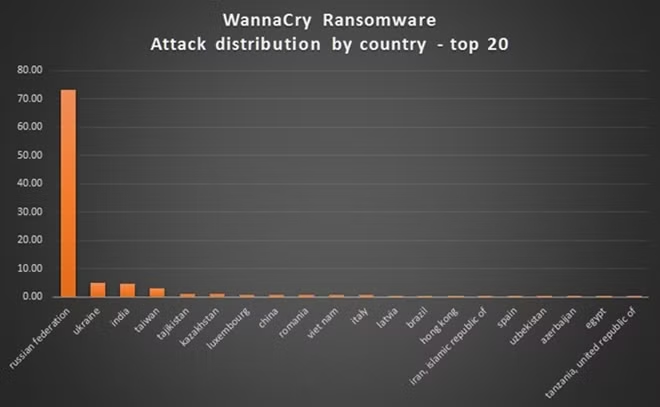
Kaspersky has listed Viet Nam among the top 20 countries most affected by this ransomware; the other countries and territories include Russia, Ukraine, India, Taiwan, and mainland China.

The VNCERT said the ransomware is extremely dangerous as it is capable of stealing information and decrypting the entire system that has been infected.

Once the computer’s data have been encrypted, or ‘locked down’, a message would appear saying that the users’ files are no longer accessible. 

Should they want to get their data back, users are asked to pay up large sums of money to get a decryption key. 

The longer the users wait, the higher the ransom money. 

The hackers behind WannaCry only accept ransom paid via BitCoin, a digital currency that ensures that the transaction cannot be traced back.

WannaCry exploits a Windows vulnerability codenamed EternalBlue, which has been patched by Microsoft in an update deployed on March 14. 

However, not everyone has installed the patch yet, and those who have not are vulnerable to WannaCry.

The exploitation of EternalBlue, suspected to have been developed using a hacking method leaked from US National Security Agency, allows the malware to spread through file-sharing protocols set up across the internal networks of organisations, many of which criss-cross the globe, according to Financial Times.

WannaCry developers have prepared a Q&A section in various languages, offering infected users localised instructions on how to recover data and how to pay the ransom.

Vu Ngoc Son, deputy head of the anti-malware department of Bkav Corporation, the largest internet security firm in Viet Nam, said that the WannaCry ransomware’s behaviour is “not new”, but he believes that the use of this ransomware will not really ease up as “it can directly earn large profits for hackers”.

Bkav recommends that all computer users immediately install updates and security patches and hotfixes via Windows Update. Users are also advised to back up valuable data regularly.

Currently, an estimated 200,000 victims in 150 different countries are reported to have been hit by the cyberattack.


VNS

Other News

AI offers both opportunities, challenges for Vietnam's growth

AI offers both opportunities, challenges for Vietnam's growth

Dr. Ho Duc Thang, a full-time member of the National Assembly’s Committee for Cultural and Educational, said productivity is the key to sustaining double-digit economic growth, and AI has greater potential to improve productivity than any previous technology.

Top leader unveils people-centred vision for new development model

Top leader unveils people-centred vision for new development model

Vietnam's growth model, long fueled by low-cost labour, resource extraction, contract manufacturing, expanded investment, and capital accumulation, has run out of road. The country now needs a sweeping reform agenda to shift from extensive growth to a model driven by productivity, knowledge, science and technology, innovation, and digital transformation.

First national semiconductor chip prototyping support centre makes debut

First national semiconductor chip prototyping support centre makes debut

Vietnam's semiconductor ecosystem now comprises around 60 chip design companies, some 7,000 chip design engineers and 166 universities offering semiconductor-related training programmes. Initial registrations from 12 organisations indicate demand for the prototyping of approximately 30,000 chips.

Vietnam targets at least 10 large strategic technology firms by 2030

Vietnam targets at least 10 large strategic technology firms by 2030

Deputy Prime Minister Ho Quoc Dung has signed a decision approving a plan to develop large domestic strategic technology enterprises in the 2026–2030 period, aimed at advancing digital infrastructure, digital human resources, digital data, strategic technologies and cybersecurity.

Protecting users crucial in building digital trust: Experts

Protecting users crucial in building digital trust: Experts

In Vietnam, digital transformation in the finance and banking sector is accelerating cashless payments, expanding access to financial services, improving market transparency and supporting economic growth and macroeconomic management.

Fostering skilled workforce for innovation era: experts

Fostering skilled workforce for innovation era: experts

Experts said close coordination among State management agencies, research institutes, universities, and businesses will improve training quality and serve the dual goals of quality education and practical research application.

Startup forum bridges Silicon Valley and local innovation ecosystem

Startup forum bridges Silicon Valley and local innovation ecosystem

The University of Economics Ho Chi Minh City (UEH), Saigon Asset Management (SAM), and Plug and Play Tech Centre co-hosted the “From Vietnam to Silicon Valley” forum, exploring AI innovation, venture capital, and pathways to integrate Vietnam’s startup ecosystem with Silicon Valley and global markets.

Experts call for stronger action against fake news online

Experts call for stronger action against fake news online

Experts have warned that fake news, misinformation and harmful online content are increasingly shaping public perceptions, particularly among young people, and stressed the need for stronger legal safeguards, technology tools and wider dissemination of credible information to tackle the problem effectively.

Protecting digital future in post-quantum, AI era

Protecting digital future in post-quantum, AI era

Participants highlighted the importance of building a proactive, synchronised and sustainable national cybersecurity ecosystem through closer cooperation among regulators, technology firms, research institutions and cybersecurity experts.