NASA's TESS, Hunting for New Worlds, Returns ‘First Light Science Image'

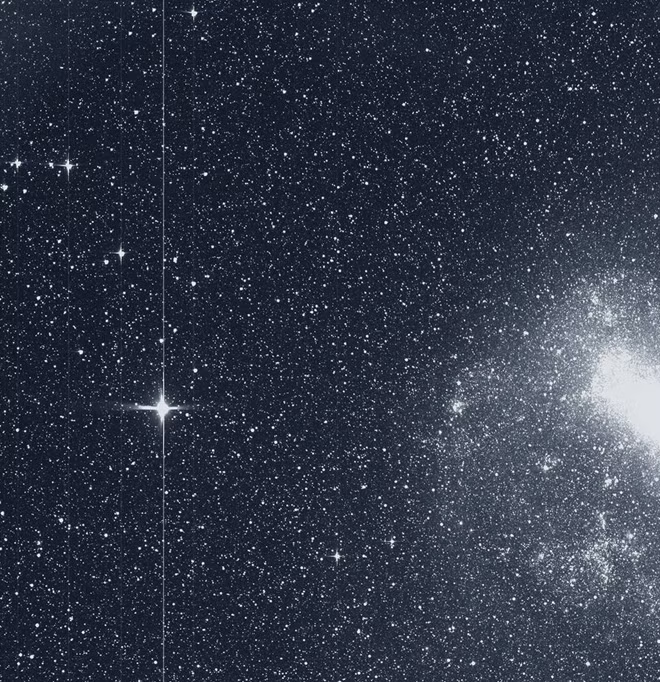
The US' National Aeronautics and Space Administration (NASA) released a jaw-dropping new image captured by its newest planet hunter, the Transiting Exoplanet Survey Satellite (TESS), on Monday, offering skywatchers a look at stars and galaxies sitting on the southern celestial hemisphere.

The image, which was snapped on August 7 over a 30 minute period, captured dozens of constellations, including Capricornus and Pictor, and both the Large and Small Magellanic Clouds, according to NASA's release on the photo.

"In a sea of stars brimming with new worlds, TESS is casting a wide net and will haul in a bounty of promising planets for further study," Paul Hertz, astrophysics division director at NASA Headquarters in Washington, DC, said in a statement. "This first light science image shows the capabilities of TESS' cameras, and shows that the mission will realize its incredible potential in our search for another Earth."
NASA's Transiting Exoplanet Survey Satellite (TESS) shares first image in hunt for new worlds

TESS also captured the likes of NGC 104, a spherical collection of hundreds of thousands of stars that includes Beta Gruis and R Doradus. Both stars are so bright that they show up as vertical lines of white in images picked up by TESS' second and fourth cameras.

The image is the first TESS has provided since it officially began its scientific search for planets on July 25. It previously photographed C/2018 N1, a comet discovered by NASA's Near-Earth Object Wide-Field Infrared Survey Explorer (NEOWISE) satellite on June 29.

Designed as a successor to the Kepler spacecraft, TESS will build on the legacy of the planet hunter by targeting stars that are some 30 to 300 light years away and 30 to 100 times brighter than those detected by Kepler, according to NASA.

Kepler and TESS also differ in terms of their respective orbits. TESS will fly in an elliptical, 13.7-day orbit around Earth, a stark difference from Kepler, which followed a longer heliocentric orbit around the sun that took some 371 days to complete, Air & Space Magazine reported.
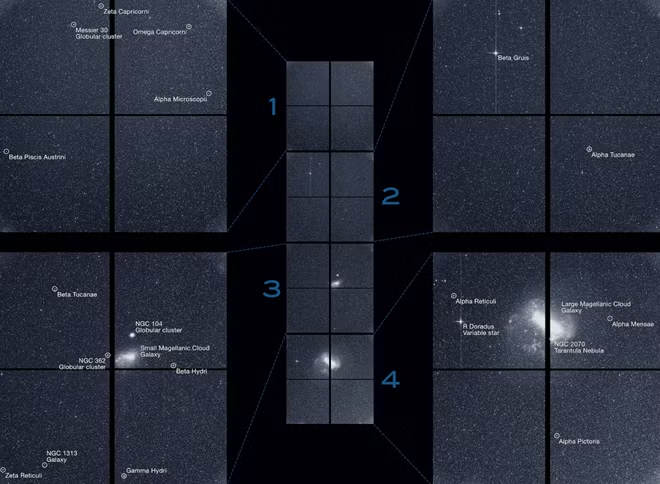
Notable features in this swath of the southern sky include the Large and Small Magellanic Clouds and a globular cluster called NGC 104, also known as 47 Tucanae.

"The amazing thing about TESS is that it is not actually that novel; nothing on it is actually brand new or pushes the envelope. What is novel is the way it's put together," Sara Seager, TESS deputy director of science at MIT, previously told Sputnik.

"TESS essentially has four, think of it as a glorified telephoto lens, but an extremely custom-made, very expensive lens. And the lenses are actually only about 10 cm in diameter in aperture, but the fact that they're all put together and they cover a very, very wide angle of view — that's what is unique about TESS."

TESS made its way to space on April 18 after being launched atop a SpaceX Falcon 9 rocket from the Cape Canaveral Air Force Station in Florida. The mission duration is expected to last some two years.

Sputnik

Other News

SK Group partners to build AI ecosystem in Vietnam

SK Group partners to build AI ecosystem in Vietnam

SK Innovation and SK Telecom signed MoUs with Nghe An province and the National Innovation Centre of Vietnam to advance AI ecosystem development and support the country’s long-term growth strategy.

Vietnam Research Excellence Fellowship for 2026-2030 approved

Vietnam Research Excellence Fellowship for 2026-2030 approved

Under the Vietnam Research Excellence Fellowship (VREF) for the 2026–2030 period, PhD students are identified as a core research force directly contributing to breakthroughs in sci-tech and innovation. Investing in top-tier doctoral candidates is more than workforce development, but a high-stakes strategic bet to forge a cohort of world-class scientists and technologists who can power Vietnam’s long-term economic ambitions.

Strategic tech must address practical challenges: PM

Strategic tech must address practical challenges: PM

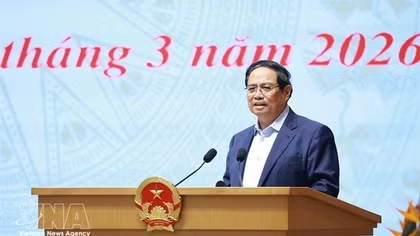
Prime Minister Pham Minh Chinh on March 28 said strategic technologies must tackle Vietnam’s practical challenges, while chairing a meeting of the Government’s Steering Committee for science and technology, innovation, digital transformation, and Project 06.

Ho Chi Minh City sets sights on becoming semiconductor hub

Ho Chi Minh City sets sights on becoming semiconductor hub

Ho Chi Minh City is stepping up efforts to attract investment from global leading groups and companies in the fields of electronic components, semiconductors and chip manufacturing as it seeks to position itself as a leading semiconductor industry hub in both the region and the world. 

Ho Chi Minh City launches upgraded technology exchange platform

Ho Chi Minh City launches upgraded technology exchange platform

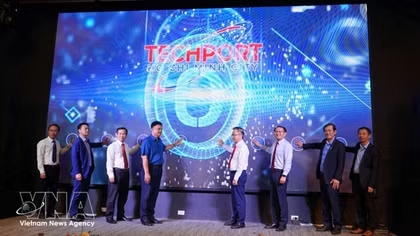
The upgraded platform represents a comprehensive shift from a simple information-sharing model to a managed online technology trading system, enabling monitoring and measurement of real transaction outcomes. It is built on three pillars, namely new tradable technology products, a modern digital platform, and an improved operational model.

AI – unmissable opportunity for Vietnam: Experts

AI – unmissable opportunity for Vietnam: Experts

AI also emerges as a key enabler for Vietnam's ambition to build financial and technology hubs. Applications can boost efficiency, automate workflows, cut costs, and sharpen data analytics, which are essential pillars of a modern financial system.

PM calls for accelerated space technology development in Vietnam

PM calls for accelerated space technology development in Vietnam

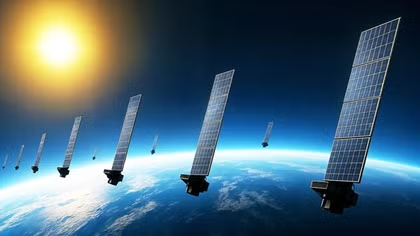
Vietnam aims by 2030 to achieve a mid-level position in space science and technology development within Southeast Asia, and after 2030 to build national capabilities to independently develop satellite technologies and apply space data to address global challenges and national security needs.

High-level forum advances Vietnam–US technological cooperation

High-level forum advances Vietnam–US technological cooperation

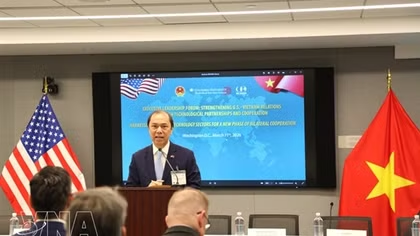
A high-level executive leadership forum focusing on strengthening Vietnam - US relations through technology cooperation was jointly held in Washington D.C. on March 11 by the Embassy of Vietnam in the US, the Weatherhead East Asian Institute of Columbia University, and the US -ASEAN Business Council (USABC). 

AI Law takes effect, anchors national governance framework

AI Law takes effect, anchors national governance framework

While many countries are still drafting policy blueprints or issuing non-binding guidance, Vietnam has moved ahead with a standalone Law on Artificial Intelligence (AI), effective from March 1, placing it among a select group of nations to adopt dedicated AI legislation at the parliamentary level. 

Vietnam International Defence Expo 2026 preparations move into high gear

Vietnam International Defence Expo 2026 preparations move into high gear

Vietnam International Defence Expo 2026, themed “Peace, Friendship, Cooperation and Development,” will be organised on a larger scale, featuring a wide array of weapons and technical equipment alongside product exhibitions, seminars and panel discussions, drills, live field demonstrations, and business networking activities.

Ministry requests urgent measures to counter UAVs threatening aviation safety

Ministry requests urgent measures to counter UAVs threatening aviation safety

Ministry of Construction requested the Ministry of National Defence, the Ministry of Public Security and provincial and municipal steering committees for counter-terrorism to strengthen the management, inspection and supervision of UAVs and other aerial devices, ensuring strict compliance with Decree No. 288/2025/ND-CP and relevant legal regulations.