Facebook Messenger is reported to be under attack in recent days by a new virus.
The virus uses a name in the victim’s friend list to send a compressed file on the social media site. The file, named “video _” with four random numbers, such as “video_3622.zip”, has been sent via the messenger app to users in Vietnam.
Such notifications are used to spread the virus, and when the user clicks on the link they will be directed to a site where the virus could be downloaded onto their computer.
 |
According to Vu Ngoc Son, internet security expert from BKAV Technology Group Vietnam, the new virus was only spreading through the Google Chrome browser.
The purpose of the malicious software was to take control of the target computer and mine virtual currency. The users’ computer would slow down significantly, making it almost impossible to use, he said.
The biggest danger of this new virus was that hackers could use the victim’s friend list to continue to spread.
The expert also recommended that Facebook users should immediately change the password for their account if they have opened the attached file.
In order to avoid becoming a victim, users should be careful when receiving files via messenger and should confirm with the sender if the file is genuine.
BKAV has updated a sample to identify this malware, called W32.FBCoinMail.Worm. Users can download the latest BKAV software for virus removal.

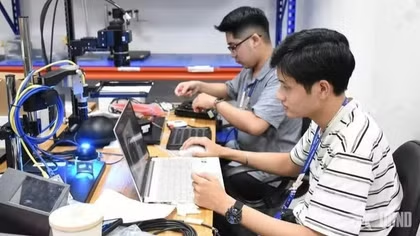
Although the Political Bureau’s Resolution No. 57-NQ/TW allows pilot schemes for new practical issues and accepts risks and delays in science, technology and innovation, concerns over risks and responsibility persist.
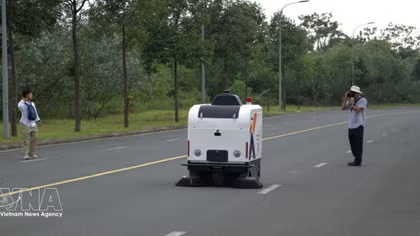
The two projects involve an intelligent autonomous transportation system developed by Phenikaa-X JSC and a technology for producing mixed rare-earth oxides with a purity of over 95% on a semi-industrial scale developed by the Mining Technology and Construction Consultancy JSC.

If the proposed threshold is approved and takes effect, the five largest technology companies could add up to 7.6 trillion VND (291 million USD) in R&D funding annually.

In just a few years, AI has evolved from an experimental technology into an “assistant” for many banks, supporting everything from customer service, credit approval, and fraud detection to risk management. However, as the technological gap between institutions narrows, a new question is emerging: What will determine banks' competitive advantage in the AI era?

A meeting has been held in Bac Ninh to discuss potential cooperation with Plug and Play in developing the northern province’s innovation ecosystem and establishing an artificial intelligence (AI) centre of excellence, with Standing Vice Chairman of the provincial People’s Committee Mai Son receiving a delegation from the global innovation platform.

The project aims to assess the safety, reliability and readiness of autonomous vehicles under real traffic conditions, as well as the effectiveness of autonomous public transport and compatibility with existing systems. Its results will contribute to developing technical standards, operating procedures and management models suited to Hanoi’s traffic conditions.
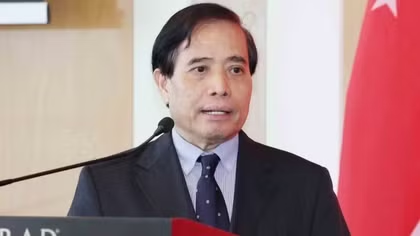
As Vietnam accelerates digital transformation and high-tech development, Singapore’s experience and the engagement of global technology companies demonstrate that human resources preparation must stay ahead of the curve. The ability to filter knowledge, collaborate, innovate and effectively use AI will increasingly become essential to helping workers adapt to a changing labour market and strengthening the competitiveness of Vietnam’s economy in the new era.

The country needs a long-term approach, sustained investment and a willingness to accept risks, potentially requiring at least 10–20 years of persistent efforts, an expert has said.
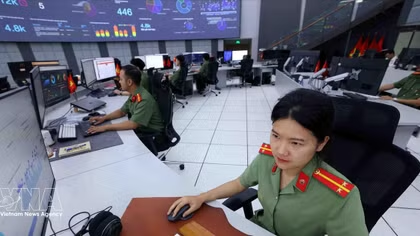
Cybersecurity, information security and data security risks must be identified and addressed early and from afar, with appropriate defensive measures ready to neutralise threats and protect national interests in cyberspace, said Lieutenant General Le Xuan Minh, Director of the Ministry of Public Security’s Department of Cybersecurity and Hi-tech Crime Prevention (A05).
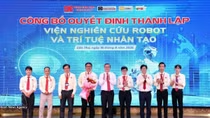
Dr. Nguyen Van Quang, Rector of Nam Can Tho University, said the university is developing a value chain covering training, research, technology development, testing, technology transfer and commercialisation. The model is designed to link research more closely with practical needs, ensuring that technologies generate products and products create value for society.
The state visit to New Zealand by Party General Secretary and President To Lam has opened the door to cooperation, and the key task now is turning that opportunity into a pathway for people, students, scientists, and businesses to move forward together.
Vietnam should give priority to areas where it has potential to build strengths, particularly manufacturing and packaging.
The WB report identifies Vietnam as one of the few economies outside the European Union (EU) to have adopted a comprehensive AI regulatory framework as early as 2025. Vietnam applies a risk-tiered approach similar to that of the EU AI Act, imposing different obligations depending on whether an AI system poses “unacceptable,” “high,” “low” or “minimal” risks. The approach is viewed as a strategic step towards ensuring safe and transparent AI governance.

Carrying the message 'Verify Before You Trust', the campaign seeks to foster a new public habit: before believing, sharing or making decisions based on information found online, people should take the time to verify the source, context and authenticity of the content.
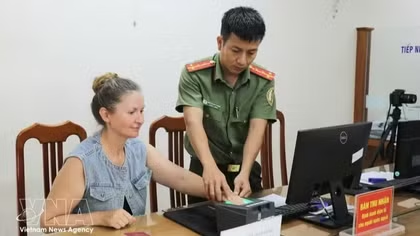
Since July 2025, immigration authorities have processed 84,831 applications, with Republic of Korean, Chinese and Japanese nationals accounting for the largest numbers of registered users.
Dr. Ho Duc Thang, a full-time member of the National Assembly’s Committee for Cultural and Educational, said productivity is the key to sustaining double-digit economic growth, and AI has greater potential to improve productivity than any previous technology.
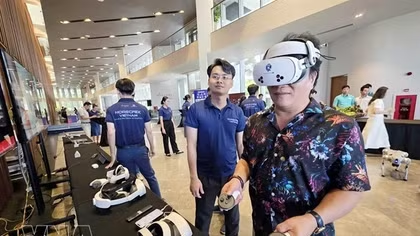
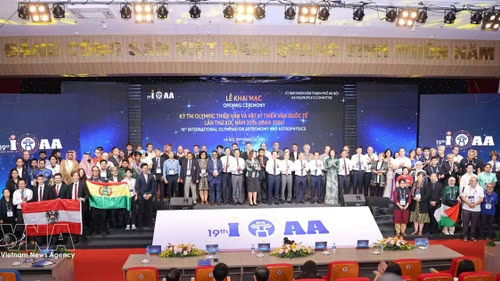
There will also be over 40 discussions focusing on AI applications, sustainable development and human resource development, as well as meetings for companies to find international partners.

To strengthen its competitiveness in attracting global talent, the city has introduced a comprehensive package of incentives, including housing assistance, transportation support, streamlined immigration and work permit procedures, improved research facilities, and favourable working conditions.
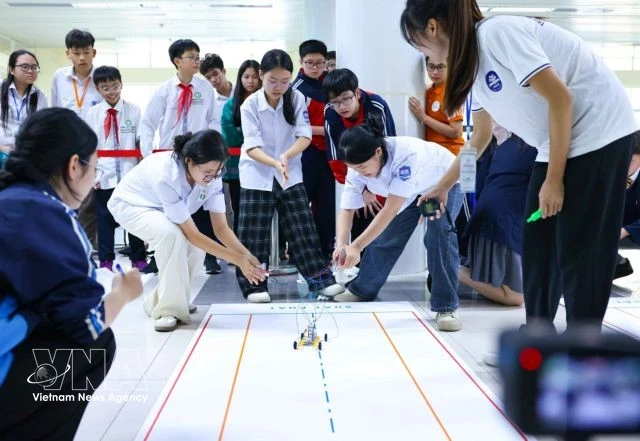
Nearly 467,600 from more than 874,800 university applicants have registered for STEM majors for the 2026 admissions cycle, accounting for 53.45% of all candidates, according to the Ministry of Education and Training.

Vietnam's growth model, long fueled by low-cost labour, resource extraction, contract manufacturing, expanded investment, and capital accumulation, has run out of road. The country now needs a sweeping reform agenda to shift from extensive growth to a model driven by productivity, knowledge, science and technology, innovation, and digital transformation.