Physical inactivity can lead to serious illness

Some 40 percent of primary and secondary school students in Hanoi and Ho Chi Minh City are inactive, a survey by the National Institute of Nutrition revealed

“They do almost no physical exercise,” Tran Khanh Van, deputy head of the institute’s department of micronutrients, told Kinh te & Do thi (Economic & Urban Affairs) newspaper. “A sub-survey even shows that most of students do not play sports.”

According to Van, the average height of Vietnamese people is less than other countries in the Asia region.

While the average heights of Vietnamese men and women are 164cm and 153cm, respectively, the numbers for Japanese adults are 172cm for men and 158cm for women.

The country’s average height increased by 1.1cm over the last decade. Over the last 15 years, the average height of Japanese people increased by 2.8cm for men and 2.5cm for women.

Students in Bac Ninh province play football. Physical inactivity is a growing problem among Vietnamese youth (Source: VNA)

“It means height does not completely depend on genes but also on nutrition, environment, psychological issues and fitness,” said Van.

Research by the institute shows that, among factors affecting height growth, genetic factors account for only 23 percent while fitness and diet make up 20 and 32 percent, respectively.

“Appropriate exercises can help children eat well, sleep tight, accelerate their physical development and negate genetic disadvantages,” Van said.

Physical inactivity can lead to serious health problems including diabetes, obesity and cancer.

The institute’s research, conducted on more than 17,000 people aged at least 25, shows that 25.1 percent suffer cardiovascular diseases while 16.3 percent are obese.

Vietnam has set a goal to reduce inactivity by 10 percent by 2025 and to keep obesity and hypertension under 15 and 30 percent, respectively.

Minister of Health Nguyen Thi Kim Tien stressed the importance of hygiene, a balanced diet and physical exercise to having a healthy body.

The Ministry of Health encourages people to do more exercises, quit smoking, limit alcohol intake, reduce sugar and salt intake and eat more fruits and vegetables.

“Children need to exercise to release their energy, understand their inner selves and connect with the outer world,” Huong Ly, an experienced Montessori teacher in Hanoi told Vietnam News. “Exercises and children are close friends who should not be apart. Exercises are a joy,” she added.

Minister of Education and Training Phung Xuan Nha said the ministry asked schools to ensure all students exercise daily, offer facilities for physical education and encourage the establishment of sports clubs.

Achieving 10,000 steps a day is Tien’s simple recommendation for busy people to keep fit. She also recommends monitoring blood pressure regularly.

“Vietnamese people do not pay much attention to healthcare at a young age even though up to 70 percent of deaths are related to non-infectious diseases which are caused by inactive lifestyles,” she said.

According to Ly, children living in urban areas do not have many safe playgrounds or open spaces to participate in outdoor activities. Parents’ fears about safety also contribute to their children’s inactivity.

By using smartphones as babysitters, parents prevent their children from developing healthily and happily. Ly recommends parents become role models by creating opportunities to do exercises with their children.

“If your house is too tiny for kids to run around, a weekend trip to a park or a mountain is ideal for the whole family to breathe fresh air, be more active and get close to each other,” Ly said.

“Small kids should be told about how exercises help them feel happier and more comfortable,” she said. “Adolescents, meanwhile, should learn about how their immune system improves, their muscles build and their energy grows by working out.”

Parents can also motivate their children by telling them about the benefits of physical training and setting realistic goals for them to achieve.

“It may be as easy as running 10km in a month,” she said.

VNS/VNA

Other News

Vietnam steps up implementation of ethnic affairs strategy through 2030

Vietnam steps up implementation of ethnic affairs strategy through 2030

To accelerate the implementation of the the Ethnic Affairs Strategy by 2030, with a vision toward 2045, the Prime Minister requested ministries, agencies and local authorities to continue thoroughly carrying out the Party and State’s policies on ethnic affairs, enhancing the effectiveness of State management and strengthening oversight of policy implementation.

Security preparations reviewed for APEC 2027 in Phu Quoc

Security preparations reviewed for APEC 2027 in Phu Quoc

The team examined the APEC 2027 Convention Centre, where main conference activities are scheduled; Sun Serenia Hospital, designated to provide healthcare and emergency medical services for delegates; provincial road DT.975, which connects Phu Quoc International Airport to the convention centre; and the area surrounding Phu Quoc International Airport.

Hanoi accelerates seven Red River bridge projects, many exceed 70% completion

Hanoi accelerates seven Red River bridge projects, many exceed 70% completion

According to the municipal Transport Construction Investment Project Management Board, the city is simultaneously implementing seven projects, namely Tu Lien, Ngoc Hoi, Tran Hung Dao, Thuong Cat, Van Phuc, Hong Ha and Me So bridges. Construction is being carried out on multiple fronts, focusing on bored piles, pile caps, piers and superstructure works.

Dien Bien battlefield legacy powers tourism revival

Dien Bien battlefield legacy powers tourism revival

Seventy-two years after the Dien Bien Phu Victory, its legacy still reverberates. The unity, self-reliance, and resilience forged in that historic triumph remain a powerful internal engine, now propelling Dien Bien toward fast and sustainable development.

Hanoi accelerates shift to green buses, targets 100% by 2030

Hanoi accelerates shift to green buses, targets 100% by 2030

In the 2027–2030 period, the city will accelerate the transition towards the complete phase-out of fossil fuel-powered buses. The share of electric and green energy-fueled buses is projected to reach 79–89% by 2029 and 100% by 2030.

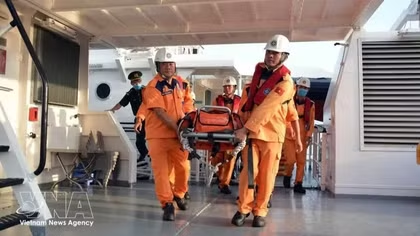
36 fishermen safely rescued after boat breaks down near Truong Sa

36 fishermen safely rescued after boat breaks down near Truong Sa

At 8:00 the same day, KN475 began towing the disabled fishing boat toward Da Tay A island. The towing operation was carried out safely, and by 18:30 both the vessel and its crew had arrived at the island without incident, where repairs and additional support procedures were arranged.

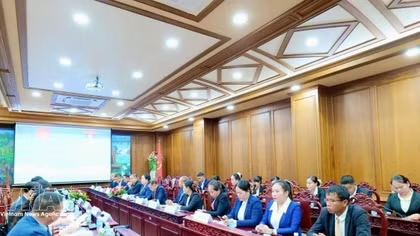
Vietnamese language contest in Laos strengthens youth ties, bilateral friendship

Vietnamese language contest in Laos strengthens youth ties, bilateral friendship

Held in response to the launch of the Vietnamese Language Day among overseas Vietnamese communities, the event aimed to enhance the quality of Vietnamese language teaching and learning in Laos while contributing to the great friendship, special solidarity, comprehensive cooperation and strategic cohesion between the two countries.

Vietnamese language contest in Laos strengthens youth ties, bilateral friendship

Vietnamese language contest in Laos strengthens youth ties, bilateral friendship

Held in response to the launch of the Vietnamese Language Day among overseas Vietnamese communities, the event aimed to enhance the quality of Vietnamese language teaching and learning in Laos while contributing to the great friendship, special solidarity, comprehensive cooperation and strategic cohesion between the two countries.

Hanoi launches 10 electric bus routes from April 1

Hanoi launches 10 electric bus routes from April 1

By the end of April, the number of buses using electricity and other green energy sources in the city is expected to reach 822, including 683 electric buses and 139 compressed natural gas (CNG) buses, representing 42.1% of the total number of vehicles.