- Vietnam proposes strengthening Mekong-India transport connectivity
- Senior Indian diplomat visits the Public Security Newspaper
- Vietnam to benefit from India’s tsunami early warning system
 |
These are of Prime Minister Narendra Modi (@NarendraModi), his office (@PMOIndia), External Affairs Minister Sushma Swaraj (@sushmaswaraj), Ministry of Eternal Affairs (@MEAIndia) and President of India (@Rashtrapatibvn). PM Modi has the third largest following on Twitter in the world and he is the highest following on Instagram. Swaraj is the most followed Foreign Minister in the world. MEA is among the top most followed government offices in the world.
Be it connecting with its citizens in a distress situation, facilitating documentations, visas, helping foreign nationals, or a means to connect with foreign leaders – Indian government has made most use from #Hashtag Diplomacy. In fact, in order to bridge the gap between government and people, Indian leaders and diplomats have perfected the art of speaking in 140 characters (on Twitter).
In a short span of three years, PM Modi has become the third most followed leader on Twitter (after Pope Francis and US President Donald Trump), with 32.1 million followers. According to ratings by Twiplomacy, Modi is the top most followed leader in Asia. He is also most followed and effective world leader on Instagram with 6.8 million followers, closely followed by Trump (6.3 million).
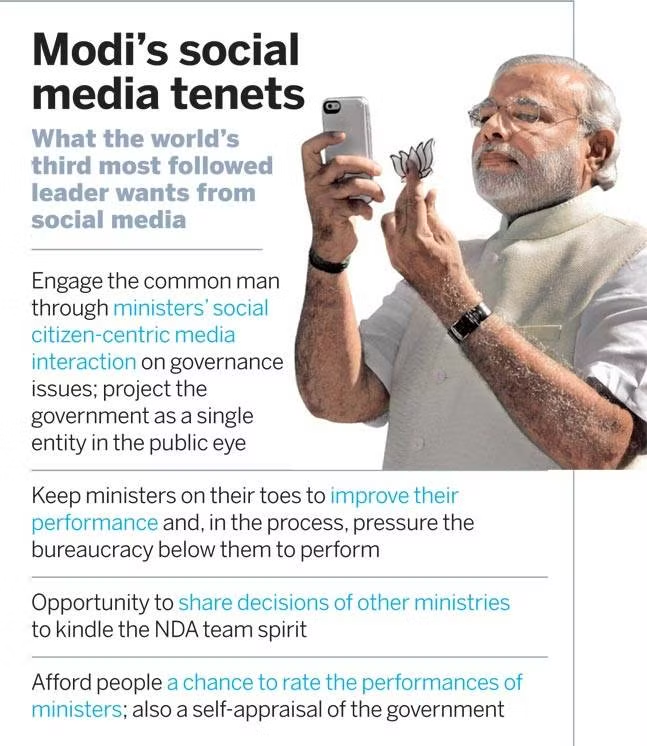 |
Each of Modi’s posts received on average 223,000 interactions, highest for all Instagram users.Modi’s Facebook (FB) page has 42,119,451 followers. PM effectively uses the platform to announce his visits to foreign countries and discuss the issue he plans to take up. Modi also used Weibo to connect with the Chinese President Xi Jinping. He tweeted in Japanese to connect with its leader Shinzo Abe; congratulated Israeli PM Benjamin Netanyahu in Hebrew and got response in Hindi. Besides, there were selfies with Australian PM Malcolm Turnbull in Delhi Metro, Chinese PM Li Keqiang, and with Fiji PM Frank Bainimarama shared on social media that made complicated body language in diplomacy easier for a common man to understand.
Indian diplomacy that has traditionally lived a conservative, protected life, has transformed itself to be the most active and interactive. Starting from Foreign Minister Swaraj, all Indian missions and embassies are actively present on the social media.
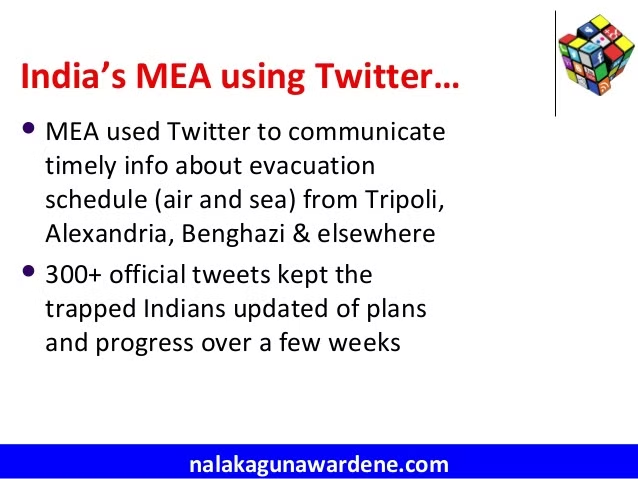 |
EAM Swaraj is the world’s most followed Foreign Minister (8.75 million) while MEA’s Twitter handle remains the third most popular Foreign Ministries in the world on the social media with 1.42 million followers. MEA’s Public Diplomacy another Twitter handle @IndianDiplomacy has touched 1.3 million followers in a short span and together @MEAIndia and @IndianDiplomacy have 2.7 million people actively engaged with Indian diplomats, taking digital diplomacy to a new height.
MEA’s passport division’s Twitter handle @passportsevamea and @CPVIndia (belonging to senior official handling passport division) is another major hit among people to resolve delays and other issues with regard to the travel document. Besides, the two Ministers of States –VK Singh and MJ Akbar too remain highly active and popular on the Twitter having 1 million and 90, 000 followers, respectively. MEA’s activities on other social networking sites are equally impressive. On FB, Swaraj’s has 2,853,852 followers and MEA’s is followed by 2,030,480 people.
MEA in particular has created a mechanism where action begins in less than 24 hours on all grievances and issues are usually sorted out in the following next hours. All messages are handled with a sense of urgency, acknowledged and resolved in no time. This has not only generated a great deal of confidence among the citizens, but also created an environment for effective governance, empowered people, removed red-tapism, and made grievance redressal faster. Besides, a message has been clearly gone that an Indian stranded on a foreign soil, or needing help of the government will not be left alone at God’s mercy.
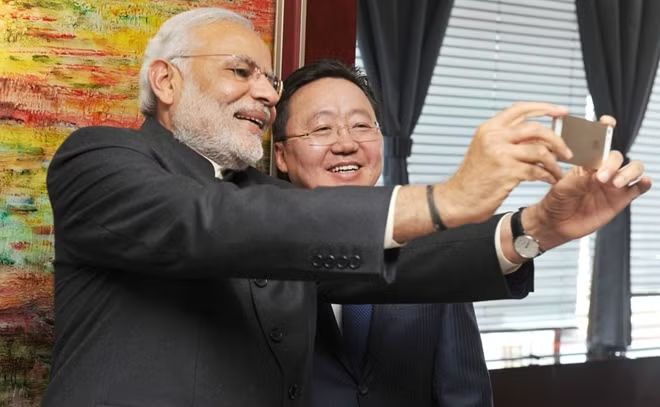 |
| The Prime Minister, Shri Narendra Modi and the President of Mongolia, Mr. Tsakhiagiin Elbegdorj taking a selfie, in Mongolia on May 17, 2015. PIB |
“People feel empowered about the thought that if you find yourself in a difficult situation abroad, you can send a tweet to your foreign minister, embassy asking for help—with the very real expectation that they will respond and help you,” Michael Kugelman, senior associate for South Asia at the Woodrow Wilson Center told the Quartz India magazine.
Swaraj also uses the platform to deliver political messages to foreign countries – sometimes extending a hand of friendship and sometimes rebuking them like she did to Pakistan Foreign Advisor Sartaz Aziz recently.
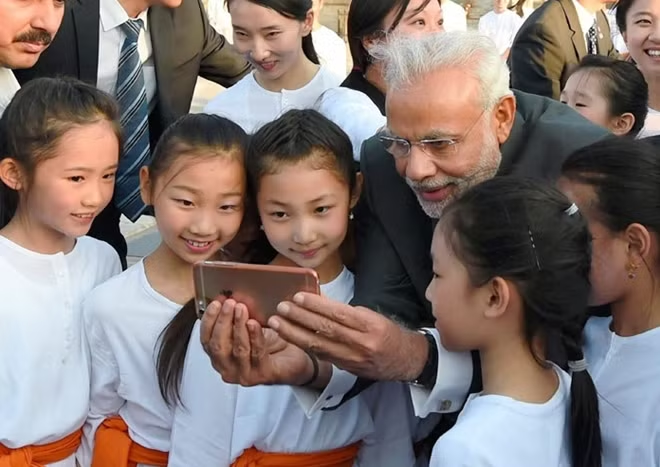 |
| Prime Minister Narendra Modi takes a group selfie with Chinese Premier Li Keqiang and children at the Temple of Heaven in Beijing (PTI photo) |
The Indian success story is evident not only by the increasing number of followers but also the increasing number of issues addressed effectively and in a fast paced manner. Social media was the most effective way to reach out to the government, whether it was the humongous rescue mission in Yemen, or saving stranded Indian seafarers in UAE, rescue operations against sea pirates, or bringing back abducted Indians, responding to earthquake in Nepal, helping out Indians in distress.
“Diplomacy in an age of social media is beginning to leave its ozone chamber, its protected past, to become interactive, better networked and more people-centred and people-friendly… Indian embassies and diplomatic missions across the world are active on Facebook, YouTube and Twitter these days and what was considered as a no-go for Indian officialdom until a few years ago is now de rigeur” former Foreign Secretary Nirupama Rao said at a speech delivered at UNESCO in Paris.
Thanks to social media, Twitter Diplomacy or #Hashtag Diplomacy is the new face of Indian Diplomacy: Fast, furious and effective.