 |
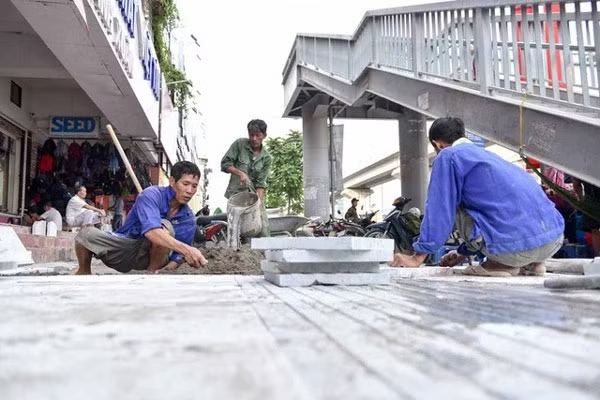
| Workers lay out stone tiles on the pavement of Nguyen Trai Street, Thanh Xuan District, Ha Noi |
The city will pave 936 streets with natural stone in 12 districts across Ha Noi from now until 2020.
The move comes as the city’s pavement continues to degrade, hindering pedestrians and other commuters as well as worsening the city’s image, according to local authorities.
By choosing only one material to pave all across the city, the city hopes to ensure consistency and avoid the current mix of stone materials around the streets.
According to experts, the natural stone’s biggest asset is its reliability. They say it should remain strong for 50 to 70 years.
The funds to implement the project will be from the city budget and mobilised from other social sources.
The material’s reliability will hopefully put an end to the rounds of replacements and repairs required every few years on the current pavement material.
Twelve companies have been selected to provide the stone for the construction and the project is estimated to cost not more than VND500,000 (US$22) per square metre.
Vice Chairman of the Viet Nam Construction Association Pham Sy Liem told Tien Phong (Vanguard) newspaper that the use of natural stones to pave sidewalks was better than the current practice of using cement blocks or standard bricks.
However, the paving should be undertaken with careful consideration towards ease of walking for pedestrians and maintaining smooth traffic flow for vehicles.
Stricter management and more comprehensive infrastructure development were needed to ensure that newly-paved streets would not be dug out again by electricity or cable sectors to put electric lines or cables underground, he said.
He noted that natural stones should only be used to pave streets that already have comprehensive infrastructure development such as streets around Hoan Kiem Lake or Ba Dinh Square. Otherwise, the new sidewalks could be at great risk of being dug up again.
The municipal Construction Department said the department would co-ordinate with relevant agencies to make surveys and appropriate designs on infrastructure projects to ensure development proceeds but does not result in the destruction of newly paved sidewalks.
A worker of the Construction and Environment Ltd.Co, which is working on paving pavements along Nguyen Trai Street in Thanh Xuan District, told the newspaper that his team of 20 workers would pave around 200sq m of pavements each day at a cost of VND500,000 ($22) per metre, more expensive than paving streets with normal bricks.
A resident in Giai Phong Street in Hai Ba Trung District said the replacements of all pavements by natural stones was unnecessarily costly because many sidewalks were still in good condition. Moreover, "it is quite slippery to walk on natural stones when it rains," he said.
Nguyen Thi Lan, a resident of Le Trong Tan Street, said the use of natural stones would make the pavements bright, beautiful and clean. However, she was concerned about potential waste if the pavements are dug again for the repair or construction of water pipes or telephone cables.
Pavements of Le Trong Tan Street were paved with natural stones on a trial basis beginning in May last year. However, natural stones on some parts of the pavements cracked or broke into small pieces, Tien Phong newspaper reported.
Nguyen Dinh Nghi, former Deputy Head of the Viet Nam Institute for Construction Materials, said apart from natural stones, other kinds of absorbent materials could also be used for pavements to prevent flooding.
Many developing countries chiefly use terrazzo, a composite material, to pave streets in urban areas. Terrazzo consists of chips of marble, quartz, granite and glass or other suitable material. One advantage of this material is preventing slips, according to Nghi.
Terrazzo made strictly following European standards are beautiful, high quality and reliable, as well as much cheaper than natural stones, he said.
A representative from Construction Material Production and Trade Co.ltd, one of the companies chosen to provide natural stones for the project, told the newspaper that using natural stones is more expensive than terrazzo. Terrazzo costs around VND70,000-100,000 ($3-4.4) per square metre, one-fifth the price of natural stones.