5G technology expansion expected to boost Vietnam’s digital economy

The Ministry of Science and Technology reported that by 2025, 5G had been commercialised nationwide, covering more than 90% of the population. Viettel alone has deployed 30,000 5G base stations, achieving 90% outdoor coverage and 70% indoor coverage, exceeding its commitments to the Government.

5G technology expansion expected to boost Vietnam’s digital economy -0
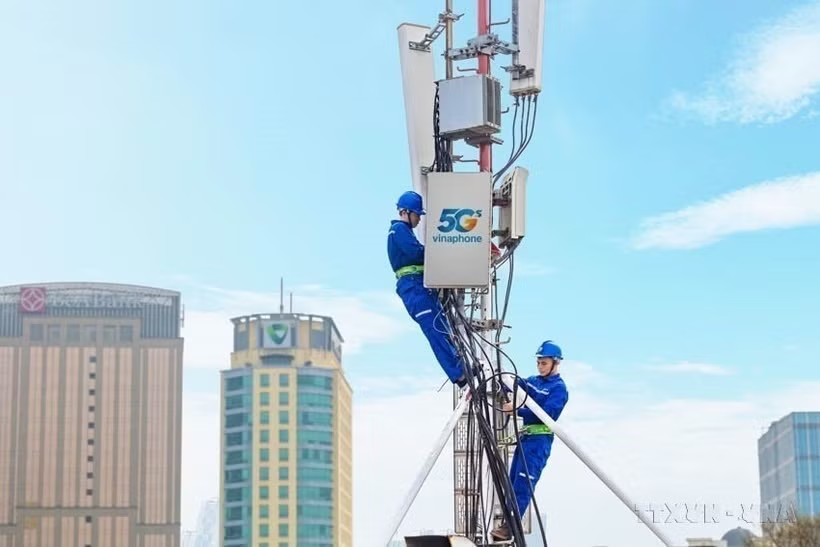
In Vietnam, 5G technology infrastructure has begun to be widely deployed by domestic network operators (Photo: VNA)

With domestic telecom operators’ strong efforts to deploy 5G infrastructure on a wide scale, Vietnam expects a surge in new applications in the coming period, delivering significant benefits for the State, businesses and the public.

Laying infrastructure groundwork

Since August 2025, Viettel Post has organised dozens of livestream sales sessions in Thai Nguyen, Vinh Long, Bac Ninh and Lai Chau provinces to support the sale of agricultural products in mountainous areas. After just three livestreams in Sin Ho commune of the northern province of Lai Chau, more than 300 tonnes of yacon root were sold by local Mong farmers.

According to Viettel Post Deputy General Director Dinh Thanh Son, 5G connectivity and integrated logistics systems are helping farmers overcome the long-standing challenge of price volatility. With 5G, farmers can livestream directly from fields, tea hills or home gardens, introducing their produce to consumers nationwide - effectively “bringing the marketplace to their fingertips”.

Beyond trade, 5G is also reshaping agricultural production, as 5G-enabled Internet of Things (IoT) devices for monitoring temperature, humidity and weather conditions are being piloted on a growing scale.

The Ministry of Science and Technology reported that by 2025, 5G had been commercialised nationwide, covering more than 90% of the population. Viettel alone has deployed 30,000 5G base stations, achieving 90% outdoor coverage and 70% indoor coverage, exceeding its commitments to the Government.

Nguyen Duy Lam, a senior telecommunications solutions expert at Huawei Vietnam, observed that while 5G deployment in Vietnam is progressing rapidly, particularly in e-commerce, more advanced applications such as smart cities and smart factories will require additional time, strong enterprise participation and supportive government policies.

Enabling application development

Explaining Viettel’s large-scale 5G investment, Viettel Telecom Deputy General Director Nguyen Ha Thanh said the group views 5G as strategic national digital infrastructure, in line with Resolution No. 57-NQ/TW. The effectiveness of 5G investment, she noted, should be assessed from a national perspective, including improvements in governance efficiency, living standards and the emergence of new business models.

Initial business results are already evident, with 5G subscribers accounting for 50% of Viettel’s new subscriptions, data usage rising by 15-20%, and customer satisfaction increasing by 20%, said Thanh.

With infrastructure in place, application deployment is expected to accelerate. Thanh said that Viettel Telecom is set to roll out three virtual assistant platforms serving individuals, households and enterprises, operating on its 5G network.

Meanwhile, MobiFone is advancing 5G-based smart city applications in Hanoi, including AI-powered camera systems, emergency response drones and multi-purpose urban monitoring platforms addressing traffic congestion, flooding, environmental pollution and food safety. Hanoi is also planning to develop large-scale smart urban areas under the Smart City 3.0 model, based on real-time data and automation.

According to Nguyen Anh Cuong, Deputy Director of the Authority of Telecommunications under the Ministry of Science and Technology, infrastructure sharing policies will be applied flexibly, particularly in remote areas, to optimise investment efficiency while ensuring fair competition and sustainable network development.

VNA

Other News

Vietnam joins Artemis Accords on space exploration

Vietnam joins Artemis Accords on space exploration

Vietnam views space science and technology as a strategic sector that can lift national science-technology capacity and support sustainable growth. The country wants to work with member nations on peaceful, safe, equitable, transparent and sustainable space exploration under international law, with tangible benefits for people and the planet.

Vietnam seeks deeper role in global semiconductor value chain

Vietnam seeks deeper role in global semiconductor value chain

As global semiconductor supply chains are restructured, experts said Vietnam’s opportunity lies not only in attracting projects but also in accumulating knowledge, technology and management expertise to move into higher-value activities.

Vietnam moves to standardize digital economy measurement

Vietnam moves to standardize digital economy measurement

The digital economy is a strategic priority for Vietnam, which aims to raise its share of GDP to at least 30% by 2030, in line with the Politburo’s Resolution No. 57-NQ/TW on breakthroughs in science and technology, innovation and national digital transformation.

AI platform launched to help businesses build brands

AI platform launched to help businesses build brands

Addressing the event, experts and business representatives stressed that harnessing digital technologies requires businesses to adopt a new mindset, use data in decision-making, and maintain brand identity and consumer trust.

Top leader calls for greater contribution from Vietnamese experts in Canada

Top leader calls for greater contribution from Vietnamese experts in Canada

At a meeting with representatives of the Canadian Vietnamese Scientists and Experts Association (CVSEA) on September 25 (local time), the top leader praised the contributions and professional capabilities of Vietnamese experts and intellectuals in Canada, describing them as a valuable intellectual resource and an important bridge connecting Vietnam with Canada and the wider world.

Hanoi approves controlled pilot of two technology projects

Hanoi approves controlled pilot of two technology projects

The two projects involve an intelligent autonomous transportation system developed by Phenikaa-X JSC and a technology for producing mixed rare-earth oxides with a purity of over 95% on a semi-industrial scale developed by the Mining Technology and Construction Consultancy JSC.

Banking industry in AI era: When data becomes competitive advantage

Banking industry in AI era: When data becomes competitive advantage

In just a few years, AI has evolved from an experimental technology into an “assistant” for many banks, supporting everything from customer service, credit approval, and fraud detection to risk management. However, as the technological gap between institutions narrows, a new question is emerging: What will determine banks' competitive advantage in the AI era?

Bac Ninh considers establishing AI centre of excellence

Bac Ninh considers establishing AI centre of excellence

A meeting has been held in Bac Ninh to discuss potential cooperation with Plug and Play in developing the northern province’s innovation ecosystem and establishing an artificial intelligence (AI) centre of excellence, with Standing Vice Chairman of the provincial People’s Committee Mai Son receiving a delegation from the global innovation platform.

Hanoi allows 24-month trial of autonomous vehicles at Hoa Lac

Hanoi allows 24-month trial of autonomous vehicles at Hoa Lac

The project aims to assess the safety, reliability and readiness of autonomous vehicles under real traffic conditions, as well as the effectiveness of autonomous public transport and compatibility with existing systems. Its results will contribute to developing technical standards, operating procedures and management models suited to Hanoi’s traffic conditions.

Singapore's experience suggests solutions to Vietnam's human resources challenge in AI era

Singapore's experience suggests solutions to Vietnam's human resources challenge in AI era

As Vietnam accelerates digital transformation and high-tech development, Singapore’s experience and the engagement of global technology companies demonstrate that human resources preparation must stay ahead of the curve. The ability to filter knowledge, collaborate, innovate and effectively use AI will increasingly become essential to helping workers adapt to a changing labour market and strengthening the competitiveness of Vietnam’s economy in the new era.