Global report: South Korea trials QR codes for Covid-19 tracing

South Korea is testing a new QR code tracing system to track visitors at entertainment venues, restaurants and churches as it battles to contain persistent clusters of infection. It comes as Pakistan’s prime minister, Imran Khan, called for people to “live with the virus”.

A church-linked Covid-19 cluster of 40 cases in the Seoul metropolitan area has been the third major flare-up in recent weeks, following more than 250 infections stemming from nightclubs and bars in the capital and at least 112 cases at a logistics centre in Bucheon, west of Seoul.

Starting on 10 June visitors to nightclubs, bars, karaoke clubs, daytime discos, indoor gyms that hold group exercises and indoor standing concert halls will be required to use any of a number of commercially available apps to generate a one-time personalised QR code that can be scanned at the door. 

The decision to trial the codes came after authorities struggled to trace people in the nightclub outbreak because much of the information on handwritten visitor logs was found to be false or incomplete.
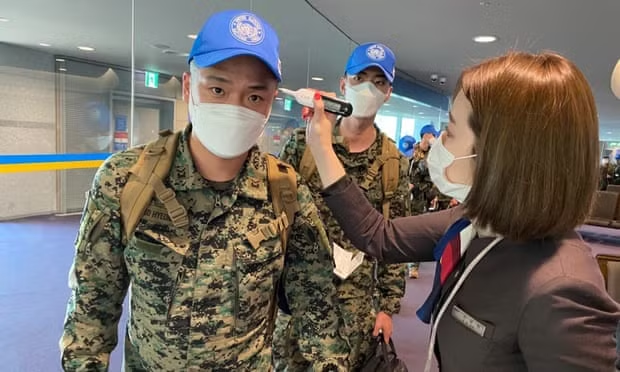
South Korean peacekeeping troops are checked for fever before boarding a flight. Photograph: South Korean Defense Ministry Handout/EPA

While infections from the recent clusters have eased, there are fears of a spike when 1.8 million school students return to class on Wednesday.

In Pakistan the prime minister has defended his decision to lift almost all lockdown measures because of economic losses, as deaths and infections continued to rise. In a televised address Khan said his government could not afford to continue giving cash handouts to the poor on such a large scale.

“Our conditions don’t allow that we keep feeding money to them, how long we can give them money?” he said, adding that around 130 million to 150 million people were adversely affected by the shutdowns.

The country would open to tourism but cinemas, theatres and schools would remain closed. Khan urged people to act responsibly but said more infections and deaths were inevitable.

“This virus will spread more. I have to say it with regret that there will be more deaths,” Khan warned. “If people do take care they can live with the virus.”

New Zealand’s prime minister, Jacinda Ardern, has said restrictions may be eased again sooner than planned as the country was “ahead of schedule”. Cabinet will decide next Monday whether to move to level-1 restrictions – the most lenient – two weeks ahead of when the government had planned to make that decision. New Zealand has had no Covid-19 cases for 11 straight days.

It is believed level-1 restrictions will involve little other than the continued closure of borders. This did not apply for the international crew of the film Avatar 2, who were given special permission arrive and begin filming. The director, James Cameron, and 55 members of his crew arrived on a privately chartered plane over the weekend, with many people angered that they were granted an exception.

There are fears the increased use of antibiotics to combat the pandemic will strengthen bacterial resistance and ultimately lead to more deaths during the crisis and beyond, the World Health Organization (WHO) has warned.

WHO director general Tedros Adhanom Ghebreyesus said on Monday a “worrying number” of bacterial infections were becoming increasingly resistant to the medicines traditionally used to treat them.


The Guardian

Other News

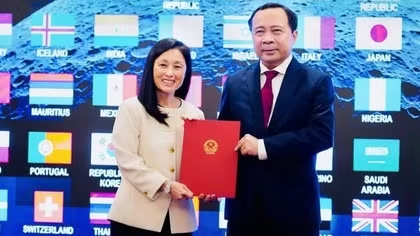
Vietnam joins Artemis Accords on space exploration

Vietnam joins Artemis Accords on space exploration

Vietnam views space science and technology as a strategic sector that can lift national science-technology capacity and support sustainable growth. The country wants to work with member nations on peaceful, safe, equitable, transparent and sustainable space exploration under international law, with tangible benefits for people and the planet.

Vietnam seeks deeper role in global semiconductor value chain

Vietnam seeks deeper role in global semiconductor value chain

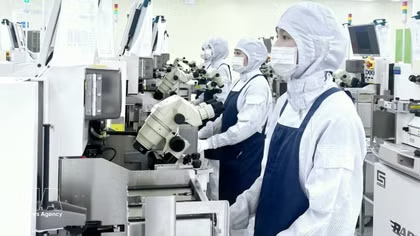
As global semiconductor supply chains are restructured, experts said Vietnam’s opportunity lies not only in attracting projects but also in accumulating knowledge, technology and management expertise to move into higher-value activities.

Vietnam moves to standardize digital economy measurement

Vietnam moves to standardize digital economy measurement

The digital economy is a strategic priority for Vietnam, which aims to raise its share of GDP to at least 30% by 2030, in line with the Politburo’s Resolution No. 57-NQ/TW on breakthroughs in science and technology, innovation and national digital transformation.

AI platform launched to help businesses build brands

AI platform launched to help businesses build brands

Addressing the event, experts and business representatives stressed that harnessing digital technologies requires businesses to adopt a new mindset, use data in decision-making, and maintain brand identity and consumer trust.

Top leader calls for greater contribution from Vietnamese experts in Canada

Top leader calls for greater contribution from Vietnamese experts in Canada

At a meeting with representatives of the Canadian Vietnamese Scientists and Experts Association (CVSEA) on September 25 (local time), the top leader praised the contributions and professional capabilities of Vietnamese experts and intellectuals in Canada, describing them as a valuable intellectual resource and an important bridge connecting Vietnam with Canada and the wider world.

Hanoi approves controlled pilot of two technology projects

Hanoi approves controlled pilot of two technology projects

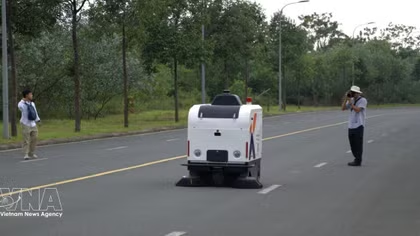
The two projects involve an intelligent autonomous transportation system developed by Phenikaa-X JSC and a technology for producing mixed rare-earth oxides with a purity of over 95% on a semi-industrial scale developed by the Mining Technology and Construction Consultancy JSC.

Banking industry in AI era: When data becomes competitive advantage

Banking industry in AI era: When data becomes competitive advantage

In just a few years, AI has evolved from an experimental technology into an “assistant” for many banks, supporting everything from customer service, credit approval, and fraud detection to risk management. However, as the technological gap between institutions narrows, a new question is emerging: What will determine banks' competitive advantage in the AI era?

Bac Ninh considers establishing AI centre of excellence

Bac Ninh considers establishing AI centre of excellence

A meeting has been held in Bac Ninh to discuss potential cooperation with Plug and Play in developing the northern province’s innovation ecosystem and establishing an artificial intelligence (AI) centre of excellence, with Standing Vice Chairman of the provincial People’s Committee Mai Son receiving a delegation from the global innovation platform.

Hanoi allows 24-month trial of autonomous vehicles at Hoa Lac

Hanoi allows 24-month trial of autonomous vehicles at Hoa Lac

The project aims to assess the safety, reliability and readiness of autonomous vehicles under real traffic conditions, as well as the effectiveness of autonomous public transport and compatibility with existing systems. Its results will contribute to developing technical standards, operating procedures and management models suited to Hanoi’s traffic conditions.

Singapore's experience suggests solutions to Vietnam's human resources challenge in AI era

Singapore's experience suggests solutions to Vietnam's human resources challenge in AI era

As Vietnam accelerates digital transformation and high-tech development, Singapore’s experience and the engagement of global technology companies demonstrate that human resources preparation must stay ahead of the curve. The ability to filter knowledge, collaborate, innovate and effectively use AI will increasingly become essential to helping workers adapt to a changing labour market and strengthening the competitiveness of Vietnam’s economy in the new era.