How is Vietnam applying artificial intelligence?

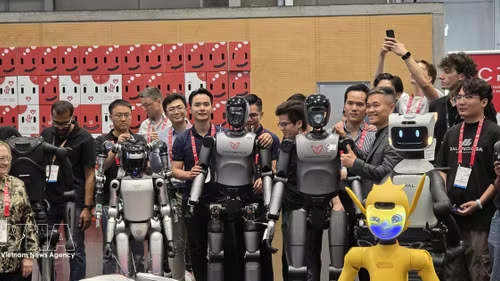
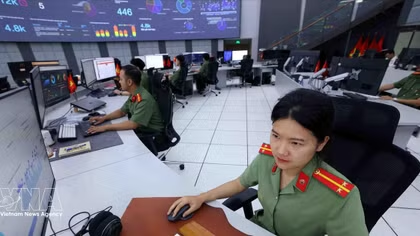
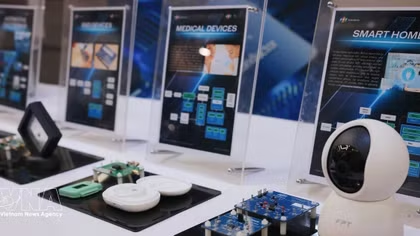
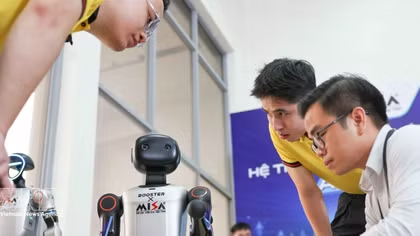
Artificial intelligence (AI) is being used in Vietnam in apps used such as face-identification technology cameras, smartphone chatbots, self-propelling vehicles, and nano robots developed by FPT Group, Zalo Brain and Zalo Assistant by VNG.

Connected with more than 3,000 celebrities and influential persons in Vietnam, CastingAsia is conquering the Vietnam online marketing market with AI.

This is AI-driven influencer marketing using computer vision, natural language processing (NLP) and deep learning to search, connect, manage, report and discover fraud.

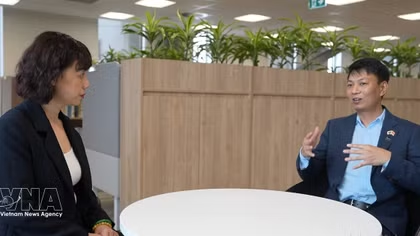
Shingo Hayashi, CastingAsia’s Regional Director, said the company now has 10,000 influencers and the figure is expected to soar to 50,000 by the end of this year, which would help it become the largest influencer marketing platform in Asia.

CastingAsia’s ambitious plan shows that AI is a ‘fertile land’ for Asia and Vietnam. Vice president of Microsoft Ralph Haupter said AI has often been the main topic in discussions with his partners, clients and Asian leaders in recent years.

Analysts say that developing AI is one of the rare opportunities for Vietnam to put its mark on the world’s technology map.

 There are several favorable conditions for Vietnam to develop AI. 

 Vietnam has a qualified workforce for AI. Vietnamese youth have good mathematics basis which allows them to carry out research on AI through online resources.

 Dr Le Viet Quoc, a Vietnamese at Google Brain, is recognized by technology circles for bringing deep learning into reality and resuming research ad application of AI which was once at a standstill for many years.

 Large Vietnamese technology firms such as FPT, AI and Viettel have also stepped up research on AI and created AI-based solutions such as e-government, SMAS (a school management software piece), DMS, ONE (the overall solution for managing online sales system), SMMS (the user manual single phase energy meter) and Voffice (an electronic office system). 

 Vietnam’s largest online education complex has opened Topica AI Lab with an aim to develop AI-based ideas.

 Sources said that AI is used at some hospitals in Vietnam to treat patients suffering from serious diseases. 

 Most recently, the Phu Tho General Hospital used IBM Watson for Oncology to choose the right treatment regimen for a cancer patient. After the treatment was chosen, the patient received biological targeted therapy with a new kind of medicine. After one month of treatment, the patient was able to move and had no need for painkillers.

Vietnamnet

Other News

AI offers both opportunities, challenges for Vietnam's growth

AI offers both opportunities, challenges for Vietnam's growth

Dr. Ho Duc Thang, a full-time member of the National Assembly’s Committee for Cultural and Educational, said productivity is the key to sustaining double-digit economic growth, and AI has greater potential to improve productivity than any previous technology.

Top leader unveils people-centred vision for new development model

Top leader unveils people-centred vision for new development model

Vietnam's growth model, long fueled by low-cost labour, resource extraction, contract manufacturing, expanded investment, and capital accumulation, has run out of road. The country now needs a sweeping reform agenda to shift from extensive growth to a model driven by productivity, knowledge, science and technology, innovation, and digital transformation.

First national semiconductor chip prototyping support centre makes debut

First national semiconductor chip prototyping support centre makes debut

Vietnam's semiconductor ecosystem now comprises around 60 chip design companies, some 7,000 chip design engineers and 166 universities offering semiconductor-related training programmes. Initial registrations from 12 organisations indicate demand for the prototyping of approximately 30,000 chips.

Vietnam targets at least 10 large strategic technology firms by 2030

Vietnam targets at least 10 large strategic technology firms by 2030

Deputy Prime Minister Ho Quoc Dung has signed a decision approving a plan to develop large domestic strategic technology enterprises in the 2026–2030 period, aimed at advancing digital infrastructure, digital human resources, digital data, strategic technologies and cybersecurity.

Protecting users crucial in building digital trust: Experts

Protecting users crucial in building digital trust: Experts

In Vietnam, digital transformation in the finance and banking sector is accelerating cashless payments, expanding access to financial services, improving market transparency and supporting economic growth and macroeconomic management.

Fostering skilled workforce for innovation era: experts

Fostering skilled workforce for innovation era: experts

Experts said close coordination among State management agencies, research institutes, universities, and businesses will improve training quality and serve the dual goals of quality education and practical research application.

Startup forum bridges Silicon Valley and local innovation ecosystem

Startup forum bridges Silicon Valley and local innovation ecosystem

The University of Economics Ho Chi Minh City (UEH), Saigon Asset Management (SAM), and Plug and Play Tech Centre co-hosted the “From Vietnam to Silicon Valley” forum, exploring AI innovation, venture capital, and pathways to integrate Vietnam’s startup ecosystem with Silicon Valley and global markets.

Experts call for stronger action against fake news online

Experts call for stronger action against fake news online

Experts have warned that fake news, misinformation and harmful online content are increasingly shaping public perceptions, particularly among young people, and stressed the need for stronger legal safeguards, technology tools and wider dissemination of credible information to tackle the problem effectively.

Protecting digital future in post-quantum, AI era

Protecting digital future in post-quantum, AI era

Participants highlighted the importance of building a proactive, synchronised and sustainable national cybersecurity ecosystem through closer cooperation among regulators, technology firms, research institutions and cybersecurity experts.