New Experiment Suggests Humans Can Grow Potatoes on Mars

The International Potato Center (CIP) in Peru has announced that they have successfully grown potatoes in a hermetically-sealed orbital environment that simulates conditions on Mars, indicating that it is possible to repeat the events of the 2015 film The Martian, by growing crops in red-planet soil.

The interior of the Peruvian CubeSat satellite was designed to mimic Martian conditions as closely as possible, with a thin carbon-dioxide atmosphere and little oxygen. The CubeSat houses soil and tubers, with sensors constantly monitoring the potatoes and sending a livestream to Earth. On Wednesday, CIP announced in a news release that "preliminary results are positive" and that they believe edible potatoes are on the way.

Ordinarily, normal potato plants cannot grow under such extreme conditions, but potatoes have a wide potential for genetic flexibility. CIP breeder Walter Amoros explained that potato clones were used, those particular strains meant to survive in high-salinity soil with very little water. The clones were originally developed to be grown in Peru's Pampas de La Joya salt desert, said to be the most Martian-like biome on Earth.
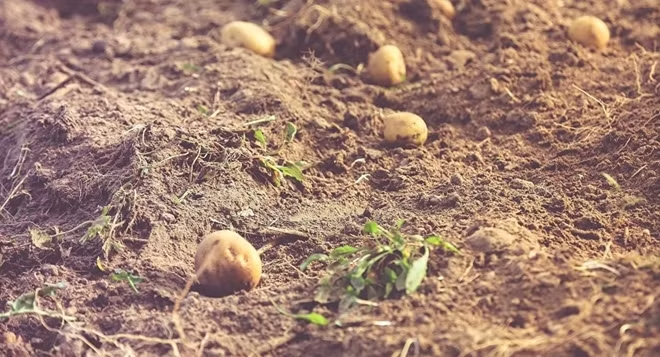
"We have been looking at the very dry soils found in the southern Peruvian desert. These are the most Mars-like soils found on Earth," said Chris McKay of NASA's Ames Research Center (ARC). "This [research] could have a direct technological benefit on Earth and a direct biological benefit on Earth."

"Growing crops under Mars-like conditions is an important phase of this experiment," said Julio Valdivia-Silva, an ARC research associate. "If the crops can tolerate the extreme conditions that we are exposing them to in our CubeSat, they have a good chance to grow on Mars."

Andy Weir, author of the science fiction novel on which The Martian was based, researched extensively to make the story as scientifically accurate as possible. "Well, they've known for a while that crops can grow in Martian soil," he told Engadget on Wednesday. "It's just a matter of cleaning the perchlorates out of the soil, and providing an Earth-like environment (air, water, temperature, etc.)."

Perchlorates, acidic salts used in rocket fuel and fireworks, are most commonly found in salt deserts. Chemical analysis revealed a large amount of perchlorates present in Martian soil, about 100,000 times that of typical Earth soil. As perchlorates are toxic to humans, Martian-grown food would be rendered inedible.
The research is promising, and soon may prove Mark Watney right. Mars will come to fear our botany powers.
Sputnik

Other News

Vietnam joins Artemis Accords on space exploration

Vietnam joins Artemis Accords on space exploration

Vietnam views space science and technology as a strategic sector that can lift national science-technology capacity and support sustainable growth. The country wants to work with member nations on peaceful, safe, equitable, transparent and sustainable space exploration under international law, with tangible benefits for people and the planet.

Vietnam seeks deeper role in global semiconductor value chain

Vietnam seeks deeper role in global semiconductor value chain

As global semiconductor supply chains are restructured, experts said Vietnam’s opportunity lies not only in attracting projects but also in accumulating knowledge, technology and management expertise to move into higher-value activities.

Vietnam moves to standardize digital economy measurement

Vietnam moves to standardize digital economy measurement

The digital economy is a strategic priority for Vietnam, which aims to raise its share of GDP to at least 30% by 2030, in line with the Politburo’s Resolution No. 57-NQ/TW on breakthroughs in science and technology, innovation and national digital transformation.

AI platform launched to help businesses build brands

AI platform launched to help businesses build brands

Addressing the event, experts and business representatives stressed that harnessing digital technologies requires businesses to adopt a new mindset, use data in decision-making, and maintain brand identity and consumer trust.

Top leader calls for greater contribution from Vietnamese experts in Canada

Top leader calls for greater contribution from Vietnamese experts in Canada

At a meeting with representatives of the Canadian Vietnamese Scientists and Experts Association (CVSEA) on September 25 (local time), the top leader praised the contributions and professional capabilities of Vietnamese experts and intellectuals in Canada, describing them as a valuable intellectual resource and an important bridge connecting Vietnam with Canada and the wider world.

Hanoi approves controlled pilot of two technology projects

Hanoi approves controlled pilot of two technology projects

The two projects involve an intelligent autonomous transportation system developed by Phenikaa-X JSC and a technology for producing mixed rare-earth oxides with a purity of over 95% on a semi-industrial scale developed by the Mining Technology and Construction Consultancy JSC.

Banking industry in AI era: When data becomes competitive advantage

Banking industry in AI era: When data becomes competitive advantage

In just a few years, AI has evolved from an experimental technology into an “assistant” for many banks, supporting everything from customer service, credit approval, and fraud detection to risk management. However, as the technological gap between institutions narrows, a new question is emerging: What will determine banks' competitive advantage in the AI era?

Bac Ninh considers establishing AI centre of excellence

Bac Ninh considers establishing AI centre of excellence

A meeting has been held in Bac Ninh to discuss potential cooperation with Plug and Play in developing the northern province’s innovation ecosystem and establishing an artificial intelligence (AI) centre of excellence, with Standing Vice Chairman of the provincial People’s Committee Mai Son receiving a delegation from the global innovation platform.

Hanoi allows 24-month trial of autonomous vehicles at Hoa Lac

Hanoi allows 24-month trial of autonomous vehicles at Hoa Lac

The project aims to assess the safety, reliability and readiness of autonomous vehicles under real traffic conditions, as well as the effectiveness of autonomous public transport and compatibility with existing systems. Its results will contribute to developing technical standards, operating procedures and management models suited to Hanoi’s traffic conditions.

Singapore's experience suggests solutions to Vietnam's human resources challenge in AI era

Singapore's experience suggests solutions to Vietnam's human resources challenge in AI era

As Vietnam accelerates digital transformation and high-tech development, Singapore’s experience and the engagement of global technology companies demonstrate that human resources preparation must stay ahead of the curve. The ability to filter knowledge, collaborate, innovate and effectively use AI will increasingly become essential to helping workers adapt to a changing labour market and strengthening the competitiveness of Vietnam’s economy in the new era.