Children face risks in cyberspace with 87% accessing internet daily

With 87% of Vietnamese children aged 12-17 years old access the internet every day, they are facing a myriad of risks in cyberspace, according to Tran Dang Khoa, deputy head of the Information Security Department under the Ministry of Information and Communications.

Khoa stated that parents often provide their children with mobile devices from an early age. However, he added these children do not have the skills to protect themselves in cyberspace.

A Google survey conducted in 2022 on parents' opinions regarding online safety revealed that the average age of Vietnamese children first owning a mobile phone is nine years old.

However, the average age at which children are informed about information security in cyberspace is 13 years old, Khoa said.
Children face risks in cyberspace with 87% accessing internet daily -0
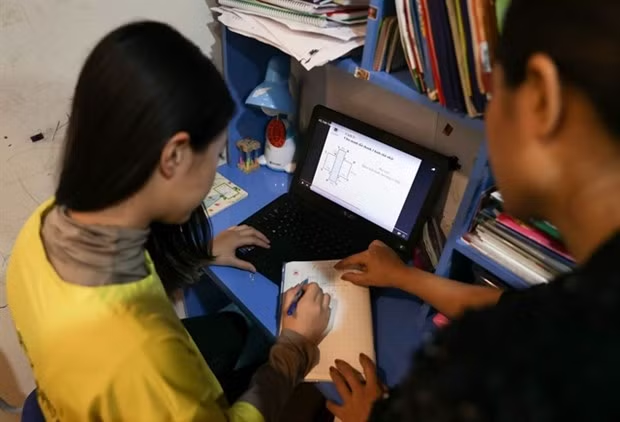
A child learns online at home in Hanoi. (Photo: VNA)

This leaves four years that children are interacting online without being told about the risks they face.

“Young Voice” Vietnam conducted in 2020 by the Management and Sustainable Development Institute (MSD) and Save the Children showed that children often use the internet for learning (83%), entertainment (71%), making friends (71%), sharing information (23%), shopping (30%) and live streaming (6.3%).

Nguyen Phuong Linh, head of the Management and Sustainable Development Institute, said that in cyberspace, children face many risks.

According to statistics in 2020, 40% of children feel unsafe when using the internet, she said.

More than 70% of children have had unwanted experiences such as personal information disclosure, harassing texts and cyberbullying, she said.

The risks become more diverse and unpredictable and do not spare anyone, she said.

Therefore, children need to be educated and equipped with the knowledge to protect themselves and take advantage of technology, she said.

Khoa said cyberspace is a result of digital technology - it needs digital technology to develop, and it also needs digital technology to be safe.

Digital technology products must be created and applied to successfully implement the programme “Protecting and supporting children to interact healthy and creatively in cyberspace in 2021-25” that was issued under Decision No 830 in 2021 by the Prime Minister, he said.

The programmes’ goal is to protect private lives, prevent online harm to children and focus on equipping children with digital immune systems while maintaining healthy cyberspace, developing Vietnamese products and applications for children to learn, connect, and entertain creatively.

Linh said parents and teachers must accompany and help children interact in a healthy and creative cyberspace based on six principles.

The six principles consist of recognising children's right to access and use the internet; helping the children use the internet safely as soon as possible; respecting the children's privacy; understanding the psychology and development of children to accompany them; guiding children to access support when needed; being available when the children need.

Ngo Tuan Anh, general director of Smart Cyber Security, said that when schools equip computer rooms with an internet connection according to regulations, the big challenge is finding and equipping tools to help monitor and manage students.

There are technology solutions that can help schools manage students on the internet conveniently, he said.

"The products apply the cloud computing model, allowing schools to deploy and easily use at a reasonable monthly cost quickly,” he said.

Dinh Thi Nhu Hoa, a representative of Vietnam Cybersecurity Emergency Response Teams/Coordination Centre (VNCERT/CC), suggested primary protection technologies, such as protection technology on operating systems, browsers, applications; child-protection devices and applications on the terminal; and applications that support reflection and inspection.

VNA

Other News

Vietnam joins Artemis Accords on space exploration

Vietnam joins Artemis Accords on space exploration

Vietnam views space science and technology as a strategic sector that can lift national science-technology capacity and support sustainable growth. The country wants to work with member nations on peaceful, safe, equitable, transparent and sustainable space exploration under international law, with tangible benefits for people and the planet.

Vietnam seeks deeper role in global semiconductor value chain

Vietnam seeks deeper role in global semiconductor value chain

As global semiconductor supply chains are restructured, experts said Vietnam’s opportunity lies not only in attracting projects but also in accumulating knowledge, technology and management expertise to move into higher-value activities.

Vietnam moves to standardize digital economy measurement

Vietnam moves to standardize digital economy measurement

The digital economy is a strategic priority for Vietnam, which aims to raise its share of GDP to at least 30% by 2030, in line with the Politburo’s Resolution No. 57-NQ/TW on breakthroughs in science and technology, innovation and national digital transformation.

AI platform launched to help businesses build brands

AI platform launched to help businesses build brands

Addressing the event, experts and business representatives stressed that harnessing digital technologies requires businesses to adopt a new mindset, use data in decision-making, and maintain brand identity and consumer trust.

Top leader calls for greater contribution from Vietnamese experts in Canada

Top leader calls for greater contribution from Vietnamese experts in Canada

At a meeting with representatives of the Canadian Vietnamese Scientists and Experts Association (CVSEA) on September 25 (local time), the top leader praised the contributions and professional capabilities of Vietnamese experts and intellectuals in Canada, describing them as a valuable intellectual resource and an important bridge connecting Vietnam with Canada and the wider world.

Hanoi approves controlled pilot of two technology projects

Hanoi approves controlled pilot of two technology projects

The two projects involve an intelligent autonomous transportation system developed by Phenikaa-X JSC and a technology for producing mixed rare-earth oxides with a purity of over 95% on a semi-industrial scale developed by the Mining Technology and Construction Consultancy JSC.

Banking industry in AI era: When data becomes competitive advantage

Banking industry in AI era: When data becomes competitive advantage

In just a few years, AI has evolved from an experimental technology into an “assistant” for many banks, supporting everything from customer service, credit approval, and fraud detection to risk management. However, as the technological gap between institutions narrows, a new question is emerging: What will determine banks' competitive advantage in the AI era?

Bac Ninh considers establishing AI centre of excellence

Bac Ninh considers establishing AI centre of excellence

A meeting has been held in Bac Ninh to discuss potential cooperation with Plug and Play in developing the northern province’s innovation ecosystem and establishing an artificial intelligence (AI) centre of excellence, with Standing Vice Chairman of the provincial People’s Committee Mai Son receiving a delegation from the global innovation platform.

Hanoi allows 24-month trial of autonomous vehicles at Hoa Lac

Hanoi allows 24-month trial of autonomous vehicles at Hoa Lac

The project aims to assess the safety, reliability and readiness of autonomous vehicles under real traffic conditions, as well as the effectiveness of autonomous public transport and compatibility with existing systems. Its results will contribute to developing technical standards, operating procedures and management models suited to Hanoi’s traffic conditions.

Singapore's experience suggests solutions to Vietnam's human resources challenge in AI era

Singapore's experience suggests solutions to Vietnam's human resources challenge in AI era

As Vietnam accelerates digital transformation and high-tech development, Singapore’s experience and the engagement of global technology companies demonstrate that human resources preparation must stay ahead of the curve. The ability to filter knowledge, collaborate, innovate and effectively use AI will increasingly become essential to helping workers adapt to a changing labour market and strengthening the competitiveness of Vietnam’s economy in the new era.