Toshiba gets go-ahead for chip unit sale at angry shareholder meeting

Toshiba Corp shareholders agreed to split off its prized NAND flash memory unit on Thursday, paving the way for a sale to raise at least $9 billion to cover U.S. nuclear unit charges that threaten the conglomerate's future.
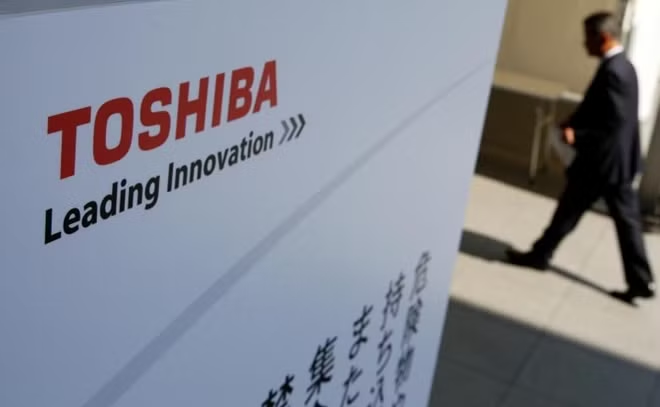
The logo of Toshiba is seen as a shareholder arrives at Toshiba's extraordinary shareholders meeting in Chiba, Japan March 30, 2017.REUTERS/Toru Hanai

The logo of Toshiba is seen as a shareholder arrives at Toshiba's extraordinary shareholders meeting in Chiba, Japan March 30, 2017.REUTERS/Toru Hanai

Coming a day after Westinghouse filed for bankruptcy, the extraordinary general meeting saw angry shareholders vent at CEO Satoshi Tsunakawa, with one noting that managers had only last year described the chip and nuclear businesses as core units at the conglomerate.

"How can something that was supposed to be a pillar turn into a hole," said the shareholder, asking Tsunakawa about the company's nuclear business.

"Toshiba has become a laughingstock around the world. You have no clue what's going on," shouted another.

Toshiba, which expects to book an annual net loss of 1 trillion yen ($9 billion) for this business year on a writedown at Westinghouse, has said it is selling most or even all of a unit that is the world's second-biggest producer of NAND chips.

Initial bids for the sale closed on Wednesday.

A source with knowledge of the planned sale said that about 10 potential bidders are interested. Those suitors include Western Digital Corp which operates a chip plant with Toshiba in Japan, Micron Technology Inc, South Korean chipmaker SK Hynix Inc and financial investors.

The government-backed Innovation Network Corporation of Japan, and Development Bank of Japan are expected to enter later bidding rounds as part of a consortium, sources have said, declining to be identified as they were not authorized to speak on the matter publicly.

A separate source said that Foxconn, the world's largest contract electronics manufacturer, is expected to place an offer which is likely to be the highest bid. Other sources have said the Japanese government is likely to block a sale to Foxconn due to its deep ties with China.

While the vote, which won the backing of more than two-thirds of shareholders, and the bankruptcy filing by Westinghouse are steps forward in Toshiba's struggle to stay in business, it woes are far from over.

Toshiba, which bought Westinghouse in 2006 for $5.4 billion now faces months of complex negotiations over the fate of its U.S. nuclear business, a discussion that could embroil the U.S. and Japanese governments.

The U.S. government has guaranteed loans of $8.3 billion loan to help finance some the construction of four reactors in the United States.

Putting American taxpayers on the hook for any losses related to Westinghouse's failure would be an embarrassment for Japanese Prime Minister Shinzo Abe, particularly if the debacle sparks criticism from President Donald Trump of Japanese corporations in the United States.

During talks in Washington this month Japan's Trade Minister Hiroshige Seko agreed to share information on developments with his U.S. counterparts Energy Secretary Rick Perry and Commerce Secretary Wilbur Ross.

Senior officials from both countries will get a chance to discuss Toshiba further in April when Vice President Mike Pence visit for bilateral economic talks. Ross will travel with Pence, according to a Japanese government official with direct knowledge of preparations.
Reuters

Other News

AI offers both opportunities, challenges for Vietnam's growth

AI offers both opportunities, challenges for Vietnam's growth

Dr. Ho Duc Thang, a full-time member of the National Assembly’s Committee for Cultural and Educational, said productivity is the key to sustaining double-digit economic growth, and AI has greater potential to improve productivity than any previous technology.

Top leader unveils people-centred vision for new development model

Top leader unveils people-centred vision for new development model

Vietnam's growth model, long fueled by low-cost labour, resource extraction, contract manufacturing, expanded investment, and capital accumulation, has run out of road. The country now needs a sweeping reform agenda to shift from extensive growth to a model driven by productivity, knowledge, science and technology, innovation, and digital transformation.

First national semiconductor chip prototyping support centre makes debut

First national semiconductor chip prototyping support centre makes debut

Vietnam's semiconductor ecosystem now comprises around 60 chip design companies, some 7,000 chip design engineers and 166 universities offering semiconductor-related training programmes. Initial registrations from 12 organisations indicate demand for the prototyping of approximately 30,000 chips.

Vietnam targets at least 10 large strategic technology firms by 2030

Vietnam targets at least 10 large strategic technology firms by 2030

Deputy Prime Minister Ho Quoc Dung has signed a decision approving a plan to develop large domestic strategic technology enterprises in the 2026–2030 period, aimed at advancing digital infrastructure, digital human resources, digital data, strategic technologies and cybersecurity.

Protecting users crucial in building digital trust: Experts

Protecting users crucial in building digital trust: Experts

In Vietnam, digital transformation in the finance and banking sector is accelerating cashless payments, expanding access to financial services, improving market transparency and supporting economic growth and macroeconomic management.

Fostering skilled workforce for innovation era: experts

Fostering skilled workforce for innovation era: experts

Experts said close coordination among State management agencies, research institutes, universities, and businesses will improve training quality and serve the dual goals of quality education and practical research application.

Startup forum bridges Silicon Valley and local innovation ecosystem

Startup forum bridges Silicon Valley and local innovation ecosystem

The University of Economics Ho Chi Minh City (UEH), Saigon Asset Management (SAM), and Plug and Play Tech Centre co-hosted the “From Vietnam to Silicon Valley” forum, exploring AI innovation, venture capital, and pathways to integrate Vietnam’s startup ecosystem with Silicon Valley and global markets.

Experts call for stronger action against fake news online

Experts call for stronger action against fake news online

Experts have warned that fake news, misinformation and harmful online content are increasingly shaping public perceptions, particularly among young people, and stressed the need for stronger legal safeguards, technology tools and wider dissemination of credible information to tackle the problem effectively.

Protecting digital future in post-quantum, AI era

Protecting digital future in post-quantum, AI era

Participants highlighted the importance of building a proactive, synchronised and sustainable national cybersecurity ecosystem through closer cooperation among regulators, technology firms, research institutions and cybersecurity experts.