Vietnam’s MicroDragon satellite to enter orbit in early 2019

MicroDragon, a made-in-Vietnam earth observation satellite, will be launched into space in Japan on January 17, 2019, according to the Vietnam National Space Centre (VNSC) under the Vietnam Academy of Science and Technology.
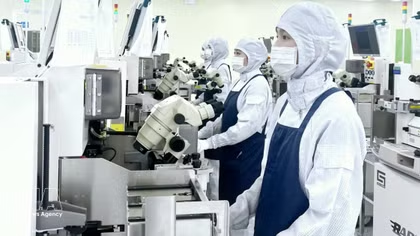
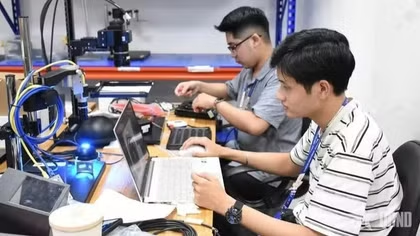
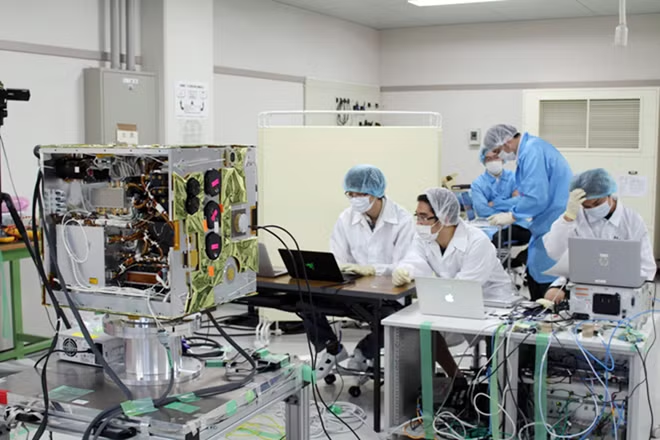
Vietnamese engineers work to develop MicroDragon satellite. (Photo: )

Vietnamese engineers work to develop MicroDragon satellite. (Photo: )

Citing an announcement of the Japan Aerospace Exploration Agency (JAXA) on November 3, the VNSC said MicroDragon and six Japanese satellites will be launched by an Epsilon-4 rocket from the Uchinoura Space Centre in Kagoshima Prefecture at 9:50:20-9:59:37 (local time). MicroDragon will be separated from the rocket at a height of 511 kilometres.

MicroDragon was developed by 36 Vietnamese engineers from the VNSC, who were sent to study space technology in Japan’s top five universities, namely the University of Tokyo, Keio University, Hokkaido University, Tohoku University and Kyushu Institute of Technology. Starting manufacturing the satellite in 2013, the group successfully completed and tested it in 2017. 

The satellite, measuring 50x50x50 centimeters and weighing 50 kilograms, is designed to monitor the quality of water in coastal areas, locate fishery resources, and observe changes in the ocean to assist the nation’s aquaculture. Also, it will help exchange database with the Microsatellite community in the world to enhance capacity in response to climate change and natural disasters. 

Earlier, VNSC engineers successfully made a satellite named PicoDragon (10x10x11.35 centimeters, 1 kg), which was launched into orbit in 2013. As scheduled, after MicroDragon, Vietnam will make LOTUSat-1 and LOTUSat-2 satellites with advanced radar technology, each weighing 600kg and measuring 1.5×1.5×3 meters with a 5-year lifetime in orbit.

VNA

Other News

Vietnam joins Artemis Accords on space exploration

Vietnam joins Artemis Accords on space exploration

Vietnam views space science and technology as a strategic sector that can lift national science-technology capacity and support sustainable growth. The country wants to work with member nations on peaceful, safe, equitable, transparent and sustainable space exploration under international law, with tangible benefits for people and the planet.

Vietnam seeks deeper role in global semiconductor value chain

Vietnam seeks deeper role in global semiconductor value chain

As global semiconductor supply chains are restructured, experts said Vietnam’s opportunity lies not only in attracting projects but also in accumulating knowledge, technology and management expertise to move into higher-value activities.

Vietnam moves to standardize digital economy measurement

Vietnam moves to standardize digital economy measurement

The digital economy is a strategic priority for Vietnam, which aims to raise its share of GDP to at least 30% by 2030, in line with the Politburo’s Resolution No. 57-NQ/TW on breakthroughs in science and technology, innovation and national digital transformation.

AI platform launched to help businesses build brands

AI platform launched to help businesses build brands

Addressing the event, experts and business representatives stressed that harnessing digital technologies requires businesses to adopt a new mindset, use data in decision-making, and maintain brand identity and consumer trust.

Top leader calls for greater contribution from Vietnamese experts in Canada

Top leader calls for greater contribution from Vietnamese experts in Canada

At a meeting with representatives of the Canadian Vietnamese Scientists and Experts Association (CVSEA) on September 25 (local time), the top leader praised the contributions and professional capabilities of Vietnamese experts and intellectuals in Canada, describing them as a valuable intellectual resource and an important bridge connecting Vietnam with Canada and the wider world.

Hanoi approves controlled pilot of two technology projects

Hanoi approves controlled pilot of two technology projects

The two projects involve an intelligent autonomous transportation system developed by Phenikaa-X JSC and a technology for producing mixed rare-earth oxides with a purity of over 95% on a semi-industrial scale developed by the Mining Technology and Construction Consultancy JSC.

Banking industry in AI era: When data becomes competitive advantage

Banking industry in AI era: When data becomes competitive advantage

In just a few years, AI has evolved from an experimental technology into an “assistant” for many banks, supporting everything from customer service, credit approval, and fraud detection to risk management. However, as the technological gap between institutions narrows, a new question is emerging: What will determine banks' competitive advantage in the AI era?

Bac Ninh considers establishing AI centre of excellence

Bac Ninh considers establishing AI centre of excellence

A meeting has been held in Bac Ninh to discuss potential cooperation with Plug and Play in developing the northern province’s innovation ecosystem and establishing an artificial intelligence (AI) centre of excellence, with Standing Vice Chairman of the provincial People’s Committee Mai Son receiving a delegation from the global innovation platform.

Hanoi allows 24-month trial of autonomous vehicles at Hoa Lac

Hanoi allows 24-month trial of autonomous vehicles at Hoa Lac

The project aims to assess the safety, reliability and readiness of autonomous vehicles under real traffic conditions, as well as the effectiveness of autonomous public transport and compatibility with existing systems. Its results will contribute to developing technical standards, operating procedures and management models suited to Hanoi’s traffic conditions.

Singapore's experience suggests solutions to Vietnam's human resources challenge in AI era

Singapore's experience suggests solutions to Vietnam's human resources challenge in AI era

As Vietnam accelerates digital transformation and high-tech development, Singapore’s experience and the engagement of global technology companies demonstrate that human resources preparation must stay ahead of the curve. The ability to filter knowledge, collaborate, innovate and effectively use AI will increasingly become essential to helping workers adapt to a changing labour market and strengthening the competitiveness of Vietnam’s economy in the new era.