Vietnam’s solar power market: attractive but risky

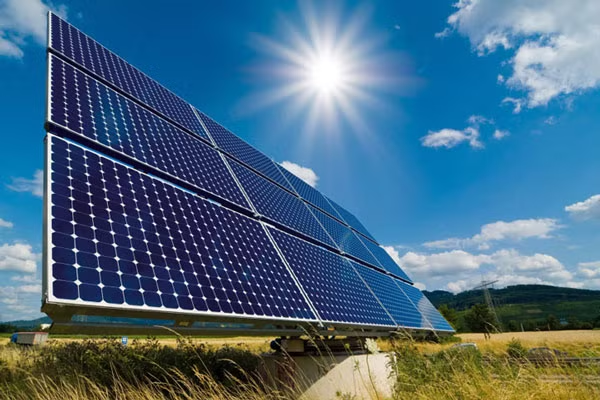
Vietnam is considered the second biggest potential market in Southeast Asia for solar power.

The electricity demand in Vietnam is predicted to increase by 11 percent per annum, or 20 billion kwh in the next years. 

Under the 2011-2020 national electricity development plan, Vietnam would have 850 MW of solar electricity by 2020, 4,000 MW by 2025 and 12,000 MW by 2030.

In April 2017, the PM signed a decision on encouraging the development of solar projects in Vietnam. Under the decision, the Electricity of Vietnam (EVN) has the responsibility of buying all the electricity output to be generated by solar power projects for 20 years at least. The electricity purchase price is VND2,086 per kwh, or 9.35 US cents.

However, despite the encouragement and tax incentives, investors still find it risky to develop solar power projects.

Under a circular issued by the Ministry of Industry and Trade (MOIT), EVN will have to buy electricity from the projects which connect the national grid and become commercially operational prior to June 30, 2019. 

This means that in order to enjoy the preferential sell price set by MOIT, investors will have only two years to implement their projects. Meanwhile, they have too many things to do, from completing documents and applying for licensing to clearing sites.

In addition, investors have to fulfill procedures and submit documents to MOIT for the approval of the solar power development programming. Small-scale projects (less than 50 MW) must be approved by MOIT, while big-scale projects (more than 50 MW) must get the PM’s approval.

Investors also note that the PM’s Decision No 11 is only valid in the period from June 1, 2017 to June 30, 2019. This means that the electricity sales and selling price after June 30, 2019 remain unclear.

Monika Bieri from SERIS said at the workshop titled The Solar Future Vietnam on November 30 that Vietnam is the second largest potential market in South East Asia, just after Indonesia. 

Le Viet Nga, who worked in the oil and gas sector for many years, now director of an enterprise in Vung Tau City, is considering developing a solar power project, because the oil & gas sector is facing difficulties, while solar power has great potential. 

However, Nga said he will try with a small project and there is no need to ask for a license from MOIT.

Nguyen Duc Cuong from the Energy Institute of MOIT also noted that the biggest challenges are administrative procedures to ask for permission to develop projects and add solar energy projects to the national electricity development program.
Vietnamnet

Other News

Vietnam targets at least 10 large strategic technology firms by 2030

Vietnam targets at least 10 large strategic technology firms by 2030

Deputy Prime Minister Ho Quoc Dung has signed a decision approving a plan to develop large domestic strategic technology enterprises in the 2026–2030 period, aimed at advancing digital infrastructure, digital human resources, digital data, strategic technologies and cybersecurity.

Protecting users crucial in building digital trust: Experts

Protecting users crucial in building digital trust: Experts

In Vietnam, digital transformation in the finance and banking sector is accelerating cashless payments, expanding access to financial services, improving market transparency and supporting economic growth and macroeconomic management.

Fostering skilled workforce for innovation era: experts

Fostering skilled workforce for innovation era: experts

Experts said close coordination among State management agencies, research institutes, universities, and businesses will improve training quality and serve the dual goals of quality education and practical research application.

Startup forum bridges Silicon Valley and local innovation ecosystem

Startup forum bridges Silicon Valley and local innovation ecosystem

The University of Economics Ho Chi Minh City (UEH), Saigon Asset Management (SAM), and Plug and Play Tech Centre co-hosted the “From Vietnam to Silicon Valley” forum, exploring AI innovation, venture capital, and pathways to integrate Vietnam’s startup ecosystem with Silicon Valley and global markets.

Experts call for stronger action against fake news online

Experts call for stronger action against fake news online

Experts have warned that fake news, misinformation and harmful online content are increasingly shaping public perceptions, particularly among young people, and stressed the need for stronger legal safeguards, technology tools and wider dissemination of credible information to tackle the problem effectively.

Protecting digital future in post-quantum, AI era

Protecting digital future in post-quantum, AI era

Participants highlighted the importance of building a proactive, synchronised and sustainable national cybersecurity ecosystem through closer cooperation among regulators, technology firms, research institutions and cybersecurity experts.

Vietnam attends SAHA 2026 defence, aerospace exhibition in Türkiye

Vietnam attends SAHA 2026 defence, aerospace exhibition in Türkiye

Vietnam’s participation in SAHA 2026 International Defence & Aerospace Exhibition in Istanbul reflects the country’s consistent policy of enhancing international defence integration and promoting defence industry cooperation towards self-reliance, self-strengthening, modernisation and dual-use development.

SK Group partners to build AI ecosystem in Vietnam

SK Group partners to build AI ecosystem in Vietnam

SK Innovation and SK Telecom signed MoUs with Nghe An province and the National Innovation Centre of Vietnam to advance AI ecosystem development and support the country’s long-term growth strategy.

Vietnam Research Excellence Fellowship for 2026-2030 approved

Vietnam Research Excellence Fellowship for 2026-2030 approved

Under the Vietnam Research Excellence Fellowship (VREF) for the 2026–2030 period, PhD students are identified as a core research force directly contributing to breakthroughs in sci-tech and innovation. Investing in top-tier doctoral candidates is more than workforce development, but a high-stakes strategic bet to forge a cohort of world-class scientists and technologists who can power Vietnam’s long-term economic ambitions.