5G key for Vietnam in Fourth Industrial Revolution

As part of plans to catch up with developed economies, Vietnam is looking to embrace the Fourth Industrial Revolution (FIR), with 5G coverage one of the key steps.

Party General Secretary and President Nguyen Phu Trong last year signed Resolution 52-NQ/TW on behalf of the Politburo outlining guidelines and policies to actively participate in the FIR, which set a target of affordable nationwide 5G network coverage by 2030.

To realise this ambitious vision, the Government is planning to test fifth-generation mobile networks in major urban centres such as Hanoi and HCM City.

The Government has issued the first licence to test 5G for Viettel, the country's largest mobile operator, with more than 60 million subscribers in a country with a population of nearly 100 million.

The company tested 5G in Hanoi and HCM City in May last year, and tests are expected to be completed this month.

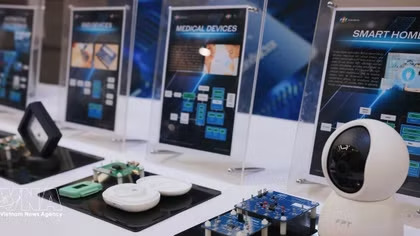
The number of 5G subscribers in Vietnam is expected to reach 6.3 million by 2025. (Photo: VNA)

In April 2019, Viettel said it had successfully tested a 5G broadcasting station in Hanoi at a speed of 600 to 700 Mbps, on a par with Verizon's network in the US.

Other mobile carriers including MobiFone and Vinaphone are also expected to launch their own 5G networks next year.

MobiFone has received a licence to become the second operator to conduct 5G network testing.

Notably, Viettel claimed that it had developed its own core technologies for 5G networks, including chips and devices. In fact, the group said it was aiming to produce 80 percent of the core network infrastructure needed for the network this year. The rest would come from outside suppliers.

MobiFone has chosen to go with Samsung technology, while Vinaphone is cooperating with Nokia.

In the process of Vietnam deploying 5G, many leading technology corporations in the world have expressed their interest in working closely with the Government, carriers, and private enterprises to help the country properly implement its 5G coverage plan and commercialise the technology this year.

5G technology would bring a new economy, helping the country create a series of new products for smart cities, said the Vietnam Telecommunications Authority (VNTA) under the Ministry of Information and Communications.

In the first phase of 5G technology, many Vietnamese enterprises will focus their resources on producing 5G chipset processors. These are considered the "heart" of 5G technology.

Although there have been proactive steps in deploying a 5G network, analysts said the road ahead for Vietnamese carriers is full of challenges and opportunities.

The number of 5G subscribers in Vietnam is expected to reach 6.3 million by 2025, according to a 5G development report published by Cisco in October.

By deploying 5G services, Vietnamese telecom companies could raise their revenue by up to 300 million USD each year from 2025, it noted. 

However, Vietnamese mobile service providers would have to invest 1.5-2.5 billion USD in infrastructure development from 2020-25 to launch and operate 5G services, the report said.

Cisco suggested Vietnam and Southeast Asian countries need to address the release of a slow frequency spectrum for 5G services while carriers need to introduce 5G services with appropriate prices to encourage users to move to higher speeds.

Le Dang Dung, chairman and acting general director of Viettel, said when 5G technology started to boom, Viettel will need its own 5G equipment. Therefore, the group must find a way to successfully develop 5G technology, he said.

More importantly, all 5G hardware and software products will be researched and produced by Viettel in Vietnam to ensure information security, Dung said.

Determining the production of 5G chipsets is extremely difficult and expensive, Deputy Minister of Information and Communications Phan Tam said, adding that the ministry wants to form a community of businesses and experts to share experiences of 5G chipset production in Vietnam in the near future.
VNA

Other News

AI offers both opportunities, challenges for Vietnam's growth

AI offers both opportunities, challenges for Vietnam's growth

Dr. Ho Duc Thang, a full-time member of the National Assembly’s Committee for Cultural and Educational, said productivity is the key to sustaining double-digit economic growth, and AI has greater potential to improve productivity than any previous technology.

Top leader unveils people-centred vision for new development model

Top leader unveils people-centred vision for new development model

Vietnam's growth model, long fueled by low-cost labour, resource extraction, contract manufacturing, expanded investment, and capital accumulation, has run out of road. The country now needs a sweeping reform agenda to shift from extensive growth to a model driven by productivity, knowledge, science and technology, innovation, and digital transformation.

First national semiconductor chip prototyping support centre makes debut

First national semiconductor chip prototyping support centre makes debut

Vietnam's semiconductor ecosystem now comprises around 60 chip design companies, some 7,000 chip design engineers and 166 universities offering semiconductor-related training programmes. Initial registrations from 12 organisations indicate demand for the prototyping of approximately 30,000 chips.

Vietnam targets at least 10 large strategic technology firms by 2030

Vietnam targets at least 10 large strategic technology firms by 2030

Deputy Prime Minister Ho Quoc Dung has signed a decision approving a plan to develop large domestic strategic technology enterprises in the 2026–2030 period, aimed at advancing digital infrastructure, digital human resources, digital data, strategic technologies and cybersecurity.

Protecting users crucial in building digital trust: Experts

Protecting users crucial in building digital trust: Experts

In Vietnam, digital transformation in the finance and banking sector is accelerating cashless payments, expanding access to financial services, improving market transparency and supporting economic growth and macroeconomic management.

Fostering skilled workforce for innovation era: experts

Fostering skilled workforce for innovation era: experts

Experts said close coordination among State management agencies, research institutes, universities, and businesses will improve training quality and serve the dual goals of quality education and practical research application.

Startup forum bridges Silicon Valley and local innovation ecosystem

Startup forum bridges Silicon Valley and local innovation ecosystem

The University of Economics Ho Chi Minh City (UEH), Saigon Asset Management (SAM), and Plug and Play Tech Centre co-hosted the “From Vietnam to Silicon Valley” forum, exploring AI innovation, venture capital, and pathways to integrate Vietnam’s startup ecosystem with Silicon Valley and global markets.

Experts call for stronger action against fake news online

Experts call for stronger action against fake news online

Experts have warned that fake news, misinformation and harmful online content are increasingly shaping public perceptions, particularly among young people, and stressed the need for stronger legal safeguards, technology tools and wider dissemination of credible information to tackle the problem effectively.

Protecting digital future in post-quantum, AI era

Protecting digital future in post-quantum, AI era

Participants highlighted the importance of building a proactive, synchronised and sustainable national cybersecurity ecosystem through closer cooperation among regulators, technology firms, research institutions and cybersecurity experts.