 |
| FPT Corporation Chairman Truong Gia Binh |
As one of the pioneers of the Industry 4.0, could you identify the challenge for Vietnam in this revolution?
Whether we like it or not, Industry 4.0 will come. This revolution will completely change the way people communicate and work and alter the structure of industry throughout the world.
For Vietnam, in this revolution there two scenarios are likely to occur; of which the first is that if Vietnam takes responsive initiatives, the nation may have the opportunity to make breakthroughs as certain countries have been successful in the previous three revolutions.
The second is that if Vietnam is passive and inundated in the revolution, the country could become an industrial landfill. Therefore, in my personal view, the challenge is very large and very urgent.
In your opinion, what advantages does Vietnam have to turn these challenges into opportunities?
Vietnam's advantage is that it has a large population of young people who can learn new things rapidly. For example, soon after the big corporations in the world have introduced technology platforms leading the development of digital networks, such as Cloud, IoT and Predix, FPT's young engineers have approached such new technologies and have learned very fast.
In particular, regarding the Amazon Web Services Cloud platform, our young engineers currently own over 370 certifications.
At present Vietnam is one of the countries with the highest number of engineers who have obtained the Amazon Web Service Cloud cloud computing technology certifications. In addition to the General Electric's Predix industrial IoT platform, FPT also takes the lead in the number of certified engineers involved in this technology.
Furthermore, we also dare to try new things. Coca-Cola is prioritising the digitisation of plant and business operations in its smart plant building process and FPT is exploring ways in which to provide the appropriate digital solutions to promote the operation of Coca-Cola Vietnam.
Also, right now, at the beginning of Industry 4.0, the Vietnamese Government has been very interested and has acted to promote access to the opportunities in this revolution.
You’ve just mentioned that Vietnam may have the opportunity to record certain breakthroughs in development. So what should we do to make it happen?
The most important is the spirit of activeness, daring to try new things and having the courage to engage with an open attitude. In addition, we also need to open up a new working space, a new business space, and re-train labour.
At the enterprise level, what should businesses do to prepare for the process of "encroachment", "adaptation" or "taking advantage" of Industry 4.0, when many technologies have evolved and can change the pattern of production in the world?
Five years ago, the competition between businesses led to "big fish swallowing small fish". But in the digital revolution, businesses will compete with speed that means “fast fish will eat slow fish,” so even a small but fast fish can beat larger fish.
According to forecasts by the World Economic Forum (WEF), by 2020, 30% of companies’ revenue will come from new business models based on digital technology and enterprises who are aware of the importance of digital transformation will be 26% more profitable than others.
Therefore, in order not to be swept away in the digital revolution, in my opinion, depending on the field and the operating model, businesses should have prioritised digital transformation.
For example, for businesses serving mass customers, three important "battles" in digital conversion are the customers’ experience on products or services; personalised products and services for each customer; and building a suitable access model for customers before competitors or start-ups seize the opportunity.
DEVELOPING PROGRAMMES A MUST TO ACTIVELY RESPOND AND SEIZE THE OPPORTUNITY
What suggestions do you have for the Government to plan strategies to cope with the challenges, especially for social implications such as reduced employment due to new technology?
We have to develop programmes to actively respond to and seize the opportunity. Recently, the Prime Minister has promulgated Directive No. 16 on promoting the capacity in accessing the Industry 4.0.
What is required now is how to bring the directive into life. The relevant agencies responsible for the tasks assigned in this directive should take specific actions quickly.
WEF's forecast on future employment in the Industry 4.0 shows that over the next five years, approximately 7.1 million people will lose their jobs due to labour surplus and automation.
However, there are millions of other jobs that will be created through the digital revolution, especially in the IT field.
By 2020, the number of people working on IoT is expected to reach 4.5 million and with high individualisation, job size and an unlimited workload.
I think that, with the 14th largest population in the world and in the “golden age,” along with the ability to learn quickly, Vietnam has a great opportunity to participate in the Industry 4.0.
However, the revolution requires high quality human resources. In response to this, a comprehensive change in education and training is inevitable.
We need a human resource that has the start-up spirit, creativeness and the courage to take part in this revolution and to take the fastest application of achievements created by the digital revolution to enhance the sudden mutation to the economy.
The role of simple labour is increasingly overshadowed by the development of science and technology, which will switch the focus of "power" to superior minds. As one of the top training centres in IT, how does FPT define its mission and vision on human training in the context of the Industry 4.0?
A: As many as 81% of business leaders, surveyed around the world, expressed their belief that machines can create more productive employees.
So, in the future, it will not be human to fight with machines but to cooperate with the machines in order to create super brains in all fields.
To do that, we need creative and courageous people to try new things and this is one of the weaknesses of the education system.
As soon as we established FPT University, we identified the important difference that the training programme had to be closely linked to the needs of the industry.
FPT University must quickly incorporate the latest technology trends and industry requirements into its training programmes.
In this 4.0 revolution, FPT University is one of the first universities to cooperate with leading corporations, such as IBM, Siemens, General Electric and Amazon Web Services, in jointly training digital human resources based on new technology platforms.
What are your forecasts for the Industry 4.0 in the world as well as in Vietnam? For example, services or products that have never existed before?
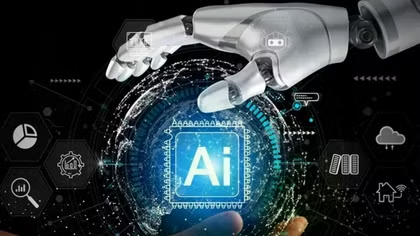
You do not have time to think about this change as it happens very fast. With superior data analysis capabilities, along with vision and language capabilities, artificial intelligence (AI) can help the fields of advertising, finance, healthcare, consuming and aviation to improve their business process and create new business models.