Chang'e 4 landing: China probe makes historic touchdown on far side of the moon

A Chinese spacecraft has become the first ever to land on the far side of the moon, according to state-run media, in a giant leap for human space exploration.

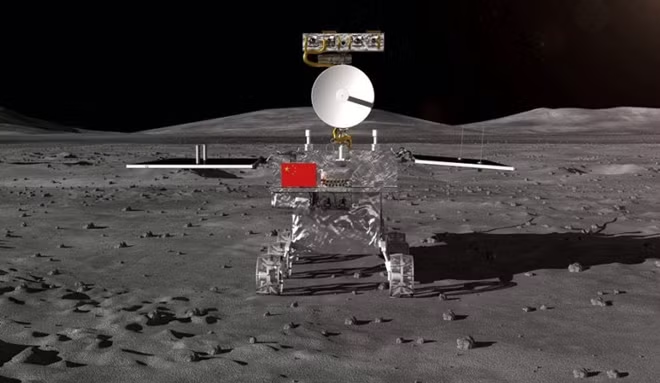
The China National Space Administration (CNSA) landed the robotic probe Chang’e 4 in the unexplored South Pole-Aitken basin, the largest, oldest, deepest, crater on the moon’s surface.

Early reports of a successful landing sparked confusion after state-run media China Daily and CGTN deleted tweets celebrating the mission. China Daily’s tweet said: ‘“China’s Chang’e 4 landed on the moon’s far side, inaugurating a new chapter in mankind’s lunar exploration history.”

Official confirmation of the landing came two hours later via state broadcaster CCTV, which said the lunar explorer had touched down at 10.26am (2.26am GMT). The Communist party-owned Global Times also said the probe had “successfully made the first-ever soft landing” on the far side of the moon.

An image tweeted by the English-language version of CCTV showed the first close-up shot of the far lunar surface.

The mission aims to take detailed measurements of the moon’s terrain and mineral composition. The Aitken basin is thought to have been formed during a gigantic collision very early in the moon’s history. The collision is likely to have thrown up material from the moon’s interior, meaning that Chang’e 4 could provide new clues as to how the natural satellite was formed.

The successful landing was touted as a “huge feather in China’s cap” by Malcolm Davis, senior analyst in defence strategy and capability at the Australian Strategic Policy Institute.

“There’s a lot of geopolitics or astropolitics about this, it’s not just a scientific mission, this is all about China’s rise as a superpower,” said Davis. “There’s a lot of enthusiasm for the space program in China. There’s a lot of nationalism in China, they see China’s role in space as a key part of their rise.”

The landing was greeted as “an impressive accomplishment” by Nasa administrator Jim Brindestine.

A spokesperson from the Australian Space Agency said the agency did not have a comment on the mission except to offer China its congratulations on the success of the landing and to “wish them all the best”.
Davis said China’s successful landing could “set a fire under the Americans”, who may not like the idea that the next person to set foot on the moon may be a Chinese Taikonaut, as they are unofficially called.

“I imagine we will see an announcement the Chinese do intend to send Taikonauts to the moon by 2030,” said Davis.

Chang’e 4 entered an elliptical path around the moon at the weekend, drawing as close as 15km (9 miles) from the surface.

Spacecraft have taken pictures of the moon’s far side before, but no lander has ever touched down there. The move marks a step towards China’s ambition to become a leading power in space exploration alongside the US and Russia.

Davis said China’s extraterrestrial ambitions seemed to be driven by multiple factors, including a desire for military dominance of space. Other motivations include the access to vast resource wealth provided by the moon and asteroids, in particular Helium-3 which is believed to exist in great abundance on the moon, and also that dominance of the region would be a sign of China’s growing power.

“China has been very clear in its understanding of this. They have compared the moon to the South China sea and Taiwan, and asteroids to the East China sea. They’re making a very clear geopolitical comparison with what’s happening with space and we need to pay attention to that.”

The Guardian

Other News

SK Group partners to build AI ecosystem in Vietnam

SK Group partners to build AI ecosystem in Vietnam

SK Innovation and SK Telecom signed MoUs with Nghe An province and the National Innovation Centre of Vietnam to advance AI ecosystem development and support the country’s long-term growth strategy.

Vietnam Research Excellence Fellowship for 2026-2030 approved

Vietnam Research Excellence Fellowship for 2026-2030 approved

Under the Vietnam Research Excellence Fellowship (VREF) for the 2026–2030 period, PhD students are identified as a core research force directly contributing to breakthroughs in sci-tech and innovation. Investing in top-tier doctoral candidates is more than workforce development, but a high-stakes strategic bet to forge a cohort of world-class scientists and technologists who can power Vietnam’s long-term economic ambitions.

Strategic tech must address practical challenges: PM

Strategic tech must address practical challenges: PM

Prime Minister Pham Minh Chinh on March 28 said strategic technologies must tackle Vietnam’s practical challenges, while chairing a meeting of the Government’s Steering Committee for science and technology, innovation, digital transformation, and Project 06.

Ho Chi Minh City sets sights on becoming semiconductor hub

Ho Chi Minh City sets sights on becoming semiconductor hub

Ho Chi Minh City is stepping up efforts to attract investment from global leading groups and companies in the fields of electronic components, semiconductors and chip manufacturing as it seeks to position itself as a leading semiconductor industry hub in both the region and the world. 

Ho Chi Minh City launches upgraded technology exchange platform

Ho Chi Minh City launches upgraded technology exchange platform

The upgraded platform represents a comprehensive shift from a simple information-sharing model to a managed online technology trading system, enabling monitoring and measurement of real transaction outcomes. It is built on three pillars, namely new tradable technology products, a modern digital platform, and an improved operational model.

AI – unmissable opportunity for Vietnam: Experts

AI – unmissable opportunity for Vietnam: Experts

AI also emerges as a key enabler for Vietnam's ambition to build financial and technology hubs. Applications can boost efficiency, automate workflows, cut costs, and sharpen data analytics, which are essential pillars of a modern financial system.

PM calls for accelerated space technology development in Vietnam

PM calls for accelerated space technology development in Vietnam

Vietnam aims by 2030 to achieve a mid-level position in space science and technology development within Southeast Asia, and after 2030 to build national capabilities to independently develop satellite technologies and apply space data to address global challenges and national security needs.

High-level forum advances Vietnam–US technological cooperation

High-level forum advances Vietnam–US technological cooperation

A high-level executive leadership forum focusing on strengthening Vietnam - US relations through technology cooperation was jointly held in Washington D.C. on March 11 by the Embassy of Vietnam in the US, the Weatherhead East Asian Institute of Columbia University, and the US -ASEAN Business Council (USABC). 

AI Law takes effect, anchors national governance framework

AI Law takes effect, anchors national governance framework

While many countries are still drafting policy blueprints or issuing non-binding guidance, Vietnam has moved ahead with a standalone Law on Artificial Intelligence (AI), effective from March 1, placing it among a select group of nations to adopt dedicated AI legislation at the parliamentary level. 

Vietnam International Defence Expo 2026 preparations move into high gear

Vietnam International Defence Expo 2026 preparations move into high gear

Vietnam International Defence Expo 2026, themed “Peace, Friendship, Cooperation and Development,” will be organised on a larger scale, featuring a wide array of weapons and technical equipment alongside product exhibitions, seminars and panel discussions, drills, live field demonstrations, and business networking activities.

Ministry requests urgent measures to counter UAVs threatening aviation safety

Ministry requests urgent measures to counter UAVs threatening aviation safety

Ministry of Construction requested the Ministry of National Defence, the Ministry of Public Security and provincial and municipal steering committees for counter-terrorism to strengthen the management, inspection and supervision of UAVs and other aerial devices, ensuring strict compliance with Decree No. 288/2025/ND-CP and relevant legal regulations.