CO2 levels mark 'new era' in the world's changing climate

Levels of CO2 in the atmosphere have surged past an important threshold and may not dip below it for "many generations".

The 400 parts per million benchmark was broken globally for the first time in recorded history in 2015.

But according to the World Meteorological Organization (WMO), 2016 will likely be the first full year to exceed the mark.

The high levels can be partly attributed to a strong El Niño event.

While human emissions of CO2 remained fairly static between 2014 and 2015, the onset of a strong El Niño weather phenomenon caused a spike in levels of the gas in the atmosphere.

That's because the drought conditions in tropical regions produced by El Niño meant that vegetation was less able to absorb CO2. There were also extra emissions from fires, sparked by the drier conditions.

In its annual Greenhouse Gas Bulletin, the World Meteorological Organisation says the conditions helped push the growth in the levels of CO2 in the atmosphere above the average for the last ten years.
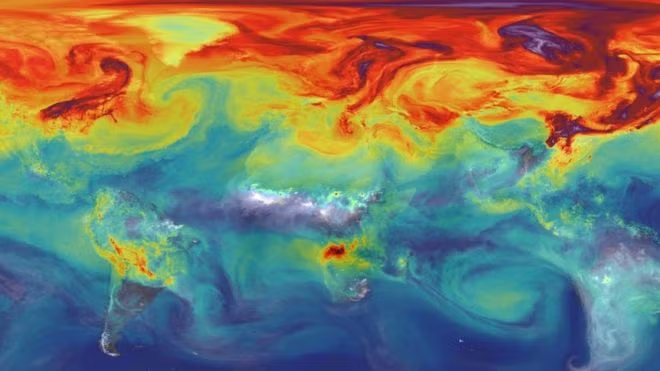
A depiction of the global sources of CO2 which are dominated by the US, China and Europe. Photo: NASA

At the atmospheric monitoring station in Mauna Loa, Hawaii, levels of CO2 broke through 400 parts per million (ppm), meaning 400 molecules of CO2 for every one million molecules in the atmosphere.

The last time CO2 was regularly above 400ppm was three to five million years ago, say experts.

Prior to 1800 atmospheric levels were around 280ppm, according to the US National Oceanic And Atmospheric Administration (Noaa).

The WMO says that the rise through the 400ppm barrier has persisted and it's likely that 2016 will be the first full year when the measurements show CO2 above that benchmark, and "hence for many generations".

While the El Niño factor has now disappeared, the human impact on climate change has not, the WMO argues.

"The year 2015 ushered in a new era of optimism and climate action with the Paris climate change agreement," said WMO Secretary-General Petteri Taalas.
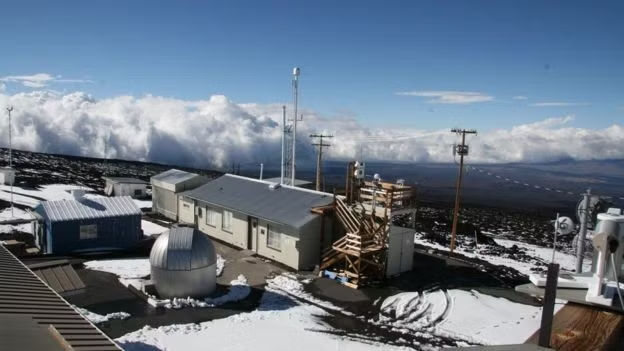
The air sampling station at Mauna Loa observatory in Hawaii which recorded CO2 levels going through 400ppm. Photo: NOAA

"But it will also make history as marking a new era of climate change reality with record high greenhouse gas concentrations."

The report also details the growth in other greenhouse gases, including methane and nitrous oxide.

In 2015, levels of methane were 2.5 times greater than in the pre-industrial era, while nitrous oxide was 1.2 times above the historic measure.

The study also points to the impact of these increased concentrations of warming gases on the world's climate.

Between 1990 and 2015 there was a 37% increase in radiative forcing or warming effect, caused by a build up of these substances, from industrial, agricultural and domestic activities.

While welcoming new initiatives like the global agreement to phase out HFC gases agreed recently in Rwanda, the WMO argues that nations must retain their focus on cutting CO2.

"Without tackling CO2 emissions, we cannot tackle climate change and keep temperature increases to below 2 degrees C above the pre-industrial era," said Petteri Taalas.

"It is therefore of the utmost importance that the Paris Agreement does indeed enter into force well ahead of schedule on 4 November and that we fast-track its implementation."

Around 200 nations who signed the Paris climate agreement will meet in Morocco in November to decide on the next steps forward.
BBC

Other News

SK Group partners to build AI ecosystem in Vietnam

SK Group partners to build AI ecosystem in Vietnam

SK Innovation and SK Telecom signed MoUs with Nghe An province and the National Innovation Centre of Vietnam to advance AI ecosystem development and support the country’s long-term growth strategy.

Vietnam Research Excellence Fellowship for 2026-2030 approved

Vietnam Research Excellence Fellowship for 2026-2030 approved

Under the Vietnam Research Excellence Fellowship (VREF) for the 2026–2030 period, PhD students are identified as a core research force directly contributing to breakthroughs in sci-tech and innovation. Investing in top-tier doctoral candidates is more than workforce development, but a high-stakes strategic bet to forge a cohort of world-class scientists and technologists who can power Vietnam’s long-term economic ambitions.

Strategic tech must address practical challenges: PM

Strategic tech must address practical challenges: PM

Prime Minister Pham Minh Chinh on March 28 said strategic technologies must tackle Vietnam’s practical challenges, while chairing a meeting of the Government’s Steering Committee for science and technology, innovation, digital transformation, and Project 06.

Ho Chi Minh City sets sights on becoming semiconductor hub

Ho Chi Minh City sets sights on becoming semiconductor hub

Ho Chi Minh City is stepping up efforts to attract investment from global leading groups and companies in the fields of electronic components, semiconductors and chip manufacturing as it seeks to position itself as a leading semiconductor industry hub in both the region and the world. 

Ho Chi Minh City launches upgraded technology exchange platform

Ho Chi Minh City launches upgraded technology exchange platform

The upgraded platform represents a comprehensive shift from a simple information-sharing model to a managed online technology trading system, enabling monitoring and measurement of real transaction outcomes. It is built on three pillars, namely new tradable technology products, a modern digital platform, and an improved operational model.

AI – unmissable opportunity for Vietnam: Experts

AI – unmissable opportunity for Vietnam: Experts

AI also emerges as a key enabler for Vietnam's ambition to build financial and technology hubs. Applications can boost efficiency, automate workflows, cut costs, and sharpen data analytics, which are essential pillars of a modern financial system.

PM calls for accelerated space technology development in Vietnam

PM calls for accelerated space technology development in Vietnam

Vietnam aims by 2030 to achieve a mid-level position in space science and technology development within Southeast Asia, and after 2030 to build national capabilities to independently develop satellite technologies and apply space data to address global challenges and national security needs.

High-level forum advances Vietnam–US technological cooperation

High-level forum advances Vietnam–US technological cooperation

A high-level executive leadership forum focusing on strengthening Vietnam - US relations through technology cooperation was jointly held in Washington D.C. on March 11 by the Embassy of Vietnam in the US, the Weatherhead East Asian Institute of Columbia University, and the US -ASEAN Business Council (USABC). 

AI Law takes effect, anchors national governance framework

AI Law takes effect, anchors national governance framework

While many countries are still drafting policy blueprints or issuing non-binding guidance, Vietnam has moved ahead with a standalone Law on Artificial Intelligence (AI), effective from March 1, placing it among a select group of nations to adopt dedicated AI legislation at the parliamentary level. 

Vietnam International Defence Expo 2026 preparations move into high gear

Vietnam International Defence Expo 2026 preparations move into high gear

Vietnam International Defence Expo 2026, themed “Peace, Friendship, Cooperation and Development,” will be organised on a larger scale, featuring a wide array of weapons and technical equipment alongside product exhibitions, seminars and panel discussions, drills, live field demonstrations, and business networking activities.

Ministry requests urgent measures to counter UAVs threatening aviation safety

Ministry requests urgent measures to counter UAVs threatening aviation safety

Ministry of Construction requested the Ministry of National Defence, the Ministry of Public Security and provincial and municipal steering committees for counter-terrorism to strengthen the management, inspection and supervision of UAVs and other aerial devices, ensuring strict compliance with Decree No. 288/2025/ND-CP and relevant legal regulations.