Coronavirus vaccine: Oxford team aim to start lab-controlled human trials

The team behind the Oxford Covid-19 vaccine hope to begin tests on volunteers who will be intentionally exposed to the virus in a “challenge trial”, a move seen as controversial since there is no proven cure for the illness.

Although challenge trials, in which healthy volunteers are given a pathogen, are routine in vaccine development, taking the approach for Covid-19, where there is no failsafe treatment if a volunteer becomes severely ill, has been questioned.

In human challenge trials volunteers are intentionally exposed in a controlled laboratory setting, meaning the trial can be completed in weeks and requires far fewer people.

The Oxford vaccine has already been tested in a phase-one trial involving about 1,000 British volunteers, with full details due to be published in the Lancet on Monday. Tens of thousands of people are also being recruited in the UK, Brazil, South Africa and the US for a further stage of testing, known as phase three.

A senior team member has said that preparations have begun for the human challenge trial to run in parallel with phase three, which would require only tens of volunteers to test the efficacy of the vaccine.
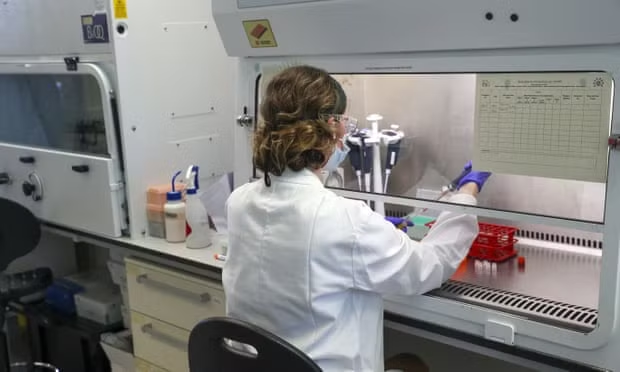
A scientist in the Oxford Vaccine Group – whose leaders include the professor Adrian Hill – working on the Covid-19 vaccine in June. Photograph: WPA/Getty Images

Prof Adrian Hill, director of Oxford University’s Jenner Institute, said that Oxford scientists were working in the laboratory on the technical side of preparation for such a trial and that the team hoped to recruit volunteers within months.

“We’re hoping to be doing challenge trials by the end of the year,” he said. “This might be in parallel or might be after the phase three trial is completed. They’re not competing options, they’re complementary.”

A growing number of scientists, including members of the Oxford team, argue that the human challenge trial approach is justified given that the risk would be very low for healthy people in their 20s, and since it would be set against the global impact of the pandemic and emergence of treatments such as Remdesivir.

One recent analysis put the risk of death from Covid-19 for someone in their 20s at around one in 3,000, similar to the risk for live kidney donation.

“Everybody would agree that the risk is extremely low in young people,” said Hill. “It’s so low that it’s very difficult to measure.”
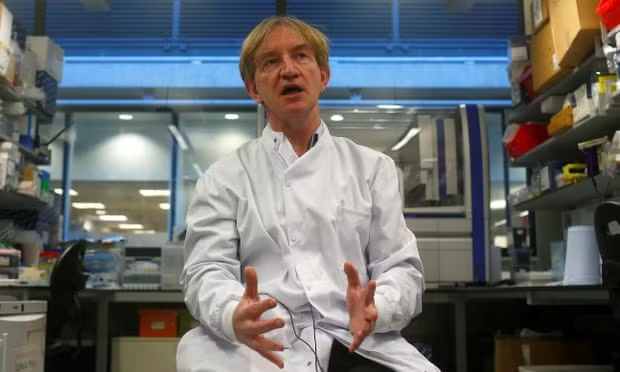
Prof Adrian Hill says the challenge trial will be complementary with a coronavirus trial which has recruited participants in Brazil and South Africa. Photograph: Eddie Keogh/Reuters

The development comes amid speculation that the publication of the Oxford team’s phase one trial results on Monday will reveal “positive news”. The results are expected to show that there are no serious side-effects from this vaccine and that subjects show a response in each aspect of the immune system, the antibodies and T-cells.

This conclusion would be in line with the results of animal studies released so far, but even if a robust immune response were confirmed, it would not be a guarantee that the vaccine protected against infection. Instead such protection could be established in the phase three trial. This phase has recruited 10,000 trial participants in the UK, about 5,000 in Brazil and 2,000 in South Africa, with a second trial in the US aiming to recruit as many as 30,000 participants.

The timeline for the phase three trial depends on waiting for enough participants to be exposed to the coronavirus in everyday life, which should reveal whether those who have received the vaccine (rather than a placebo) are protected. This can take months depending on infection levels in the community.

Hill said that the challenge trial, beginning either after or in parallel with the phase three trial, could provide complementary information about optimal dosing and administration of the vaccine, as well as being a way to test how long immunity to the virus endures after exposure or vaccination.

AstraZeneca has agreed to supply 100m doses of the Oxford vaccine to Britain, with manufacturing plans already begun and delivery scheduled for September or October. The AstraZeneca deal will provide the US with 300m doses.

Hill is among the signatories of an open letter published today from Nobel laureates and senior scientists, coordinated by the US-based campaign group 1Day Sooner, which promotes human challenge trials for the acceleration of Covid-19 vaccine development.

The letter states: “If challenge trials can safely and effectively speed the vaccine development process then there is a formidable presumption in favour of their use, which would require a very compelling ethical justification to overcome.”

Other signatories include several leading British scientists, including the Nobel laureate and biologist Sir Richard Roberts, Lord Darzi, director of the Institute of Global Health Innovation at Imperial College London, Prof Peter Openshaw, of Imperial College, and the Oxford ethicist Julian Savulescu.
The Guardian

Other News

SK Group partners to build AI ecosystem in Vietnam

SK Group partners to build AI ecosystem in Vietnam

SK Innovation and SK Telecom signed MoUs with Nghe An province and the National Innovation Centre of Vietnam to advance AI ecosystem development and support the country’s long-term growth strategy.

Vietnam Research Excellence Fellowship for 2026-2030 approved

Vietnam Research Excellence Fellowship for 2026-2030 approved

Under the Vietnam Research Excellence Fellowship (VREF) for the 2026–2030 period, PhD students are identified as a core research force directly contributing to breakthroughs in sci-tech and innovation. Investing in top-tier doctoral candidates is more than workforce development, but a high-stakes strategic bet to forge a cohort of world-class scientists and technologists who can power Vietnam’s long-term economic ambitions.

Strategic tech must address practical challenges: PM

Strategic tech must address practical challenges: PM

Prime Minister Pham Minh Chinh on March 28 said strategic technologies must tackle Vietnam’s practical challenges, while chairing a meeting of the Government’s Steering Committee for science and technology, innovation, digital transformation, and Project 06.

Ho Chi Minh City sets sights on becoming semiconductor hub

Ho Chi Minh City sets sights on becoming semiconductor hub

Ho Chi Minh City is stepping up efforts to attract investment from global leading groups and companies in the fields of electronic components, semiconductors and chip manufacturing as it seeks to position itself as a leading semiconductor industry hub in both the region and the world. 

Ho Chi Minh City launches upgraded technology exchange platform

Ho Chi Minh City launches upgraded technology exchange platform

The upgraded platform represents a comprehensive shift from a simple information-sharing model to a managed online technology trading system, enabling monitoring and measurement of real transaction outcomes. It is built on three pillars, namely new tradable technology products, a modern digital platform, and an improved operational model.

AI – unmissable opportunity for Vietnam: Experts

AI – unmissable opportunity for Vietnam: Experts

AI also emerges as a key enabler for Vietnam's ambition to build financial and technology hubs. Applications can boost efficiency, automate workflows, cut costs, and sharpen data analytics, which are essential pillars of a modern financial system.

PM calls for accelerated space technology development in Vietnam

PM calls for accelerated space technology development in Vietnam

Vietnam aims by 2030 to achieve a mid-level position in space science and technology development within Southeast Asia, and after 2030 to build national capabilities to independently develop satellite technologies and apply space data to address global challenges and national security needs.

High-level forum advances Vietnam–US technological cooperation

High-level forum advances Vietnam–US technological cooperation

A high-level executive leadership forum focusing on strengthening Vietnam - US relations through technology cooperation was jointly held in Washington D.C. on March 11 by the Embassy of Vietnam in the US, the Weatherhead East Asian Institute of Columbia University, and the US -ASEAN Business Council (USABC). 

AI Law takes effect, anchors national governance framework

AI Law takes effect, anchors national governance framework

While many countries are still drafting policy blueprints or issuing non-binding guidance, Vietnam has moved ahead with a standalone Law on Artificial Intelligence (AI), effective from March 1, placing it among a select group of nations to adopt dedicated AI legislation at the parliamentary level. 

Vietnam International Defence Expo 2026 preparations move into high gear

Vietnam International Defence Expo 2026 preparations move into high gear

Vietnam International Defence Expo 2026, themed “Peace, Friendship, Cooperation and Development,” will be organised on a larger scale, featuring a wide array of weapons and technical equipment alongside product exhibitions, seminars and panel discussions, drills, live field demonstrations, and business networking activities.

Ministry requests urgent measures to counter UAVs threatening aviation safety

Ministry requests urgent measures to counter UAVs threatening aviation safety

Ministry of Construction requested the Ministry of National Defence, the Ministry of Public Security and provincial and municipal steering committees for counter-terrorism to strengthen the management, inspection and supervision of UAVs and other aerial devices, ensuring strict compliance with Decree No. 288/2025/ND-CP and relevant legal regulations.