The Recovery trial has recruited over 5,000 patients in 165 NHS hospitals around the UK in a month, ahead of similar trials in the US and Europe, which have a few hundred.
“This is by far the largest trial in the world,” said Peter Horby, professor of emerging infectious diseases and global health at Oxford University, who is leading it. He has previously led Ebola drug trials in west Africa and the Democratic Republic of the Congo (DRC).
The Recovery team expects to be the first to have definitive data. “We’re guessing some time in June we may get the results,” said Prof Horby. “If it is really clear that there are benefits, an answer will be available quicker.” But he warned that in the case of Covid-19, there would be no “magic bullet”.
The team is working against a backdrop of doctors globally using drugs that they believe could be a cure citing “compassionate use”, without yet having good scientific evidence. Politicians are also wading in. Donald Trump has backed hydroxychloroquine, a less toxic form of the old anti-malaria drug chloroquine.
Used together with azithromycin, an antibiotic, it could be “one of the biggest game-changers in the history of medicine”, Trump tweeted. The French doctor Didier Raoult has claimed the combination is a cure, leading to public clamour for the drugs in France. President Macron visited Raoult’s hospital in Marseille last week, giving him tentative support but suggesting that trials were needed.
Both hydroxychloroquine and azithromycin are being tested separately as part of the Recovery trial, and if there is any effect in patients given those drugs alone, compared with those given no drugs, they can be combined later.
For now, said Horby, the data flying around in emails from enthusiasts and posted on social media about patients who have recovered after taking hydroxychloroquine proves nothing. He says there is no real evidence to support its use yet.
“I would say no,” said Horby. “There is in-vitro evidence that it is inhibitory against the virus [in the lab]. But I haven’t seen any sound clinical data.
“We’re seeing a large number of publications. It’s hard to keep up with them. Most of them are very disappointing. There was a paper that said it was a breakthrough – chloroquine works. But there was zero data in it. It seems to follow in that vein. They show a certain percentage of patients recovering, which would happen anyway.”
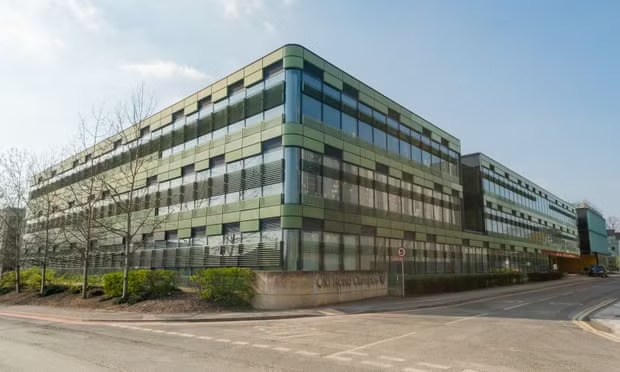 |
| Oxford University’s Jenner Institute, one of the hubs of the search for a cure to coronavirus. Photograph: Greg Blatchford/Rex/Shutterstock |
The hype and pressure cause problems for serious researchers. “There is pushback from clinicians saying we should just use this because it clearly works and shouldn’t use that because it clearly doesn’t work. They are both wrong because neither of them know.”
The number of patients being enrolled on the Recovery trial across the UK tells a story of doctors who have faith in scientific evidence over hope alone. Ten per cent of Covid-19 patients in the UK are now taking part in the trial, and the researchers say the more people join, the sooner they will have answers.
Also in the trial now are a combination of two antiretroviral drugs used in HIV treatment, lopinavir-ritonavir, known by the brand name Kaletra, and low-dose dexamethasone, a type of steroid used in a range of conditions, typically to reduce inflammation.
The next one to be included, said Horby, is an interleukin 6 antagonist, one of the immunomodulator drugs used in rheumatoid arthritis and to treat cytokine storm – something that happens when the immune system goes into overdrive, as can happen in Covid-19. They are looking at tocilizumab.
They are also in discussions about introducing convalescent plasma – blood from people who have recovered that contains antibodies against the virus. They want to trial remdesivir, but have not been able to obtain the stocks they need, because it is being tested in China and the US and because doctors are already prescribing it on compassionate use grounds.
Repurposed drugs are first because they already have a proven safety record. But as experimental drugs come along, Recovery will include those. Patients are randomly allocated one of the drugs (or a placebo). There are already 500 to 900 patients on each of the drugs being tested and 2,000 in the control groups.
The UK trial was set up with unprecedented speed. The team went to see the chief medical officer, Chris Whitty, to gain his support and enrolled the first patient nine days later. The NHS and National Institute for Health Research are on board. They recruited 1,000 patients within the first two weeks.
Martin Landray, professor of medicine and epidemiology at the Nuffield Department of Population Health, who co-leads the trial with Horby, says it’s extraordinary and may change the landscape once the pandemic is over.
“One of the things it tells you is what can happen when everybody is incentivised to make stuff happen as opposed to dither, delay or feelings that they will get into trouble if they say no,” said Prof Landray, who has worked for 20 years on cardiovascular drug trials coordinated from Oxford. After this, he thinks, it will be hard to return to the snail’s pace that has been the norm for setting up clinical trials in the UK, which can sometimes take years.
The second extraordinary thing is that the clinical care of the patients and the scientific rigour involved in trialling the drugs are hand in hand in a way that doesn’t normally happen, where the research might be going on in one corner of the hospital. “Frontline clinicians don’t know which treatments are best for patients apart from supportive care or ventilation,” he said. That gives them massive motivation to get involved in the trial, which is central to the care of the patient.
Horby says it’s unlikely they will come up with a quick cure. “We haven’t got anything like a magic bullet,” he said. “I think we have to temper people’s expectations about these drugs. It’s possible some might have an effect, but it’s likely to be modest. I think what we’ll be looking at in terms of making a significant impact will be moving on to combinations once we know of things that work. If we combine antiviral and anti-inflammatory drugs, they might have a bigger impact.”
He holds out more hope for monoclonal antibodies, which worked in Ebola. “If you are saying this is an acute, serious viral infection, that’s really difficult to treat, you can counter that with … well, look at Ebola. That’s much nastier,” he said. “Very surprisingly, the monoclonal antibodies that were trialled in eastern DRC did work. Those are the ones we will be waiting for with a bit of bated breath to put into the trial when they become available.”