Driverless taxi debuts in Tokyo in 'world first' trial ahead of Olympics

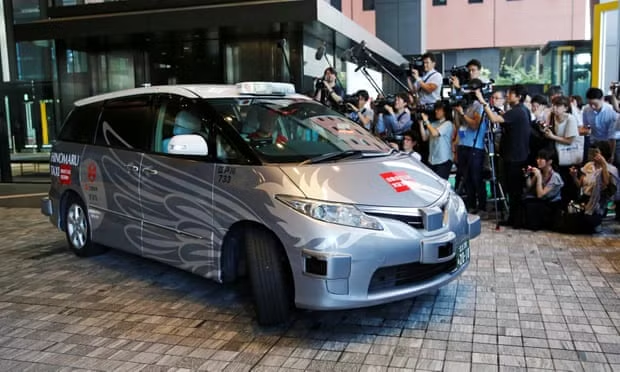
A self-driving taxi has successfully taken paying passengers through the busy streets of Tokyo, raising the prospect that the service will be ready in time to ferry athletes and tourists between sports venues and the city centre during the 2020 Summer Olympics.

ZMP, a developer of autonomous driving technology, and the taxi company Hinomaru Kotsu, claim that the road tests, which began this week, are the first in the world to involve driverless taxis and fare-paying passengers.

The trial took place as Toyota and the transport giant Uber said they were intensifying efforts to develop a self-driving vehicle, pitting themselves against rival initiatives in Japan, the US and Europe.

Toyota will invest $500m in the venture, which will develop vehicles based on the carmakers’ Sienna minivans, with a view to start testing in 2021, the firms said this week.

Uber's autonomous driving venture suffered a setback in March when one of its self-driving vans struck and killed a pedestrian during a trial in Arizona.

Nissan and the tech firm DeNa tested their Easy Ride robo-vehicle service along a 4.5km set route in the port city of Yokohama earlier this year.
DeNa and ZMP have also conducted trials of a driverless taxi using Toyota’s Estima minivans, shuttling dozens of residents from their homes to the local shops in the town of Fujisawa, near Tokyo, in March 2016.

In the latest trial in Tokyo, a minivan equipped with sensors made four round-trips a day on a busy 5.3km stretch of road between the Otemachi and Roppongi districts, according to Kyodo news.

The experiment, which ends early next month, has captured the imagination of Tokyoites, with 1,500 people applying to be passengers during the 96 planned journeys between the two destinations.

A driver and an assistant are on board to take control of the vehicle in case of any mishaps, but early journeys have passed off without incident.

Passengers unlock the door themselves and pay their one-way fare – about 1,500 yen ($13) – via a smartphone app.

One of the first passengers said his Monday morning journey felt “so natural that I almost forgot it was a self-driving car,” according to Kyodo.

Hinomaru Kotsu’s president, Kazutaka Tomita, said the test was a “precious step” towards the day when autonomous driving becomes fully commercial.

With one eye on the Tokyo Games, the firms will conduct follow-up tests later this year connecting Haneda airport and the city centre’s transport hubs.

As one of the fastest-ageing societies in the world, Japan is an ideal market for the introduction of self-driving vehicles as it contends with a shortage of drivers in depopulated rural areas and a rise in the number of accidents involving older motorists.
The Guardian

Other News

SK Group partners to build AI ecosystem in Vietnam

SK Group partners to build AI ecosystem in Vietnam

SK Innovation and SK Telecom signed MoUs with Nghe An province and the National Innovation Centre of Vietnam to advance AI ecosystem development and support the country’s long-term growth strategy.

Vietnam Research Excellence Fellowship for 2026-2030 approved

Vietnam Research Excellence Fellowship for 2026-2030 approved

Under the Vietnam Research Excellence Fellowship (VREF) for the 2026–2030 period, PhD students are identified as a core research force directly contributing to breakthroughs in sci-tech and innovation. Investing in top-tier doctoral candidates is more than workforce development, but a high-stakes strategic bet to forge a cohort of world-class scientists and technologists who can power Vietnam’s long-term economic ambitions.

Strategic tech must address practical challenges: PM

Strategic tech must address practical challenges: PM

Prime Minister Pham Minh Chinh on March 28 said strategic technologies must tackle Vietnam’s practical challenges, while chairing a meeting of the Government’s Steering Committee for science and technology, innovation, digital transformation, and Project 06.

Ho Chi Minh City sets sights on becoming semiconductor hub

Ho Chi Minh City sets sights on becoming semiconductor hub

Ho Chi Minh City is stepping up efforts to attract investment from global leading groups and companies in the fields of electronic components, semiconductors and chip manufacturing as it seeks to position itself as a leading semiconductor industry hub in both the region and the world. 

Ho Chi Minh City launches upgraded technology exchange platform

Ho Chi Minh City launches upgraded technology exchange platform

The upgraded platform represents a comprehensive shift from a simple information-sharing model to a managed online technology trading system, enabling monitoring and measurement of real transaction outcomes. It is built on three pillars, namely new tradable technology products, a modern digital platform, and an improved operational model.

AI – unmissable opportunity for Vietnam: Experts

AI – unmissable opportunity for Vietnam: Experts

AI also emerges as a key enabler for Vietnam's ambition to build financial and technology hubs. Applications can boost efficiency, automate workflows, cut costs, and sharpen data analytics, which are essential pillars of a modern financial system.

PM calls for accelerated space technology development in Vietnam

PM calls for accelerated space technology development in Vietnam

Vietnam aims by 2030 to achieve a mid-level position in space science and technology development within Southeast Asia, and after 2030 to build national capabilities to independently develop satellite technologies and apply space data to address global challenges and national security needs.

High-level forum advances Vietnam–US technological cooperation

High-level forum advances Vietnam–US technological cooperation

A high-level executive leadership forum focusing on strengthening Vietnam - US relations through technology cooperation was jointly held in Washington D.C. on March 11 by the Embassy of Vietnam in the US, the Weatherhead East Asian Institute of Columbia University, and the US -ASEAN Business Council (USABC). 

AI Law takes effect, anchors national governance framework

AI Law takes effect, anchors national governance framework

While many countries are still drafting policy blueprints or issuing non-binding guidance, Vietnam has moved ahead with a standalone Law on Artificial Intelligence (AI), effective from March 1, placing it among a select group of nations to adopt dedicated AI legislation at the parliamentary level. 

Vietnam International Defence Expo 2026 preparations move into high gear

Vietnam International Defence Expo 2026 preparations move into high gear

Vietnam International Defence Expo 2026, themed “Peace, Friendship, Cooperation and Development,” will be organised on a larger scale, featuring a wide array of weapons and technical equipment alongside product exhibitions, seminars and panel discussions, drills, live field demonstrations, and business networking activities.

Ministry requests urgent measures to counter UAVs threatening aviation safety

Ministry requests urgent measures to counter UAVs threatening aviation safety

Ministry of Construction requested the Ministry of National Defence, the Ministry of Public Security and provincial and municipal steering committees for counter-terrorism to strengthen the management, inspection and supervision of UAVs and other aerial devices, ensuring strict compliance with Decree No. 288/2025/ND-CP and relevant legal regulations.