Earth’s oldest known rock found on Moon - scientists explain how it got there

One of the Moon rock samples collected decades ago by Apollo 14 crew appears to be originally from Earth.

The rock is presumed to be the oldest known rock, formed around the same time our planet was formed, according to an analysis in Earth and Planetary Science Letters. Until this discovery, the oldest known rocks were around 2 billion years old. This rock was formed between 4 and 4.1 billion years ago, about 12.4 miles beneath the Earth’s crust, yet the most curious thing about it that it was found far beyond our planet’s surface – on the Moon.
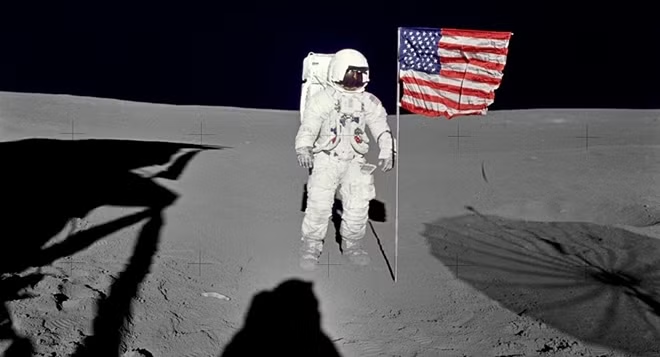
The rock was among the samples discovered by the Apollo 14 crew. The Apollo missions brought back a whole bunch of rock samples, and scientists have been methodically analyzing them ever since. This particular rock was at the end of the list, yet it appeared to be the most interesting.

NASA’s Center for Lunar Science and Exploration (CLSE) have identified this small specimen as terrestrial due to it containing a number of various minerals like quartz and feldspar, which are common on Earth but rare on the Moon. It was possible to determine how deep beneath the earth the rock had been with the use of molecular analysis.

There is a possibility that this rock could have formed on the Moon, but it is very low. The rock, unlike other Moon rock samples, is made of an extremely high amount of earth minerals and an extremely low amount of minerals commonly found on our planet’s natural satellite. Moreover, it would have to have been formed in the Moon’s core and then somehow appear on the surface.

Of course, there is still a question of how this rock could have ended up on the Moon? For starters, the Moon itself was once a piece of Earth, detached by a collision with a particularly large asteroid early in our planet’s history. The scientists even found pieces of Mars falling to the ground here on Earth after they were kicked into space by an impact. So, it is possible that in the early years of our Solar System when large asteroids were everywhere, that one of them hit the Earth and sent debris flying into space, and one of these rocks landed on our satellite’s surface.

Before the discovery, there were only guesses as to what the early Earth’s rocks looked like, but now scientists have something to work with. And there is a good chance that this is not the only part of our Earth on the moon’s surface.

David Kring, CLSE principal investigator and a senior author of the recently published journal article, said that the next step is to look for similar mineral signatures in lunar samples to find more relics from the younger Earth.

“It is an extraordinary find that helps paint a better picture of early Earth and the bombardment that modified our planet during the dawn of life,” Kring said in a statement, cited by Vice.
Sputnik

Other News

Vietnam targets at least 10 large strategic technology firms by 2030

Vietnam targets at least 10 large strategic technology firms by 2030

Deputy Prime Minister Ho Quoc Dung has signed a decision approving a plan to develop large domestic strategic technology enterprises in the 2026–2030 period, aimed at advancing digital infrastructure, digital human resources, digital data, strategic technologies and cybersecurity.

Protecting users crucial in building digital trust: Experts

Protecting users crucial in building digital trust: Experts

In Vietnam, digital transformation in the finance and banking sector is accelerating cashless payments, expanding access to financial services, improving market transparency and supporting economic growth and macroeconomic management.

Fostering skilled workforce for innovation era: experts

Fostering skilled workforce for innovation era: experts

Experts said close coordination among State management agencies, research institutes, universities, and businesses will improve training quality and serve the dual goals of quality education and practical research application.

Startup forum bridges Silicon Valley and local innovation ecosystem

Startup forum bridges Silicon Valley and local innovation ecosystem

The University of Economics Ho Chi Minh City (UEH), Saigon Asset Management (SAM), and Plug and Play Tech Centre co-hosted the “From Vietnam to Silicon Valley” forum, exploring AI innovation, venture capital, and pathways to integrate Vietnam’s startup ecosystem with Silicon Valley and global markets.

Experts call for stronger action against fake news online

Experts call for stronger action against fake news online

Experts have warned that fake news, misinformation and harmful online content are increasingly shaping public perceptions, particularly among young people, and stressed the need for stronger legal safeguards, technology tools and wider dissemination of credible information to tackle the problem effectively.

Protecting digital future in post-quantum, AI era

Protecting digital future in post-quantum, AI era

Participants highlighted the importance of building a proactive, synchronised and sustainable national cybersecurity ecosystem through closer cooperation among regulators, technology firms, research institutions and cybersecurity experts.

Vietnam attends SAHA 2026 defence, aerospace exhibition in Türkiye

Vietnam attends SAHA 2026 defence, aerospace exhibition in Türkiye

Vietnam’s participation in SAHA 2026 International Defence & Aerospace Exhibition in Istanbul reflects the country’s consistent policy of enhancing international defence integration and promoting defence industry cooperation towards self-reliance, self-strengthening, modernisation and dual-use development.

SK Group partners to build AI ecosystem in Vietnam

SK Group partners to build AI ecosystem in Vietnam

SK Innovation and SK Telecom signed MoUs with Nghe An province and the National Innovation Centre of Vietnam to advance AI ecosystem development and support the country’s long-term growth strategy.

Vietnam Research Excellence Fellowship for 2026-2030 approved

Vietnam Research Excellence Fellowship for 2026-2030 approved

Under the Vietnam Research Excellence Fellowship (VREF) for the 2026–2030 period, PhD students are identified as a core research force directly contributing to breakthroughs in sci-tech and innovation. Investing in top-tier doctoral candidates is more than workforce development, but a high-stakes strategic bet to forge a cohort of world-class scientists and technologists who can power Vietnam’s long-term economic ambitions.