Startups such as Oxbotica, FiveAI and Wayve that are testing cars in Britain say the old continent is a unique proposition with quirks and challenges that tech giant Alphabet’s Waymo, Uber, Aurora and others have yet to crack.
Operating on a shoestring relative to their U.S. rivals, the European startups say they have been forced to get creative and focus on cheaper, more tailored technologies that could cope in a heavy downpour on a busy London street.
“A car trained to drive on the wide open highways of Arizona isn’t going to survive on the streets of Croydon. It’s a totally different environment,” said Alex van Someren, venture capital investor at Amadeus Capital, which has a stake in FiveAI.
The startups hope that by developing systems and software that work in the most trying circumstances, they will be in prime position when deep-pocketed U.S. firms expand into new regions to capitalize on a future of self-driving cars.
According to the Boston Consulting Group (BCG), the era of connected high-tech vehicles is expected to generate about $150 billion of new profits for the auto sector by 2035, making the race to nail the technology a potentially lucrative one.
Some investors estimate a fifth of global new car sales will be self-driving vehicles by 2030.
While only a handful of startups are likely to survive, investors have poured $70 billion of private investment since 2014 into more than 3,400 firms globally involved in “new mobility”, ranging from autonomous driving to ride hailing to electric scooters to machine learning, according to BCG.
ON A SHOESTRING
In the English university city of Oxford, Paul Newman founded robotics and self-driving company Oxbotica to develop “universal autonomy” software that could be sold to any carmaker, fleet operator, delivery firm or transport company.
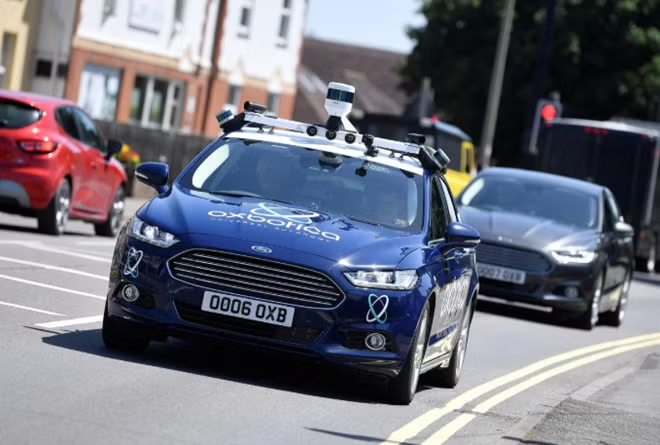
The company has been testing its software in a Ford Mondeo crowned with assorted cameras and sensors on the busy streets of the city, driving the same loop, down the high street and past the Red Lion pub, five times a day for three months.
Repeating different circuits over and over again with its fleet of cars gives the company a baseline to measure its progress, and in tricky areas it allows the software to come up with new data relevant to a specific place, Newman said.
 |
“The negotiations one has to do with bicyclists and undergraduates in the early hours - around streets that frankly were designed for ponies - in these European cities is a little bit different,” he said.
The firm now plans to open offices in North America and China, and aims to launch a self-driving taxi service in 2021 in London on specific routes - with a safety driver present - as part of a consortium working with cab company Addison Lee.
Oxbotica’s public road trials are labor-intensive and costly, and demonstrate the extent of the challenge facing companies aspiring to take on Waymo and Uber on a shoestring.
Like Wayve and FiveAI, Oxbotica is making do with a fraction of the funding doled out in the United States to futuristic transport companies. It has received funding of 22.6 million pounds ($28 million), while FiveAI has raised $37.7 million, according to the latest figures from Crunchbase.
By way of comparison, General Motors’ (GM.N) self-driving division Cruise raised $1.15 billion in May in new equity, valuing the unit at $19 billion, while California-based driverless delivery startup Nuro raised $940 million in February.
The amount of venture capital funding going into autonomous car and tech companies in Europe doubled in 2018, but was still a tiny fraction of the amount pumped into U.S. startups. The European firms pulled in $89 million last year, just 2% of the venture capital funding collected by U.S. companies, according to data from CB Insights.
RAIN STOPS PLAY
U.S. startups may benefit from generous funding but Europeans argue the yawning gap in financing – coupled with the particular regional needs - has pushed them to find cheaper ways to plug the technological gaps.
Lidar, for example, the laser pulse technology used widely in U.S. autonomous cars, struggles to paint an accurate picture of a vehicle’s surroundings once rain, fog or snow set in - so developers in Europe are testing a range of other tools.
“The challenges we have to solve here are subtly different and that calls for a different set of sensors ... and more emphasis on image and video processing, use of visual techniques for localization,” said Stan Boland, founder and CEO of FiveAI,
“The deterioration of lidar in the rain is pretty horrendous,” said Boland.
FiveAI started road tests in the London boroughs of Bromley and Croydon this year and hopes to launch passenger trials in 2020. Its long-term objective is to operate an autonomous vehicle fleet to complement public transport.
While Oxbotica’s Newman and Boland argue that lidar has a role to play - alongside other sensors and cameras - Wayve, an autonomous driving company based in the university city of Cambridge, insists the laser technology is unnecessary.
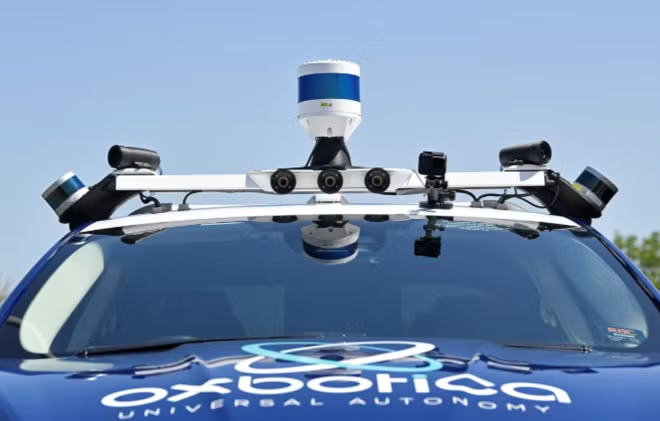 |
Wayve co-founder Amar Shah said recent improvements meant you could now get reliable relative depth estimates using cameras alone, and that would be far cheaper and more reliable when it comes to mass producing self-driving cars.
He said Wayve would be looking for partnerships in the near future with car makers, suppliers and any other bodies such as regulators involved in developing a driverless future. He also shrugged off the idea companies such as Waymo and Cruise would pose a serious threat with their bigger financial clout.
“They’ve spent ten years in Phoenix, Arizona and can barely get out of there, so how can they come to Europe?” said Shah.
‘AUTONOMY WINTER’
Nevertheless, analysts and consultants paint a future dominated by companies such as Uber and Waymo with massive fleets offering cheap monthly subscriptions for on-demand, self-driving vehicles. But full autonomy could still be years away.
“From the first idea that this will happen fairly quickly, now the autonomy winter has come,” said Arthur Kipferler, partner at automotive consultancy Berylls Strategy Advisors.
The challenges the technology faces were highlighted when a pedestrian was killed in March 2018 by a self-driving car being tested by Uber. The incident caused a temporary halt to Uber’s development program.
“When you get on the ground and you go on a test drive in autonomous vehicles, whether it’s in San Francisco or in China, in unfamiliar, complex urban environments, they’re still a ways off in terms of getting to full autonomy,” said Deborah Orida, global head of active equities at Canada Pension Plan Investment Board, which has invested in self-driving startups Aurora and Zoox.
For European start-ups, wariness on the part of investors about promises of one-size-fits-all autonomy could be an opportunity to sell their message.
But while they may see self-driving as a fundamentally regional challenge, others are critical of their localized approach, saying the U.S. giants will win out by ensuring commercially viable services first.
“If you want a business, I think you need to go where it’s easier, do it fairly quickly and then scale up, learn, and go to the next level of difficulty,” said Kipferler at Berylls.
“If you’re in it for the research side then test it in central London or Mumbai or Delhi - and you will never have a commercial service but you will have the research.