Facebook stored hundreds of millions of passwords unprotected

Facebook mistakenly stored “hundreds of millions” of passwords in plaintext, unprotected by any encryption, the company has admitted.

The mistake, which led to user passwords being kept in Facebook’s internal servers in an insecure way, affects “hundreds of millions of Facebook Lite users, tens of millions of other Facebook users, and tens of thousands of Instagram users”, according to the social networking site. Facebook Lite is a version of Facebook created for use in nations where mobile data is unaffordable or unavailable.

In a statement, Facebook’s vice-president for engineering, security and privacy, Pedro Canahuati, said: “We have found no evidence to date that anyone internally abused or improperly accessed” the passwords, which “were never visible to anyone outside of Facebook”. Affected users will be directly notified.

Nonetheless, the risk of misuse was high. According to security reporter Brian Krebs, who cited a “senior Facebook insider”, “access logs showed some 2,000 engineers or developers made approximately nine million internal queries for data elements that contained plaintext user passwords”.
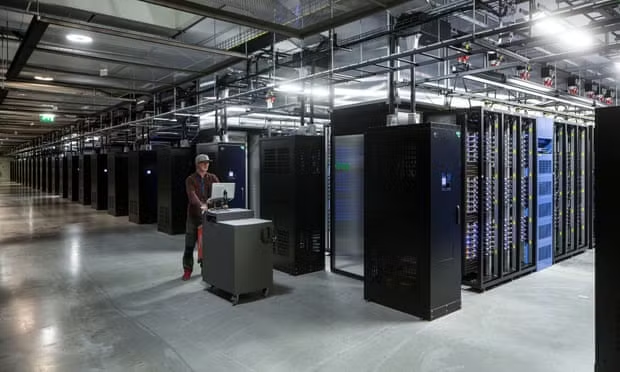
Facebook’s data centre in Sweden. Passwords were kept on the company’s servers in an insecure way. Photograph: David Levene/The Guardian
 Facebook’s data centre in Sweden. Passwords were kept on the company’s servers in an insecure way. Photograph: David Levene/The Guardian

Best practice for password security involves a number of precautions to ensure that, even if the company is hacked, stolen passwords cannot be used. Passwords should be “hashed”, a one-way process which transforms every password into a unique “hash”, and ideally “salted”, ensuring that even two identical passwords produce different hashes. Those are the security practices that Facebook normally takes, and which were overlooked in this case.

Canahuati said Facebook has now fixed this particular issue, as well as some problems the company has discovered in other security features, such as the code by which users log in through other apps.

The information commissioner’s office warns companies: “Do not store passwords in plaintext – make sure you use a suitable hashing algorithm, or another mechanism that offers an equivalent level of protection against an attacker deriving the original password.

“You should also ensure that the architecture around your password system does not allow for any inadvertent leaking of passwords in plaintext.” The guidance refers to the exact sort of error that Facebook admitted to on Thursday.

The ICO has not issued a fine purely for storing passwords in an insecure fashion, although it has cited insecure storage as an aggravating factor when penalising more serious data protection breaches.

The Guardian

Other News

Vietnam targets at least 10 large strategic technology firms by 2030

Vietnam targets at least 10 large strategic technology firms by 2030

Deputy Prime Minister Ho Quoc Dung has signed a decision approving a plan to develop large domestic strategic technology enterprises in the 2026–2030 period, aimed at advancing digital infrastructure, digital human resources, digital data, strategic technologies and cybersecurity.

Protecting users crucial in building digital trust: Experts

Protecting users crucial in building digital trust: Experts

In Vietnam, digital transformation in the finance and banking sector is accelerating cashless payments, expanding access to financial services, improving market transparency and supporting economic growth and macroeconomic management.

Fostering skilled workforce for innovation era: experts

Fostering skilled workforce for innovation era: experts

Experts said close coordination among State management agencies, research institutes, universities, and businesses will improve training quality and serve the dual goals of quality education and practical research application.

Startup forum bridges Silicon Valley and local innovation ecosystem

Startup forum bridges Silicon Valley and local innovation ecosystem

The University of Economics Ho Chi Minh City (UEH), Saigon Asset Management (SAM), and Plug and Play Tech Centre co-hosted the “From Vietnam to Silicon Valley” forum, exploring AI innovation, venture capital, and pathways to integrate Vietnam’s startup ecosystem with Silicon Valley and global markets.

Experts call for stronger action against fake news online

Experts call for stronger action against fake news online

Experts have warned that fake news, misinformation and harmful online content are increasingly shaping public perceptions, particularly among young people, and stressed the need for stronger legal safeguards, technology tools and wider dissemination of credible information to tackle the problem effectively.

Protecting digital future in post-quantum, AI era

Protecting digital future in post-quantum, AI era

Participants highlighted the importance of building a proactive, synchronised and sustainable national cybersecurity ecosystem through closer cooperation among regulators, technology firms, research institutions and cybersecurity experts.

Vietnam attends SAHA 2026 defence, aerospace exhibition in Türkiye

Vietnam attends SAHA 2026 defence, aerospace exhibition in Türkiye

Vietnam’s participation in SAHA 2026 International Defence & Aerospace Exhibition in Istanbul reflects the country’s consistent policy of enhancing international defence integration and promoting defence industry cooperation towards self-reliance, self-strengthening, modernisation and dual-use development.

SK Group partners to build AI ecosystem in Vietnam

SK Group partners to build AI ecosystem in Vietnam

SK Innovation and SK Telecom signed MoUs with Nghe An province and the National Innovation Centre of Vietnam to advance AI ecosystem development and support the country’s long-term growth strategy.

Vietnam Research Excellence Fellowship for 2026-2030 approved

Vietnam Research Excellence Fellowship for 2026-2030 approved

Under the Vietnam Research Excellence Fellowship (VREF) for the 2026–2030 period, PhD students are identified as a core research force directly contributing to breakthroughs in sci-tech and innovation. Investing in top-tier doctoral candidates is more than workforce development, but a high-stakes strategic bet to forge a cohort of world-class scientists and technologists who can power Vietnam’s long-term economic ambitions.