Facebook to integrate Instagram, Messenger and WhatsApp

Facebook is reportedly considering a merger of its three messaging platforms – WhatsApp, Instagram and Facebook Messenger – allowing users to send messages between the networks for the first time.

The plans are said to come directly from the Facebook chief executive, Mark Zuckerberg, the New York Times has reported, and would involve rewriting the basic software of the three apps to ensure they were interoperable. A WhatsApp user would be able to, for instance, text an Instagram user for the first time without needing to switch applications.

That rewrite would also involve enabling end-to-end encryption (E2E) on all three apps, according to the NYT’s Mike Isaac. While all WhatsApp messages use that security feature, which prevents anyone, including Facebook itself, from intercepting the contents of messages, support across Facebook’s wider business is patchy. Facebook Messenger only supports E2E in a special “secure conversations” mode, which is off by default and must be enabled separately for every chat, while Instagram features no encryption at all.

While E2E is a valuable security measure for users, it has the side effect of preventing Facebook from scanning messages as part of its advertising business. The technology has also come under attack from law enforcement organisations, since it hinders their ability to intercept suspect communications in real time.

The merger of Facebook’s three platforms would allow users to send encrypted messages. Photograph: Ritchie B Tongo/EPA

In a statement, Facebook told the Guardian: “We want to build the best messaging experiences we can; and people want messaging to be fast, simple, reliable and private.

“We’re working on making more of our messaging products end-to-end encrypted and considering ways to make it easier to reach friends and family across networks. As you would expect, there is a lot of discussion and debate as we begin the long process of figuring out all the details of how this will work.”

The news has raised concerns among both privacy researchers and antitrust experts.

Matthew Green, a cryptography professor at Johns Hopkins University, said the change “could be potentially be good or bad for security/privacy”.

He added: “But given recent history and financial motivations of Facebook, I wouldn’t bet my lunch money on ‘good’. Now is a great time to start moving important conversations off those services.”

In a thread on Twitter, Green wrote that his two major concerns were that the widespread rollout of E2E could result in WhatsApp getting comparatively less secure, rather than Facebook Messenger and Instagram becoming as secure as possible; and that WhatsApp users, who currently do not need to share much personal information at all with Facebook, may find their metadata co-mingled with their broader Facebook accounts.

Mark Zuckerberg, the Facebook CEO, is reported to have come up with the idea to merge the messaging platforms. Photograph: Marcio José Sánchez/AP
  Mark Zuckerberg, the Facebook CEO, is reported to have come up with the idea to merge the messaging platforms. Photograph: Marcio José Sánchez/AP

For similar reasons, the attempts to merge the networks could hit a stumbling block in Europe, where Facebook has once before been prevented from transferring data from WhatsApp to Facebook’s main service. In November 2016, the company was forced to halt a transfer of data following complaints from the pan-European data protection agency. The company was also forced by the UK’s information commissioner to promise not to do any transfers of EU user data until after the general data protection regulation (GDPR) came into force on 25 May 2018.
The Guardian

Other News

Hanoi approves controlled pilot of two technology projects

Hanoi approves controlled pilot of two technology projects

The two projects involve an intelligent autonomous transportation system developed by Phenikaa-X JSC and a technology for producing mixed rare-earth oxides with a purity of over 95% on a semi-industrial scale developed by the Mining Technology and Construction Consultancy JSC.

Banking industry in AI era: When data becomes competitive advantage

Banking industry in AI era: When data becomes competitive advantage

In just a few years, AI has evolved from an experimental technology into an “assistant” for many banks, supporting everything from customer service, credit approval, and fraud detection to risk management. However, as the technological gap between institutions narrows, a new question is emerging: What will determine banks' competitive advantage in the AI era?

Bac Ninh considers establishing AI centre of excellence

Bac Ninh considers establishing AI centre of excellence

A meeting has been held in Bac Ninh to discuss potential cooperation with Plug and Play in developing the northern province’s innovation ecosystem and establishing an artificial intelligence (AI) centre of excellence, with Standing Vice Chairman of the provincial People’s Committee Mai Son receiving a delegation from the global innovation platform.

Hanoi allows 24-month trial of autonomous vehicles at Hoa Lac

Hanoi allows 24-month trial of autonomous vehicles at Hoa Lac

The project aims to assess the safety, reliability and readiness of autonomous vehicles under real traffic conditions, as well as the effectiveness of autonomous public transport and compatibility with existing systems. Its results will contribute to developing technical standards, operating procedures and management models suited to Hanoi’s traffic conditions.

Singapore's experience suggests solutions to Vietnam's human resources challenge in AI era

Singapore's experience suggests solutions to Vietnam's human resources challenge in AI era

As Vietnam accelerates digital transformation and high-tech development, Singapore’s experience and the engagement of global technology companies demonstrate that human resources preparation must stay ahead of the curve. The ability to filter knowledge, collaborate, innovate and effectively use AI will increasingly become essential to helping workers adapt to a changing labour market and strengthening the competitiveness of Vietnam’s economy in the new era.

Protecting national security amid digital transformation, cyberspace

Protecting national security amid digital transformation, cyberspace

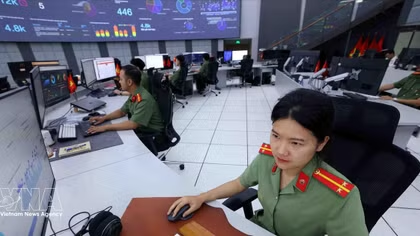
Cybersecurity, information security and data security risks must be identified and addressed early and from afar, with appropriate defensive measures ready to neutralise threats and protect national interests in cyberspace, said Lieutenant General Le Xuan Minh, Director of the Ministry of Public Security’s Department of Cybersecurity and Hi-tech Crime Prevention (A05).

Mekong Delta launches first robotics, AI research institute

Mekong Delta launches first robotics, AI research institute

Dr. Nguyen Van Quang, Rector of Nam Can Tho University, said the university is developing a value chain covering training, research, technology development, testing, technology transfer and commercialisation. The model is designed to link research more closely with practical needs, ensuring that technologies generate products and products create value for society.

Vietnam positioned to harness AI wave, World Bank report says

Vietnam positioned to harness AI wave, World Bank report says

The WB report identifies Vietnam as one of the few economies outside the European Union (EU) to have adopted a comprehensive AI regulatory framework as early as 2025. Vietnam applies a risk-tiered approach similar to that of the EU AI Act, imposing different obligations depending on whether an AI system poses “unacceptable,” “high,” “low” or “minimal” risks. The approach is viewed as a strategic step towards ensuring safe and transparent AI governance.

AI offers both opportunities, challenges for Vietnam's growth

AI offers both opportunities, challenges for Vietnam's growth

Dr. Ho Duc Thang, a full-time member of the National Assembly’s Committee for Cultural and Educational, said productivity is the key to sustaining double-digit economic growth, and AI has greater potential to improve productivity than any previous technology.

Top leader unveils people-centred vision for new development model

Top leader unveils people-centred vision for new development model

Vietnam's growth model, long fueled by low-cost labour, resource extraction, contract manufacturing, expanded investment, and capital accumulation, has run out of road. The country now needs a sweeping reform agenda to shift from extensive growth to a model driven by productivity, knowledge, science and technology, innovation, and digital transformation.