GPs could use breast cancer 'calculator' to predict risk to women

Women may be able to go to their GP to find out their risk of getting breast cancer and choose whether or not to be screened, if a new online calculator devised by scientists is successful.

Cancer Research UK scientists have worked out a way to assess women’s chances of developing the disease on the basis of both genetic data and lifestyle risks. They hope to offer a reasonably good prediction by combining information on family history and genetics with other factors such as weight, age at menopause, alcohol consumption and use of hormone replacement therapy.
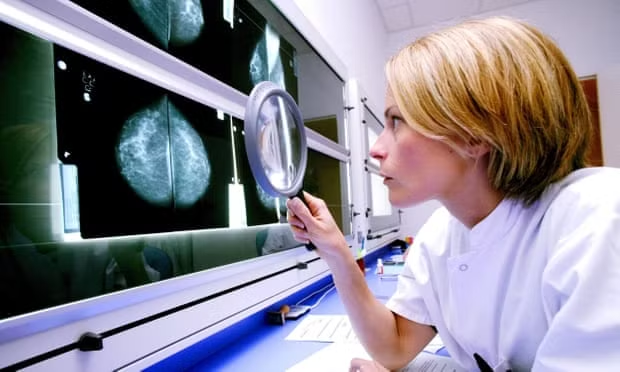
A radiologist examines mammograms on a lightbox with a magnifier. Photograph: REX/Shutterstock
 A radiologist examines mammograms on a lightbox with a magnifier. Photograph: REX/Shutterstock

Many lifestyle risk factors for breast cancer are known, but each one individually often does not add up to much. The cumulative effect, however, may be much more significant. The same applies to genes. Two inherited genes – BRCA1 and BRCA2 – give women a 50% chance of breast cancer. But there are many other genes that are now thought to play a small part. The researchers, for their risk assessment, have taken into account 300 different genes that could be identified.

“This is the first time that anyone has combined so many elements into one breast cancer prediction tool,” said Prof Antonis Antoniou, the lead author of the research at the University of Cambridge.

He added: “It could be a game changer for breast cancer because now we can identify large numbers of women with different levels of risk – not just women who are at high risk.

“This should help doctors to tailor the care they provide depending on their patients’ level of risk. For example, some women may need additional appointments with their doctor to discuss screening or prevention options and others may just need advice on their lifestyle and diet.

“We hope this means more people can be diagnosed early and survive their disease for longer, but more research and trials are needed before we will fully understand how this could be used.”

The researchers, who have published a paper in the journal Genetics in Medicine, have been hoping that a few GP practices would try out the risk assessment tool later this year.

A large proportion of the 55,000 breast cancers diagnosed each year in the NHS have been in women at increased risk of the disease. If the calculator works well, it could lead to more of those at risk being identified early, when they could be successfully treated.

It would also mean that breast cancer screening, through mammograms, could be more accurately targeted. Not all women want to be screened, at present, because of the risk of being wrongly diagnosed with cancer. The calculator may help women decide whether they want to be screened or not.
The Guardian

Other News

AI offers both opportunities, challenges for Vietnam's growth

AI offers both opportunities, challenges for Vietnam's growth

Dr. Ho Duc Thang, a full-time member of the National Assembly’s Committee for Cultural and Educational, said productivity is the key to sustaining double-digit economic growth, and AI has greater potential to improve productivity than any previous technology.

Top leader unveils people-centred vision for new development model

Top leader unveils people-centred vision for new development model

Vietnam's growth model, long fueled by low-cost labour, resource extraction, contract manufacturing, expanded investment, and capital accumulation, has run out of road. The country now needs a sweeping reform agenda to shift from extensive growth to a model driven by productivity, knowledge, science and technology, innovation, and digital transformation.

First national semiconductor chip prototyping support centre makes debut

First national semiconductor chip prototyping support centre makes debut

Vietnam's semiconductor ecosystem now comprises around 60 chip design companies, some 7,000 chip design engineers and 166 universities offering semiconductor-related training programmes. Initial registrations from 12 organisations indicate demand for the prototyping of approximately 30,000 chips.

Vietnam targets at least 10 large strategic technology firms by 2030

Vietnam targets at least 10 large strategic technology firms by 2030

Deputy Prime Minister Ho Quoc Dung has signed a decision approving a plan to develop large domestic strategic technology enterprises in the 2026–2030 period, aimed at advancing digital infrastructure, digital human resources, digital data, strategic technologies and cybersecurity.

Protecting users crucial in building digital trust: Experts

Protecting users crucial in building digital trust: Experts

In Vietnam, digital transformation in the finance and banking sector is accelerating cashless payments, expanding access to financial services, improving market transparency and supporting economic growth and macroeconomic management.

Fostering skilled workforce for innovation era: experts

Fostering skilled workforce for innovation era: experts

Experts said close coordination among State management agencies, research institutes, universities, and businesses will improve training quality and serve the dual goals of quality education and practical research application.

Startup forum bridges Silicon Valley and local innovation ecosystem

Startup forum bridges Silicon Valley and local innovation ecosystem

The University of Economics Ho Chi Minh City (UEH), Saigon Asset Management (SAM), and Plug and Play Tech Centre co-hosted the “From Vietnam to Silicon Valley” forum, exploring AI innovation, venture capital, and pathways to integrate Vietnam’s startup ecosystem with Silicon Valley and global markets.

Experts call for stronger action against fake news online

Experts call for stronger action against fake news online

Experts have warned that fake news, misinformation and harmful online content are increasingly shaping public perceptions, particularly among young people, and stressed the need for stronger legal safeguards, technology tools and wider dissemination of credible information to tackle the problem effectively.

Protecting digital future in post-quantum, AI era

Protecting digital future in post-quantum, AI era

Participants highlighted the importance of building a proactive, synchronised and sustainable national cybersecurity ecosystem through closer cooperation among regulators, technology firms, research institutions and cybersecurity experts.