Healthy mice with same-sex parents born for first time

Healthy mice with two mothers have been born for the first time in a study that pushes the boundaries of reproductive science.

Mice with two fathers were also born, but only survived a couple of days, the Chinese team behind the work reported. There is no imminent prospect of the techniques being used clinically in people, but the findings demonstrate that the biological barriers to same-sex reproduction can, technically, be overcome.

“This shows us what’s possible,” said Wei Li, of the Chinese Academy of Sciences and a senior author of the paper.

Scientists have previously managed to produce baby mice with same-sex parents, but the offspring had serious abnormalities and the methods used often required convoluted sequences of genetic manipulations, sometimes involving several generations of mice.
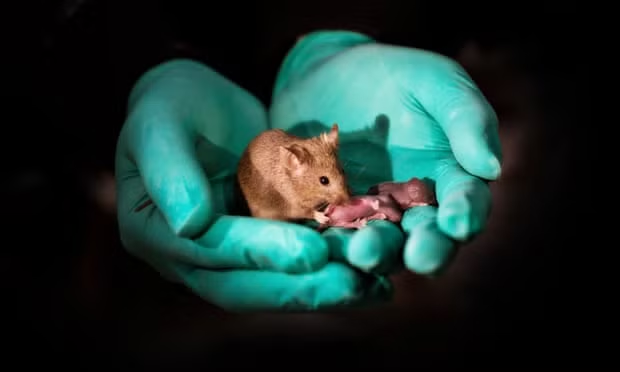
One of the healthy bimaternal mice created in the study with offspring of her own. Photograph: Leyun Wang/Cell Stem Cell

The work explores a long-standing question in biology: that of why in mammals, equal genetic contributions from both a mother and a father are necessary. Elsewhere in the animal kingdom – in hammerhead sharks and komodo dragons, for instance – no genetic contribution from a father is required.

A major barrier in mammals is a phenomenon known as “imprinting”, where for 100 or so genes only the copy that came from the mother or only the copy that came from the father are ever switched on. In the genome, maternal and paternal contributions are all jumbled together but these genes carry a chemical tag, labelling which parent the gene originated from in the first place.

Without the right pattern of male and female imprinting, a viable embryo cannot be produced.

The latest paper demonstrates how this apparent barrier could be overcome. For the mice with two mothers, the scientists started off with embryonic stem cells from a female mouse. Using the gene-editing tool Crispr-Cas9, they were able to remove maternal imprinting from three crucial regions of DNA by snipping out a single letter of the genetic code where the chemical tag was attached. This effectively made the genetic material appear more “male” in terms of its imprinting pattern.

When the modified stem cells were injected into the unfertilised egg of a second female mouse, the genetic material from the two female mice combined to form an embryo.

They produced 29 live mice from 210 embryos. The mice were normal, lived to adulthood and had babies of their own.

A similar experiment was performed using sperm and genetically modified stem cells from a male mouse, which were injected into a female egg that had been stripped of its own genetic material. These embryos were transferred to surrogate mothers, who carried them to term. But the pups only survived 48 hours after birth.

There is good evidence that imprinting plays a similar role in human reproduction, although involving some different genes. However, there is no prospect of this strategy being applied in the clinic as there would be serious concerns about the side-effects of modifying genes which are known to be crucial for basic development.

“It is unthinkable to generate a human baby that way,” said Christophe Galichet, senior scientist, at The Francis Crick Institute in London. “The authors have made an extremely important step forward in understanding why mammals can only reproduce sexually,” he added.

Prof Azim Surani, director of germline and epigenomics research at the Gurdon Institute, University of Cambridge, said: “The comprehensive nature of the manipulations involved rules out – at least for now – any such attempts to generate bi-maternal human embryos. The bi-paternal embryos in this experiment, in any case, did not survive for long”.


The Guardian

Other News

Vietnam targets at least 10 large strategic technology firms by 2030

Vietnam targets at least 10 large strategic technology firms by 2030

Deputy Prime Minister Ho Quoc Dung has signed a decision approving a plan to develop large domestic strategic technology enterprises in the 2026–2030 period, aimed at advancing digital infrastructure, digital human resources, digital data, strategic technologies and cybersecurity.

Protecting users crucial in building digital trust: Experts

Protecting users crucial in building digital trust: Experts

In Vietnam, digital transformation in the finance and banking sector is accelerating cashless payments, expanding access to financial services, improving market transparency and supporting economic growth and macroeconomic management.

Fostering skilled workforce for innovation era: experts

Fostering skilled workforce for innovation era: experts

Experts said close coordination among State management agencies, research institutes, universities, and businesses will improve training quality and serve the dual goals of quality education and practical research application.

Startup forum bridges Silicon Valley and local innovation ecosystem

Startup forum bridges Silicon Valley and local innovation ecosystem

The University of Economics Ho Chi Minh City (UEH), Saigon Asset Management (SAM), and Plug and Play Tech Centre co-hosted the “From Vietnam to Silicon Valley” forum, exploring AI innovation, venture capital, and pathways to integrate Vietnam’s startup ecosystem with Silicon Valley and global markets.

Experts call for stronger action against fake news online

Experts call for stronger action against fake news online

Experts have warned that fake news, misinformation and harmful online content are increasingly shaping public perceptions, particularly among young people, and stressed the need for stronger legal safeguards, technology tools and wider dissemination of credible information to tackle the problem effectively.

Protecting digital future in post-quantum, AI era

Protecting digital future in post-quantum, AI era

Participants highlighted the importance of building a proactive, synchronised and sustainable national cybersecurity ecosystem through closer cooperation among regulators, technology firms, research institutions and cybersecurity experts.

Vietnam attends SAHA 2026 defence, aerospace exhibition in Türkiye

Vietnam attends SAHA 2026 defence, aerospace exhibition in Türkiye

Vietnam’s participation in SAHA 2026 International Defence & Aerospace Exhibition in Istanbul reflects the country’s consistent policy of enhancing international defence integration and promoting defence industry cooperation towards self-reliance, self-strengthening, modernisation and dual-use development.

SK Group partners to build AI ecosystem in Vietnam

SK Group partners to build AI ecosystem in Vietnam

SK Innovation and SK Telecom signed MoUs with Nghe An province and the National Innovation Centre of Vietnam to advance AI ecosystem development and support the country’s long-term growth strategy.

Vietnam Research Excellence Fellowship for 2026-2030 approved

Vietnam Research Excellence Fellowship for 2026-2030 approved

Under the Vietnam Research Excellence Fellowship (VREF) for the 2026–2030 period, PhD students are identified as a core research force directly contributing to breakthroughs in sci-tech and innovation. Investing in top-tier doctoral candidates is more than workforce development, but a high-stakes strategic bet to forge a cohort of world-class scientists and technologists who can power Vietnam’s long-term economic ambitions.