Incoming! Lunar Study Reveals Big Increase in Major Asteroid Strikes on Earth

A new study has revealed that large asteroids have been striking Earth more than twice as often in the past 290 million years as they did in the 400 million years before that. The evidence wasn’t to be found here, though, but on the moon. Don’t worry, the chances of us getting hit are still one-in-a-million.

A study published Thursday in Science shed new light on the patterns of extraterrestrial impact the Earth has been subjected to in the last billion or so years of its existence. In an interesting twist, the answer wasn't found by looking for Earth craters at all, but moon craters.

The problem with studying really old craters on Earth is that, for the most part, they just aren't there. However, the moon takes just as many hits as we do, but doesn't have the disruptive weather and geological patterns the Earth does, so evidence of its pummelling by space rocks lasts much longer.
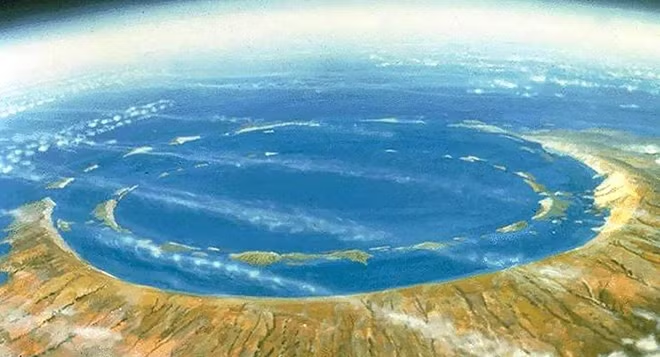
Photo: Wikipedia.
Photo: Wikipedia. 

"The only obstacle to doing this has been finding an accurate way to date large craters on the moon," William Bottke, study co-author and asteroid expert at the Southwest Research Institute, said in a Thursday statement.

Using data from NASA's Lunar Reconnaissance Orbiter, they were able to determine the rate that craters break down and — surprise! — the problem isn't that the older craters are hard to find, it's that they were never there to begin with. There's just plain fewer of them.

The study compiled a list of asteroid strikes on both bodies that created craters wider than 12 miles across and assigned them dates. Researchers found 29 craters formed less than 290 million years ago and nine between 291 and 650 million years ago. By accounting for craters that would presently be underwater or erased by Earth forces, they concluded there should have been 260 big meteor hits in the last 290 million years, which is 2.6 times more often than in the prior period.

It's still, thankfully, a rate of slightly less than one big hit per million years. The most recent crater of this size is most likely that which formed Karakul, a lake at the bottom of a 32 mile-wide impact crater in the mountains of Tajikistan, variously dated between 2.6 million to 25 million years ago, according to a 1993 paper in Lunar and Planetary Science.

"This means that the Earth has fewer older craters on its most stable regions not because of erosion, but because the impact rate was lower prior to 290 million years ago," Bottke said. "The moon is like a time capsule, helping us understand the Earth. We found that the moon shared a similar bombardment history, which meant the answer to Earth's impact rate was staring everyone right in the face."

"It's just a game of probabilities," the study's lead author, Sara Mazrouei, told The Hill, noting that a series of large collisions in the Asteroid Belt, between Mars and Jupiter, could be to blame for the increase. "These events are still rare and far between that I'm not too worried about it."
Sputnik News

Other News

SK Group partners to build AI ecosystem in Vietnam

SK Group partners to build AI ecosystem in Vietnam

SK Innovation and SK Telecom signed MoUs with Nghe An province and the National Innovation Centre of Vietnam to advance AI ecosystem development and support the country’s long-term growth strategy.

Vietnam Research Excellence Fellowship for 2026-2030 approved

Vietnam Research Excellence Fellowship for 2026-2030 approved

Under the Vietnam Research Excellence Fellowship (VREF) for the 2026–2030 period, PhD students are identified as a core research force directly contributing to breakthroughs in sci-tech and innovation. Investing in top-tier doctoral candidates is more than workforce development, but a high-stakes strategic bet to forge a cohort of world-class scientists and technologists who can power Vietnam’s long-term economic ambitions.

Strategic tech must address practical challenges: PM

Strategic tech must address practical challenges: PM

Prime Minister Pham Minh Chinh on March 28 said strategic technologies must tackle Vietnam’s practical challenges, while chairing a meeting of the Government’s Steering Committee for science and technology, innovation, digital transformation, and Project 06.

Ho Chi Minh City sets sights on becoming semiconductor hub

Ho Chi Minh City sets sights on becoming semiconductor hub

Ho Chi Minh City is stepping up efforts to attract investment from global leading groups and companies in the fields of electronic components, semiconductors and chip manufacturing as it seeks to position itself as a leading semiconductor industry hub in both the region and the world. 

Ho Chi Minh City launches upgraded technology exchange platform

Ho Chi Minh City launches upgraded technology exchange platform

The upgraded platform represents a comprehensive shift from a simple information-sharing model to a managed online technology trading system, enabling monitoring and measurement of real transaction outcomes. It is built on three pillars, namely new tradable technology products, a modern digital platform, and an improved operational model.

AI – unmissable opportunity for Vietnam: Experts

AI – unmissable opportunity for Vietnam: Experts

AI also emerges as a key enabler for Vietnam's ambition to build financial and technology hubs. Applications can boost efficiency, automate workflows, cut costs, and sharpen data analytics, which are essential pillars of a modern financial system.

PM calls for accelerated space technology development in Vietnam

PM calls for accelerated space technology development in Vietnam

Vietnam aims by 2030 to achieve a mid-level position in space science and technology development within Southeast Asia, and after 2030 to build national capabilities to independently develop satellite technologies and apply space data to address global challenges and national security needs.

High-level forum advances Vietnam–US technological cooperation

High-level forum advances Vietnam–US technological cooperation

A high-level executive leadership forum focusing on strengthening Vietnam - US relations through technology cooperation was jointly held in Washington D.C. on March 11 by the Embassy of Vietnam in the US, the Weatherhead East Asian Institute of Columbia University, and the US -ASEAN Business Council (USABC). 

AI Law takes effect, anchors national governance framework

AI Law takes effect, anchors national governance framework

While many countries are still drafting policy blueprints or issuing non-binding guidance, Vietnam has moved ahead with a standalone Law on Artificial Intelligence (AI), effective from March 1, placing it among a select group of nations to adopt dedicated AI legislation at the parliamentary level. 

Vietnam International Defence Expo 2026 preparations move into high gear

Vietnam International Defence Expo 2026 preparations move into high gear

Vietnam International Defence Expo 2026, themed “Peace, Friendship, Cooperation and Development,” will be organised on a larger scale, featuring a wide array of weapons and technical equipment alongside product exhibitions, seminars and panel discussions, drills, live field demonstrations, and business networking activities.

Ministry requests urgent measures to counter UAVs threatening aviation safety

Ministry requests urgent measures to counter UAVs threatening aviation safety

Ministry of Construction requested the Ministry of National Defence, the Ministry of Public Security and provincial and municipal steering committees for counter-terrorism to strengthen the management, inspection and supervision of UAVs and other aerial devices, ensuring strict compliance with Decree No. 288/2025/ND-CP and relevant legal regulations.