Inside Shanghai's robot bank: China opens world's first human-free branch

Xiao Long, the latest employee at the Jiujiang Road branch of the China Construction Bank is never late for work. “Welcome to China Construction Bank,” she chirps to customers arriving at the Shanghai branch, flashing her white teeth. “What can I help you with today?”

Xiao Long, or “Little Dragon”, is not your typical employee – she’s a robot at China’s first fully automated, human-free bank branch.

As guardian of the bank, she talks to customers, takes bank cards and checks accounts (she comes complete with a PIN pad) and can answer basic questions. After a quick initial chat with Xiao Long, customers pass through electronic gates where their faces and ID cards are scanned. On future visits, facial recognition alone is enough to open the gates and call up customer information.
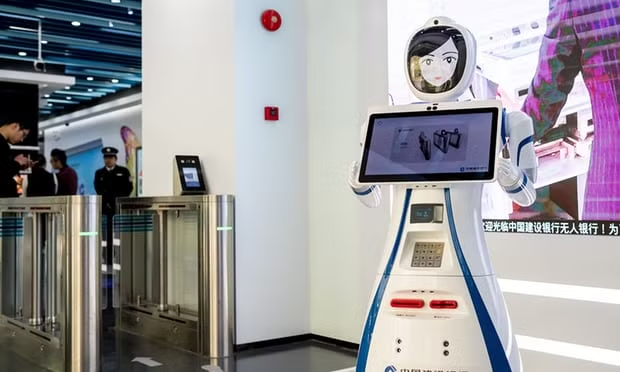
Pay pal … Xiao Lang, or Little Dragon, at the China Construction Bank on Jiujiang Road, Shanghai. Photograph: Imaginechina/Rex/Shutterstock

Inside, automated teller machines help with services such as account opening, money transfer and foreign exchange. A second robot waits inside the barriers, and there is a VR room and video-link should customers want to talk to a mortal.

The bank is rather low on customers, who in the main appear rather ambivalent. One man in his 30s shrugs that he does most of his banking online anyway, and avoids coming into branches – though at least he didn’t have to queue.

Robot waiters, robot guards
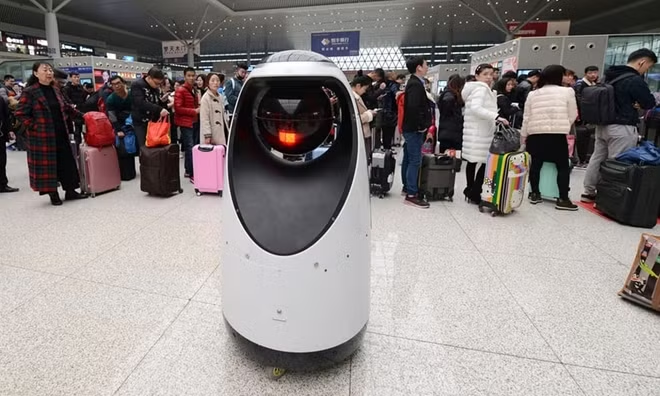
A police patrol robot at Zhengzhou East railway station. Photograph: VCG via Getty Images

Robots are handling more and more aspects of everyday life in Chinese cities. They have been deployed in train stations for security purposes; robot security guards at Zhengzhou East railway station are programmed to scan travellers’ faces and respond to common questions.

The chief executive of Chinese e-commerce giant JD.com recently predicted that robots will eventually replace human workers in the retail industry, with China’s unmanned retail sector expected to triple in size to 65bn yuan (£7.5bn) by 2020, according to iResearch.

Robots are being used to cook – both in restaurants and industrial kitchens – and a video of an entirely automated dumpling factory went viral on Chinese social media last year.

Robot waiters have been a fad for a number of years, with restaurants keen to draw customers with novel experiences, as well as saving on staff costs. Robotic waiters can be frustratingly slow for hungry diners though. Most move along pre-programmed tracks, and for some restaurants they have proved more trouble than they’re worth.
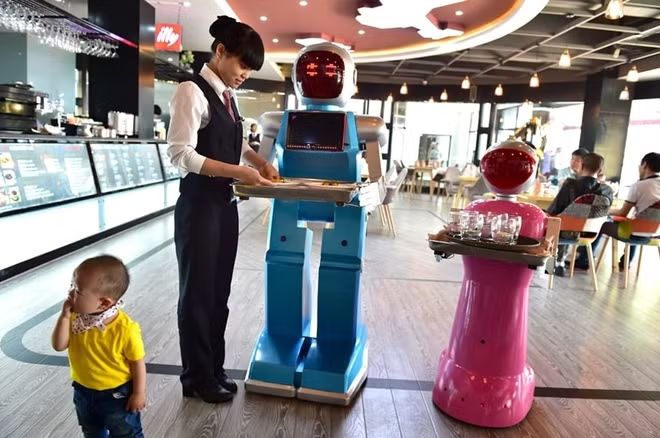
Novelty value … a couple of AI waiters, Little Blue and Little Peach, at a robot-themed restaurant in Yiwu. Photograph: VCG via Getty Images

But the rise of China’s robot industry is a core part of Beijing’s economic ambitions. Beijing’s Robotics Industry Development Plan is a five-year programme that targets the production of at least 100,000 industrial robots a year by 2020, partly to reboot the country’s ailing manufacturing sector.

“In AI and robotics, China clearly is interested in emerging as a global leader,” says Professor Yu Zhou at the department of earth science and geography at Vassar College. “Moving up the value chain is what is really behind China’s move into robots. Working wages have been increasing and there have been shortages of low-level labour.

“You have to replace this labour, and automation and robots became a natural area to look into. Robots are really seen as an upgrade – better products, more efficient and cheaper.”
The Guardian

Other News

SK Group partners to build AI ecosystem in Vietnam

SK Group partners to build AI ecosystem in Vietnam

SK Innovation and SK Telecom signed MoUs with Nghe An province and the National Innovation Centre of Vietnam to advance AI ecosystem development and support the country’s long-term growth strategy.

Vietnam Research Excellence Fellowship for 2026-2030 approved

Vietnam Research Excellence Fellowship for 2026-2030 approved

Under the Vietnam Research Excellence Fellowship (VREF) for the 2026–2030 period, PhD students are identified as a core research force directly contributing to breakthroughs in sci-tech and innovation. Investing in top-tier doctoral candidates is more than workforce development, but a high-stakes strategic bet to forge a cohort of world-class scientists and technologists who can power Vietnam’s long-term economic ambitions.

Strategic tech must address practical challenges: PM

Strategic tech must address practical challenges: PM

Prime Minister Pham Minh Chinh on March 28 said strategic technologies must tackle Vietnam’s practical challenges, while chairing a meeting of the Government’s Steering Committee for science and technology, innovation, digital transformation, and Project 06.

Ho Chi Minh City sets sights on becoming semiconductor hub

Ho Chi Minh City sets sights on becoming semiconductor hub

Ho Chi Minh City is stepping up efforts to attract investment from global leading groups and companies in the fields of electronic components, semiconductors and chip manufacturing as it seeks to position itself as a leading semiconductor industry hub in both the region and the world. 

Ho Chi Minh City launches upgraded technology exchange platform

Ho Chi Minh City launches upgraded technology exchange platform

The upgraded platform represents a comprehensive shift from a simple information-sharing model to a managed online technology trading system, enabling monitoring and measurement of real transaction outcomes. It is built on three pillars, namely new tradable technology products, a modern digital platform, and an improved operational model.

AI – unmissable opportunity for Vietnam: Experts

AI – unmissable opportunity for Vietnam: Experts

AI also emerges as a key enabler for Vietnam's ambition to build financial and technology hubs. Applications can boost efficiency, automate workflows, cut costs, and sharpen data analytics, which are essential pillars of a modern financial system.

PM calls for accelerated space technology development in Vietnam

PM calls for accelerated space technology development in Vietnam

Vietnam aims by 2030 to achieve a mid-level position in space science and technology development within Southeast Asia, and after 2030 to build national capabilities to independently develop satellite technologies and apply space data to address global challenges and national security needs.

High-level forum advances Vietnam–US technological cooperation

High-level forum advances Vietnam–US technological cooperation

A high-level executive leadership forum focusing on strengthening Vietnam - US relations through technology cooperation was jointly held in Washington D.C. on March 11 by the Embassy of Vietnam in the US, the Weatherhead East Asian Institute of Columbia University, and the US -ASEAN Business Council (USABC). 

AI Law takes effect, anchors national governance framework

AI Law takes effect, anchors national governance framework

While many countries are still drafting policy blueprints or issuing non-binding guidance, Vietnam has moved ahead with a standalone Law on Artificial Intelligence (AI), effective from March 1, placing it among a select group of nations to adopt dedicated AI legislation at the parliamentary level. 

Vietnam International Defence Expo 2026 preparations move into high gear

Vietnam International Defence Expo 2026 preparations move into high gear

Vietnam International Defence Expo 2026, themed “Peace, Friendship, Cooperation and Development,” will be organised on a larger scale, featuring a wide array of weapons and technical equipment alongside product exhibitions, seminars and panel discussions, drills, live field demonstrations, and business networking activities.

Ministry requests urgent measures to counter UAVs threatening aviation safety

Ministry requests urgent measures to counter UAVs threatening aviation safety

Ministry of Construction requested the Ministry of National Defence, the Ministry of Public Security and provincial and municipal steering committees for counter-terrorism to strengthen the management, inspection and supervision of UAVs and other aerial devices, ensuring strict compliance with Decree No. 288/2025/ND-CP and relevant legal regulations.