My data security is better than yours: tech CEOs throw shade in privacy wars

Privacy cannot be a luxury good offered only to people who can afford to buy premium products and services,” declared Sundar Pichai, the chief executive officer of Google, in a New York Times op-ed this week. “Privacy must be equally available to everyone in the world.”

Pichai’s column, published in conjunction with Google’s annual developer conference, was a two-pronged public relations offensive: an attempt by the company that has been one of the chief architects and primary beneficiaries of digital surveillance to wrap itself in the mantle of privacy, while simultaneously taking a swipe at one of its competitors.

In Silicon Valley, “privacy” is in 2019 what reclaimed wood was in 2010: a must-have design feature that signals a certain degree of authenticity and hipness and could also double as a weapon in a pinch.

Pichai’s broadside, in case you’re not attuned to the subtleties of tech CEO shade, was aimed at Apple. Google debuted a $399 smartphone on Tuesday, and it wants to rub that price point in the face of the iPhone maker, whose devices start at significantly higher prices.
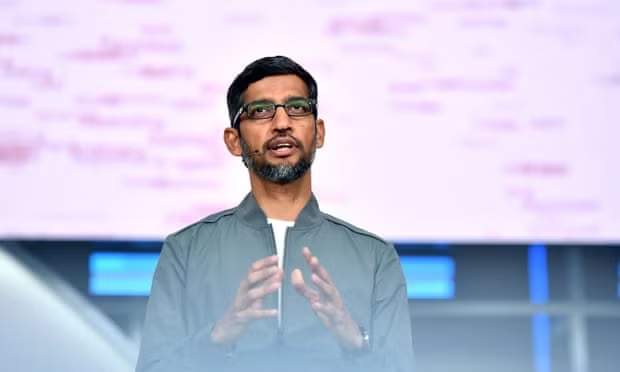
In an op-ed this week, Google’s Sundar Pichai wrote ‘privacy cannot be a luxury good’. Photograph: Josh Edelson/Getty Images
 In an op-ed this week, Google’s Sundar Pichai wrote ‘privacy cannot be a luxury good’. Photograph: Josh Edelson/Getty Images

It’s also a belated riposte to Apple’s decision to commission a massive billboard reading, “What happens on your iPhone stays on your iPhone”, in Las Vegas during the annual consumer tech conference CES this January. The billboard, described by the Washington Post as a “not-so-subtle shot at Google”, followed years of critiques by the Apple chief, Tim Cook, of the data-hungry business models of both Google and Facebook.

Of course, Facebook’s reputation on privacy issues is so awful that Mark Zuckerberg’s recent attempt to joke about it fell flat in front of an audience of the company’s own employees and developers. But that hasn’t stopped Facebook from trying to stake its own claim to the privacy moral high ground. Delivering his keynote address at the company’s annual developer conference last week, Zuckerberg stood before a giant screen reading, “The future is private”, while expounding on his plan to integrate Facebook’s various messaging apps into one – a move that many critics see as a cynical attempt to preempt antitrust action.

Central to the rollout of Facebook’s pivot to “privacy” has been the company’s own critique of Apple: one of the core principles of the new “privacy-focused platform” is a commitment not to “store sensitive data in countries with weak records on human rights like privacy and freedom of expression in order to protect data from being improperly accessed”.

Tech shade translated: Apple stores some data in China, and Facebook doesn’t, ergo Facebook is better on privacy than Apple. Pay no attention to the man behind the curtain holding 10 years of press clippings detailing Facebook’s desperate attempts to enter the Chinese market.

Mark Zuckerberg at the F8 Facebook Developer Conference in April. Photograph: John G Mabanglo/EPA

Rounding out the circular firing squad is Microsoft, which has also courted positive publicity with bold rhetoric on privacy, such as a call for regulation of facial recognition technology. Microsoft’s stance sounded great, right up until it started lobbying against regulation of facial recognition technology in its home state of Washington.

So are any of these tech companies actually good on privacy? Or are they all just craven opportunists latching onto the buzzword of the day?

“It reminds me of when I see guys who get credit for ‘respecting women,’” said Ed Zitron, a veteran of tech industry PR. “They get credit for the smallest thing. ‘Privacy’ is the woke guy on Twitter of Silicon Valley.”

In large part, it depends on what aspects of privacy you care most about. In his op-ed, Pichai emphasized Google’s ability to “protect your information”, noted Lindsey Barrett, a teaching fellow and staff attorney at Georgetown’s Communications and Technology Clinic.

“For a company like Google, all the incentives are aligned to protect their information, and therefore protect your information, but where the incentives diverge is on collection and use,” Barrett said. “None of the big companies that are trying to position themselves as strong on privacy have been willing to play ball on regulation that goes against their business interest or that would change their business models.”

Facebook may be embracing end-to-end encryption, but it still hasn’t rolled out the “clear history” tool it promised over a year ago – a feature it has admitted will harm its advertising revenues. Apple may be correct that selling products instead of advertisements is a more privacy-friendly business model, but its work in China is still cause for legitimate concern. Google may earn praise for rolling out an “incognito mode” for using Google Maps, but it’s still worth asking why this wasn’t the default from the beginning.

Still, Zitron pointed out that for Google and Apple, privacy as PR is working, with headlines in the tech press this week such as, “Facebook talked privacy, Google actually built it.”

“People are eating it up,” Zitron said. “There’s a narrative here, where you have the bad guy, which is Facebook, and now you have Apple and Google stepping in to say we’re the good guys.”

“They’re not actually caring about privacy,” he added. “They’re just trying to get associated with the idea of privacy, and it’s working. Hook, line, and sinker.”

The Guardian

Other News

SK Group partners to build AI ecosystem in Vietnam

SK Group partners to build AI ecosystem in Vietnam

SK Innovation and SK Telecom signed MoUs with Nghe An province and the National Innovation Centre of Vietnam to advance AI ecosystem development and support the country’s long-term growth strategy.

Vietnam Research Excellence Fellowship for 2026-2030 approved

Vietnam Research Excellence Fellowship for 2026-2030 approved

Under the Vietnam Research Excellence Fellowship (VREF) for the 2026–2030 period, PhD students are identified as a core research force directly contributing to breakthroughs in sci-tech and innovation. Investing in top-tier doctoral candidates is more than workforce development, but a high-stakes strategic bet to forge a cohort of world-class scientists and technologists who can power Vietnam’s long-term economic ambitions.

Strategic tech must address practical challenges: PM

Strategic tech must address practical challenges: PM

Prime Minister Pham Minh Chinh on March 28 said strategic technologies must tackle Vietnam’s practical challenges, while chairing a meeting of the Government’s Steering Committee for science and technology, innovation, digital transformation, and Project 06.

Ho Chi Minh City sets sights on becoming semiconductor hub

Ho Chi Minh City sets sights on becoming semiconductor hub

Ho Chi Minh City is stepping up efforts to attract investment from global leading groups and companies in the fields of electronic components, semiconductors and chip manufacturing as it seeks to position itself as a leading semiconductor industry hub in both the region and the world. 

Ho Chi Minh City launches upgraded technology exchange platform

Ho Chi Minh City launches upgraded technology exchange platform

The upgraded platform represents a comprehensive shift from a simple information-sharing model to a managed online technology trading system, enabling monitoring and measurement of real transaction outcomes. It is built on three pillars, namely new tradable technology products, a modern digital platform, and an improved operational model.

AI – unmissable opportunity for Vietnam: Experts

AI – unmissable opportunity for Vietnam: Experts

AI also emerges as a key enabler for Vietnam's ambition to build financial and technology hubs. Applications can boost efficiency, automate workflows, cut costs, and sharpen data analytics, which are essential pillars of a modern financial system.

PM calls for accelerated space technology development in Vietnam

PM calls for accelerated space technology development in Vietnam

Vietnam aims by 2030 to achieve a mid-level position in space science and technology development within Southeast Asia, and after 2030 to build national capabilities to independently develop satellite technologies and apply space data to address global challenges and national security needs.

High-level forum advances Vietnam–US technological cooperation

High-level forum advances Vietnam–US technological cooperation

A high-level executive leadership forum focusing on strengthening Vietnam - US relations through technology cooperation was jointly held in Washington D.C. on March 11 by the Embassy of Vietnam in the US, the Weatherhead East Asian Institute of Columbia University, and the US -ASEAN Business Council (USABC). 

AI Law takes effect, anchors national governance framework

AI Law takes effect, anchors national governance framework

While many countries are still drafting policy blueprints or issuing non-binding guidance, Vietnam has moved ahead with a standalone Law on Artificial Intelligence (AI), effective from March 1, placing it among a select group of nations to adopt dedicated AI legislation at the parliamentary level. 

Vietnam International Defence Expo 2026 preparations move into high gear

Vietnam International Defence Expo 2026 preparations move into high gear

Vietnam International Defence Expo 2026, themed “Peace, Friendship, Cooperation and Development,” will be organised on a larger scale, featuring a wide array of weapons and technical equipment alongside product exhibitions, seminars and panel discussions, drills, live field demonstrations, and business networking activities.

Ministry requests urgent measures to counter UAVs threatening aviation safety

Ministry requests urgent measures to counter UAVs threatening aviation safety

Ministry of Construction requested the Ministry of National Defence, the Ministry of Public Security and provincial and municipal steering committees for counter-terrorism to strengthen the management, inspection and supervision of UAVs and other aerial devices, ensuring strict compliance with Decree No. 288/2025/ND-CP and relevant legal regulations.