NASA tests return capsule for next-generation orion manned spacecraft

The National Aeronautics and Space Administration (NASA) and the US Coast Guard in this week has tested out the experimental Orion spacecraft’s return capsule by landing it in the Gulf of Mexico. The Orion is meant to be a modular spacecraft for use in missions as diverse as asteroid redirection and building settlements in Mars’ orbit.

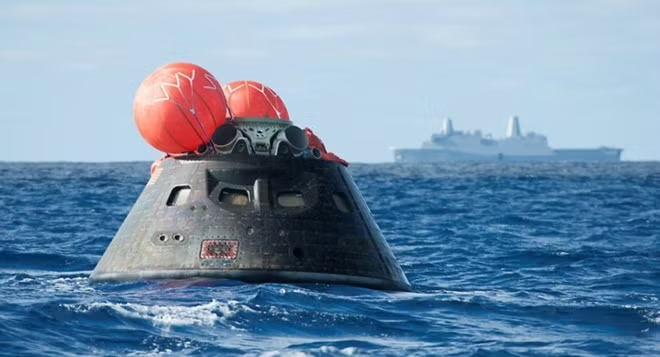
Orion's reusable return capsule, 50 percent larger than the previous generation's Apollo return capsule, is meant to land in the ocean during a return trip to Earth. For the test, the capsule was transported out to the Gulf of Mexico and then deposited into the water four miles from the Texas shoreline.

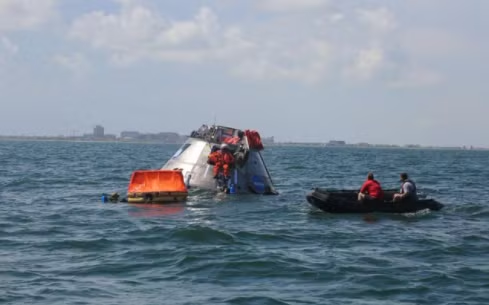
This was done to specifically test Orion's exit procedures. The capsule is designed to sustain a crew for as long as 24 hours after splashdown while they wait for a ship to retrieve them. However, if something goes wrong (e.g. a fire or a leak), the crew needs to be able to exit the capsule and get to safety on their own.
To that end, Orion is also equipped with an inflatable orange raft. The astronauts tested their ability to exit the capsule and deploy the raft without outside assistance. This is easier said than done for an astronaut returning from space: extended periods of time in space leaves the human body with weakened bones and muscles. 

"Astronauts returning to Earth in Orion will have spent many days in space, and we want to make sure the last part of their journey goes smoothly no matter what kind of conditions they land in," said Tom Walker, the NASA official who led the mission, in a statement. "Our testing in the Gulf of Mexico gives us an opportunity to practice and evaluate our plans and hardware for how to get crew out of Orion as safely and efficiently as possible."
NASA has also equipped Orion with redundant exit procedures to maximize crew safety. The redundancies give "recovery personnel and mission controllers flexibility to account for the crew's health, weather and the condition of the recovery personnel and equipment in the area in real-time," according to NASA officials. 

For the landing itself, Orion is equipped with five airbags to ensure that it remains rightside up in the water. The airbags were tested at NASA's Johnson Space Center's Neutral Buoyancy Lab. 

The ambitious Orion spacecraft is designed to carry four astronauts into or beyond Low Earth Orbit. Its primary missions are to facilitate human exploration of near-Earth asteroids and of Mars. NASA began work on Orion in 2010 alongside contractors Airbus and Lockheed Martin. 
Sputnik

Other News

AI offers both opportunities, challenges for Vietnam's growth

AI offers both opportunities, challenges for Vietnam's growth

Dr. Ho Duc Thang, a full-time member of the National Assembly’s Committee for Cultural and Educational, said productivity is the key to sustaining double-digit economic growth, and AI has greater potential to improve productivity than any previous technology.

Top leader unveils people-centred vision for new development model

Top leader unveils people-centred vision for new development model

Vietnam's growth model, long fueled by low-cost labour, resource extraction, contract manufacturing, expanded investment, and capital accumulation, has run out of road. The country now needs a sweeping reform agenda to shift from extensive growth to a model driven by productivity, knowledge, science and technology, innovation, and digital transformation.

First national semiconductor chip prototyping support centre makes debut

First national semiconductor chip prototyping support centre makes debut

Vietnam's semiconductor ecosystem now comprises around 60 chip design companies, some 7,000 chip design engineers and 166 universities offering semiconductor-related training programmes. Initial registrations from 12 organisations indicate demand for the prototyping of approximately 30,000 chips.

Vietnam targets at least 10 large strategic technology firms by 2030

Vietnam targets at least 10 large strategic technology firms by 2030

Deputy Prime Minister Ho Quoc Dung has signed a decision approving a plan to develop large domestic strategic technology enterprises in the 2026–2030 period, aimed at advancing digital infrastructure, digital human resources, digital data, strategic technologies and cybersecurity.

Protecting users crucial in building digital trust: Experts

Protecting users crucial in building digital trust: Experts

In Vietnam, digital transformation in the finance and banking sector is accelerating cashless payments, expanding access to financial services, improving market transparency and supporting economic growth and macroeconomic management.

Fostering skilled workforce for innovation era: experts

Fostering skilled workforce for innovation era: experts

Experts said close coordination among State management agencies, research institutes, universities, and businesses will improve training quality and serve the dual goals of quality education and practical research application.

Startup forum bridges Silicon Valley and local innovation ecosystem

Startup forum bridges Silicon Valley and local innovation ecosystem

The University of Economics Ho Chi Minh City (UEH), Saigon Asset Management (SAM), and Plug and Play Tech Centre co-hosted the “From Vietnam to Silicon Valley” forum, exploring AI innovation, venture capital, and pathways to integrate Vietnam’s startup ecosystem with Silicon Valley and global markets.