NASA Will Train to Defend Earth From Asteroid Impact

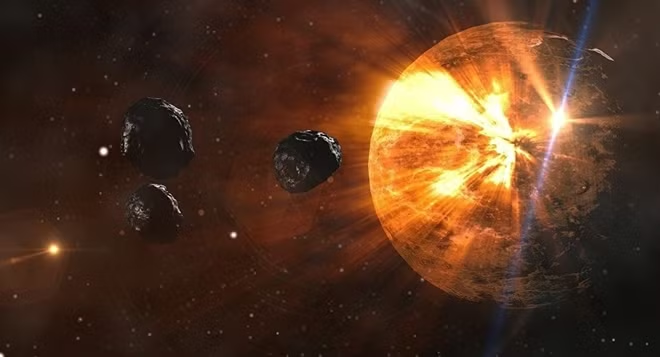
For years, the National Aeronautics and Space Administration and other organisations have been scanning the skies for asteroids and comets travelling close to Earth, studying the possible hazards that such objects might entail. During special drills, they are now set to exercise what to do if the worst-case scenario becomes reality.

Photo: Pixabay.
Photo: Pixabay. 

NASA, along with other US agencies and scientific institutions, will participate in a "tabletop exercise" to train for what to do if a so-called near-Earth object (NEOs) is poised to hit Earth. According to the Jet Propulsion Laboratory, they hope to improve their response to the celestial threat during the 2019 Planetary Defence Conference, scheduled for next week. 

Attendees of the conference will play out a fictional NEO impact scenario, developed by the lab. Such emergency simulations are standard for disaster management planning.

"These exercises have really helped us in the planetary defence community to understand what our colleagues on the disaster management side need to know. This exercise will help us develop more effective communications with each other and with our governments”, NASA's Planetary Defence Officer Lindley Johnson said, as cited in the press release.

Although the scenario is not tightly scripted, as it is designed to gather and evaluate the responses of participants in a pressing situation, there are a few input conditions. According to the fictional script, astronomers spotted a hazardous NEO on 26 March and tracked the asteroid, dubbed 2019 PDC, for a "few months”, predicting that it poses a 1 in 100 chance of impact with Earth in 2027. 

They will then have to come up with a preparation plan to deflect the hazard and mitigate its potential effects. This is not the first time that NASA has taken part in such drills. Apart from three exercises at Planetary Defence Conferences over the past six years, it has also teamed up with the Federal Emergency Management Agency (FEMA), as well as with the Departments of Defence and State three times. 

Apart from such table top exercises, NASA is also getting ready for its first spacecraft impact asteroid redirect mission. The test, titled Double Asteroid Redirection Test (DART), is scheduled for June 2021. One of SpaceX’s Falcon 9 rockets will launch in the direction of asteroid 65803 Didymos (or “Didymain”) and its tiny satellite "Didymoon" to slightly change its course. For this, the space agency has paid $69 million to Elon Musk’s company. 

This year, it was reported that the presidium of the Russian Academy of Sciences (RAS) had agreed to develop a national programme to research issues and methods of countering hazards from space, such as asteroids, comets, and space debris. According to the RAS, researchers have so far detected around 18,000 hazardous objects in space, 99 percent of which are asteroids.

The European Space Agency (ESA) is also closely monitoring the skies for potential hazards. It reported in 2017 that a potential space rock, measuring 15-30 metres (49-98 feet) had flown past the Earth at a distance of 44,000 kilometres (27,340 miles). An asteroid of this size entering the atmosphere would have a similar effect to the Chelyabinsk event, when a 10-tonne meteor exploded over Chelyabinsk Oblast in Russia, resulting in serious damage in the region in 2013. 

The event is said to have been the second largest impact after the mysterious Tunguska event on 30 June 1908. Then, Eastern Siberia was hit by an explosion, generally attributed to an air burst of a comet or a meteorite. According to various scientific estimations, about 850 square miles (2,200 square kilometres) of local forest was flattened.
Sputnik News

Other News

SK Group partners to build AI ecosystem in Vietnam

SK Group partners to build AI ecosystem in Vietnam

SK Innovation and SK Telecom signed MoUs with Nghe An province and the National Innovation Centre of Vietnam to advance AI ecosystem development and support the country’s long-term growth strategy.

Vietnam Research Excellence Fellowship for 2026-2030 approved

Vietnam Research Excellence Fellowship for 2026-2030 approved

Under the Vietnam Research Excellence Fellowship (VREF) for the 2026–2030 period, PhD students are identified as a core research force directly contributing to breakthroughs in sci-tech and innovation. Investing in top-tier doctoral candidates is more than workforce development, but a high-stakes strategic bet to forge a cohort of world-class scientists and technologists who can power Vietnam’s long-term economic ambitions.

Strategic tech must address practical challenges: PM

Strategic tech must address practical challenges: PM

Prime Minister Pham Minh Chinh on March 28 said strategic technologies must tackle Vietnam’s practical challenges, while chairing a meeting of the Government’s Steering Committee for science and technology, innovation, digital transformation, and Project 06.

Ho Chi Minh City sets sights on becoming semiconductor hub

Ho Chi Minh City sets sights on becoming semiconductor hub

Ho Chi Minh City is stepping up efforts to attract investment from global leading groups and companies in the fields of electronic components, semiconductors and chip manufacturing as it seeks to position itself as a leading semiconductor industry hub in both the region and the world. 

Ho Chi Minh City launches upgraded technology exchange platform

Ho Chi Minh City launches upgraded technology exchange platform

The upgraded platform represents a comprehensive shift from a simple information-sharing model to a managed online technology trading system, enabling monitoring and measurement of real transaction outcomes. It is built on three pillars, namely new tradable technology products, a modern digital platform, and an improved operational model.

AI – unmissable opportunity for Vietnam: Experts

AI – unmissable opportunity for Vietnam: Experts

AI also emerges as a key enabler for Vietnam's ambition to build financial and technology hubs. Applications can boost efficiency, automate workflows, cut costs, and sharpen data analytics, which are essential pillars of a modern financial system.

PM calls for accelerated space technology development in Vietnam

PM calls for accelerated space technology development in Vietnam

Vietnam aims by 2030 to achieve a mid-level position in space science and technology development within Southeast Asia, and after 2030 to build national capabilities to independently develop satellite technologies and apply space data to address global challenges and national security needs.

High-level forum advances Vietnam–US technological cooperation

High-level forum advances Vietnam–US technological cooperation

A high-level executive leadership forum focusing on strengthening Vietnam - US relations through technology cooperation was jointly held in Washington D.C. on March 11 by the Embassy of Vietnam in the US, the Weatherhead East Asian Institute of Columbia University, and the US -ASEAN Business Council (USABC). 

AI Law takes effect, anchors national governance framework

AI Law takes effect, anchors national governance framework

While many countries are still drafting policy blueprints or issuing non-binding guidance, Vietnam has moved ahead with a standalone Law on Artificial Intelligence (AI), effective from March 1, placing it among a select group of nations to adopt dedicated AI legislation at the parliamentary level. 

Vietnam International Defence Expo 2026 preparations move into high gear

Vietnam International Defence Expo 2026 preparations move into high gear

Vietnam International Defence Expo 2026, themed “Peace, Friendship, Cooperation and Development,” will be organised on a larger scale, featuring a wide array of weapons and technical equipment alongside product exhibitions, seminars and panel discussions, drills, live field demonstrations, and business networking activities.

Ministry requests urgent measures to counter UAVs threatening aviation safety

Ministry requests urgent measures to counter UAVs threatening aviation safety

Ministry of Construction requested the Ministry of National Defence, the Ministry of Public Security and provincial and municipal steering committees for counter-terrorism to strengthen the management, inspection and supervision of UAVs and other aerial devices, ensuring strict compliance with Decree No. 288/2025/ND-CP and relevant legal regulations.