Nuclear science & technology center to be built in Hanoi

Vietnam will develop a nuclear science & technology center with two components in Da Lat and Hanoi, according to the director of the Vietnam Atomic Research Institute, Tran Chi Thanh.

The center will be built with preferential loans of $US500 million from the Russian government. 

The center will help improve Vietnam’s science & technology capacity to acquire technology to be transferred, proceeding to self-control in operation, maintenance and repair of nuclear power plants, ensuring the plants’ safe and efficient operation.

The research center will bring opportunities to carry out experiments and promote the utilization of atomic energy in socio-economic fields. 

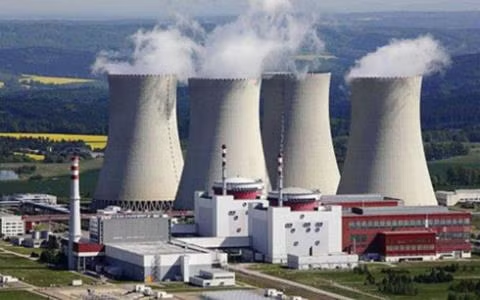
The key component of the project will be the nuclear reactor for research which has the expected capacity of 15 MW, or 30 times higher than the operational reactor in Da Lat.

At present, the reactor in Da Lat can only satisfy 30 percent of the radioisotope demand from hospitals in Vietnam. However, once the new reactor becomes operational, 100 percent of the demand will be met.

Thanh affirmed that in the last 50-60 years of the development of the atomic industry, there has been no unfortunate accident with research reactors. The research nuclear reactor is safe, and will be put into operation by 2025.

Nguyen Hao Quang, deputy director of the Vietnam Atomic Energy Institute told the press on the sidelines of the 2017 Nuclear & Science Day held in Hanoi on May 18 that the major component of the center – CNEST - would be in Dong Nai province instead of Da Lat City as initially planned.

Quang said that the subordinate component of CNET would still be set up in Hanoi as planned, but instead of focusing on researching and dealing with nuclear safety matters, it will focus on radioactivity monitoring and warnings and on risk management and analysis.

He also said at first CNEST wanted to employ 250 workers, the plan has changed. As the center won’t develop divisions to support nuclear power as initially planned, the number of workers will be lower.

As for the ideal location for the center, ROSATOM suggested that it should not be too far from city, while it needs to be near international airport. It would be better if it is near sites which will use the center’s products in the future, including hospitals and research centers. 

If so, Hanoi would be an ideal place for the center.

Vietnam has been utilizing nuclear power in an effective way in three fields – healthcare, agriculture and industry. Vietnam has created many rice, maize and soybean varieties which have brought high yields and quality.

Dat Viet/VietNamNet Bridge

Other News

AI offers both opportunities, challenges for Vietnam's growth

AI offers both opportunities, challenges for Vietnam's growth

Dr. Ho Duc Thang, a full-time member of the National Assembly’s Committee for Cultural and Educational, said productivity is the key to sustaining double-digit economic growth, and AI has greater potential to improve productivity than any previous technology.

Top leader unveils people-centred vision for new development model

Top leader unveils people-centred vision for new development model

Vietnam's growth model, long fueled by low-cost labour, resource extraction, contract manufacturing, expanded investment, and capital accumulation, has run out of road. The country now needs a sweeping reform agenda to shift from extensive growth to a model driven by productivity, knowledge, science and technology, innovation, and digital transformation.

First national semiconductor chip prototyping support centre makes debut

First national semiconductor chip prototyping support centre makes debut

Vietnam's semiconductor ecosystem now comprises around 60 chip design companies, some 7,000 chip design engineers and 166 universities offering semiconductor-related training programmes. Initial registrations from 12 organisations indicate demand for the prototyping of approximately 30,000 chips.

Vietnam targets at least 10 large strategic technology firms by 2030

Vietnam targets at least 10 large strategic technology firms by 2030

Deputy Prime Minister Ho Quoc Dung has signed a decision approving a plan to develop large domestic strategic technology enterprises in the 2026–2030 period, aimed at advancing digital infrastructure, digital human resources, digital data, strategic technologies and cybersecurity.

Protecting users crucial in building digital trust: Experts

Protecting users crucial in building digital trust: Experts

In Vietnam, digital transformation in the finance and banking sector is accelerating cashless payments, expanding access to financial services, improving market transparency and supporting economic growth and macroeconomic management.

Fostering skilled workforce for innovation era: experts

Fostering skilled workforce for innovation era: experts

Experts said close coordination among State management agencies, research institutes, universities, and businesses will improve training quality and serve the dual goals of quality education and practical research application.

Startup forum bridges Silicon Valley and local innovation ecosystem

Startup forum bridges Silicon Valley and local innovation ecosystem

The University of Economics Ho Chi Minh City (UEH), Saigon Asset Management (SAM), and Plug and Play Tech Centre co-hosted the “From Vietnam to Silicon Valley” forum, exploring AI innovation, venture capital, and pathways to integrate Vietnam’s startup ecosystem with Silicon Valley and global markets.

Experts call for stronger action against fake news online

Experts call for stronger action against fake news online

Experts have warned that fake news, misinformation and harmful online content are increasingly shaping public perceptions, particularly among young people, and stressed the need for stronger legal safeguards, technology tools and wider dissemination of credible information to tackle the problem effectively.

Protecting digital future in post-quantum, AI era

Protecting digital future in post-quantum, AI era

Participants highlighted the importance of building a proactive, synchronised and sustainable national cybersecurity ecosystem through closer cooperation among regulators, technology firms, research institutions and cybersecurity experts.