Offices grow 'brains' as companies seek to attract smarter workers

Employees will not need a key to get into the office of the future when it opens in Berlin this year, featuring ample meeting space, plenty of copy machines always stocked with paper along with high-quality air processed to maximize worker health and minimize sick time.

Their smartphones will help guide them around their new workplace — and they may need the assistance because they will not have permanent desks.

With technology changing how and where we work, property developers are tapping artificial intelligence to create more sustainable workplaces to help staff work more efficiently and comfortably.

Fierce competition for talent is turbo-charging the trend in Berlin. While the city used to be a bit of a business backwater, in recent years it gained a reputation as a start-up hub. Office vacancy rates have tumbled to just 1.5 percent as rents are rocketing, making it an ideal place for developers to showcase these new offices.
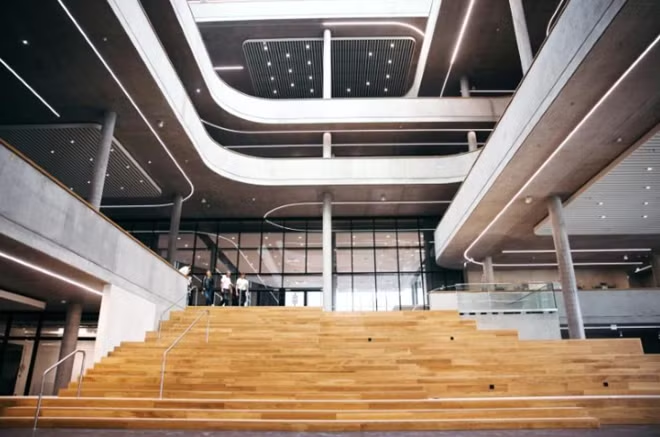
The Berlin headquarters of Zalando is seen during the final construction phase in this company photo released from Berlin, Germany on December 14, 2018. Courtesy: Zalando/Handout via REUTERS

Property owners in Berlin are taking a cue from the Netherlands, home to several intelligent and sustainable office projects.

Rapid growth of local start-ups such as Zalando and Delivery Hero is driving demand for office space in the German capital. Two new smart offices are under construction in the former no-man’s land of the Berlin Wall, next to the city’s main train station.

The Cube, being built by Austrian real estate company CA Immo, will be completed by the end of this year, and The Edge Grand Central by EDGE Technologies, a subsidiary of Dutch firm OVG Real Estate, is planned for 2020.

“The office building is the new company car. In my world, people do not want a car as a perk anymore. They look around and say, ‘This would be a nice place to work,’” said Martin Rodeck, executive managing director at EDGE Technologies Germany.

Both offices are packed with a network of sensors that measure everything from motion, temperature and lighting to humidity and C02 and are connected to a cloud platform.

In The Cube, the technology is dubbed “the brain”, a self-learning software that analyses all the data it receives and optimizes how the building is run.
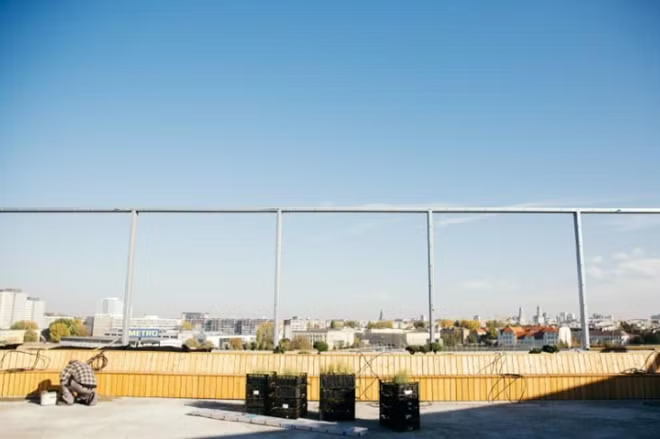
The Berlin headquarters of Zalando is seen during the final construction phase in this company photo released from Berlin, Germany on December 14, 2018. Courtesy: Zalando/Handout via REUTERS
 The Berlin headquarters of Zalando is seen during the final construction phase in this company photo released from Berlin, Germany on December 14, 2018. Courtesy: Zalando/Handout via REUTERS

For example, if part of a building is unoccupied, it can turn off the lights and heating systems. If a meeting room is crowded it can pump in more oxygen.

Users access the building via a smartphone app that knows their schedules and may suggest sitting by a window or on a floor where a meeting is scheduled. The app can be used to book meeting rooms, order food and navigate the building.

Workers will need the navigational aid to find their desk. The offices feature a “hot desking” system in which employees do not have a permanent desk, but rather the appropriate workspace for the type of work they want to do. Lockers will be available to store belongings.

Smart offices can also minimize daily frustrations such as the printer running out of paper or being unable to locate a colleague, Rodeck said.

The printers work along the predictive maintenance model. In the same way that a car warns it is running out of fuel, printers send alerts to the building’s management system when a machine needs paper, so someone can fill it up.

But to take advantage of these benefits, users need to actively opt-in to be tracked, visible to their colleagues, and their boss, while in the building. In doing so, they override the default setting to be ‘hidden’.

FALLING SICK RATES

Studies show people work better in environments providing good air quality as well as comfortable noise and humidity levels. Comparing sick leave rates in older and new offices highlights the potential benefits of state-of-the-art buildings.

When consulting firm Deloitte moved into OVG Real Estate’s landmark smart building The Edge in Amsterdam in 2015, the firm found sick rates fell drastically while the number of job applicants increased, Rodeck said.

Before online fashion retailer Zalando designed new headquarters, the company asked staff to share opinions on existing workspace. Employees complained about too few meeting rooms and the challenge of concentrating due to noise.

In its new headquarters, due to open in early 2019, workers can choose from a library for quiet work, telephone booths for private conversations as well as living rooms located on the open catwalks to encourage interaction.

“The important part is that we provide a work environment for everyone,” said Zalando’s vice president for real estate Raimund Paetzmann.

Zalando plans to install smart technology to make it easy to reserve a desk from home and take away the stress of arriving at the office and not knowing where to sit.

While shifting to hot-desking can control costs, a survey by CCL consulting and property agents Savills found half of those aged under 34 and 60 percent of those over 35 did not want to give up their fixed desk.

“We all need our home, a haven and part of the office that belongs to us,” said Franz Kuehmayer, a trend researcher at think-tank Zukunftsinstitut.

“Many employees question how they will organize their daily work life and where they can put pictures of their children.”

Reuters

Other News

SK Group partners to build AI ecosystem in Vietnam

SK Group partners to build AI ecosystem in Vietnam

SK Innovation and SK Telecom signed MoUs with Nghe An province and the National Innovation Centre of Vietnam to advance AI ecosystem development and support the country’s long-term growth strategy.

Vietnam Research Excellence Fellowship for 2026-2030 approved

Vietnam Research Excellence Fellowship for 2026-2030 approved

Under the Vietnam Research Excellence Fellowship (VREF) for the 2026–2030 period, PhD students are identified as a core research force directly contributing to breakthroughs in sci-tech and innovation. Investing in top-tier doctoral candidates is more than workforce development, but a high-stakes strategic bet to forge a cohort of world-class scientists and technologists who can power Vietnam’s long-term economic ambitions.

Strategic tech must address practical challenges: PM

Strategic tech must address practical challenges: PM

Prime Minister Pham Minh Chinh on March 28 said strategic technologies must tackle Vietnam’s practical challenges, while chairing a meeting of the Government’s Steering Committee for science and technology, innovation, digital transformation, and Project 06.

Ho Chi Minh City sets sights on becoming semiconductor hub

Ho Chi Minh City sets sights on becoming semiconductor hub

Ho Chi Minh City is stepping up efforts to attract investment from global leading groups and companies in the fields of electronic components, semiconductors and chip manufacturing as it seeks to position itself as a leading semiconductor industry hub in both the region and the world. 

Ho Chi Minh City launches upgraded technology exchange platform

Ho Chi Minh City launches upgraded technology exchange platform

The upgraded platform represents a comprehensive shift from a simple information-sharing model to a managed online technology trading system, enabling monitoring and measurement of real transaction outcomes. It is built on three pillars, namely new tradable technology products, a modern digital platform, and an improved operational model.

AI – unmissable opportunity for Vietnam: Experts

AI – unmissable opportunity for Vietnam: Experts

AI also emerges as a key enabler for Vietnam's ambition to build financial and technology hubs. Applications can boost efficiency, automate workflows, cut costs, and sharpen data analytics, which are essential pillars of a modern financial system.

PM calls for accelerated space technology development in Vietnam

PM calls for accelerated space technology development in Vietnam

Vietnam aims by 2030 to achieve a mid-level position in space science and technology development within Southeast Asia, and after 2030 to build national capabilities to independently develop satellite technologies and apply space data to address global challenges and national security needs.

High-level forum advances Vietnam–US technological cooperation

High-level forum advances Vietnam–US technological cooperation

A high-level executive leadership forum focusing on strengthening Vietnam - US relations through technology cooperation was jointly held in Washington D.C. on March 11 by the Embassy of Vietnam in the US, the Weatherhead East Asian Institute of Columbia University, and the US -ASEAN Business Council (USABC). 

AI Law takes effect, anchors national governance framework

AI Law takes effect, anchors national governance framework

While many countries are still drafting policy blueprints or issuing non-binding guidance, Vietnam has moved ahead with a standalone Law on Artificial Intelligence (AI), effective from March 1, placing it among a select group of nations to adopt dedicated AI legislation at the parliamentary level. 

Vietnam International Defence Expo 2026 preparations move into high gear

Vietnam International Defence Expo 2026 preparations move into high gear

Vietnam International Defence Expo 2026, themed “Peace, Friendship, Cooperation and Development,” will be organised on a larger scale, featuring a wide array of weapons and technical equipment alongside product exhibitions, seminars and panel discussions, drills, live field demonstrations, and business networking activities.

Ministry requests urgent measures to counter UAVs threatening aviation safety

Ministry requests urgent measures to counter UAVs threatening aviation safety

Ministry of Construction requested the Ministry of National Defence, the Ministry of Public Security and provincial and municipal steering committees for counter-terrorism to strengthen the management, inspection and supervision of UAVs and other aerial devices, ensuring strict compliance with Decree No. 288/2025/ND-CP and relevant legal regulations.