Parkinson's disease 'could be detected early on by brain changes'

Changes in the brain that can be spotted years before physical symptoms of Parkinson’s disease occur might act as an early warning sign for the condition, researchers say.

It is thought that about 145,000 people in the UK are living with Parkinson’s disease, a neurological condition that can lead to mobility problems, including slowness and tremors, as well as other symptoms such as memory difficulties. There are treatments to help manage symptoms but as yet the disease cannot be slowed or cured.

The researchers, based at King’s College London, say the latest findings could eventually lead to new ways to identify people who might go on to develop Parkinson’s; the discoveries could also confirm diagnoses, monitor the disease progression, and aid the development and testing of drugs. Those developments could be some way off though, some scientists have said.
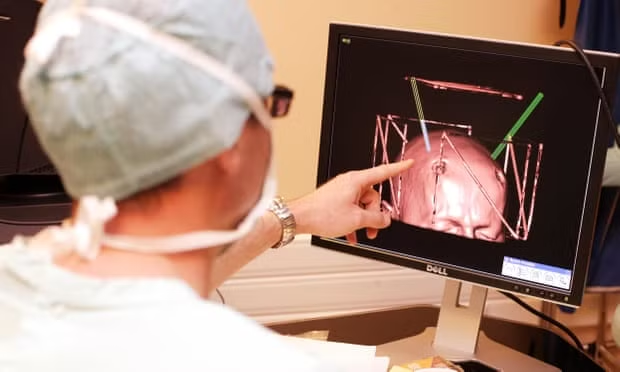
A patient with Parkinson’s disease is treated with thalamic stimulation, with electrodes inserted into the brain. Photograph: Alamy

Most of the time Parkinson’s appears to have no known cause, so people affected by the disease are not studied before their symptoms appear.

But the King’s College studies concerned with genetic mutations making the development of Parkinson’s disease more likely, could point to the warning signs.

Marios Politis, a professor and lead author of the research, said: “If you carry the gene [SNCA] it means it is almost certain you are going to develop Parkinson’s in the course of your life.”

A genetic mutation involving the SNCA gene was thought to have arisen in villages in the Peloponnese, GreeceBut Politis said that carriers were rare. “I don’t think there are more than 100 [people who are known to have it],” he said.

Writing in the journal Lancet Neurology, Politis and his colleagues described how they brought 10 individuals with this genetic mutation to the UK from Greece, as well as four people from Italy. The participants were given assessments and brain scans.

While half of these participants had physical symptoms of Parkinson’s disease, the other seven did not. The team also analysed assessments and scans from 65 people with Parkinson’s disease who did not have genetic mutations linked to the condition.

People with Parkinson’s disease show a deterioration of systems in the brain that involve a neurotransmitter called dopamine, thought to be behind certain symptoms such as slowness of movement. However there have also been signs of deterioration involving another brain chemical, serotonin.

The research revealed that, compared with scans from 25 healthy participants, scans from participants with physical symptoms of Parkinson’s disease showed deterioration to both dopamine and serotonin systems in the brain – whether or not the individuals had the genetic mutation.

A loss of serotonin neurons was also seen in many regions in the brains of people who had the genetic predisposition to Parkinson’s but who did not have physical symptoms. Politis noted that these individuals had up to a 34% decrease in serotonin neurons compared with the healthy participants.

The changes were seen about 15 to 20 years before these individuals would typically start to show physical symptoms. In addition, these genetically predisposed participants showed no sign of deterioration in their dopamine system. “That by itself is a major breakthrough on how you see Parkinson’s disease,” said Politis.

He said the findings were exciting and could pave the way for screening, or even offer ways to test new drugs to find out whether they worked. “It is a completely new window on the disorder,” said Politis.

Roger Barker, professor of clinical neuroscience at the University of Cambridge, said the findings supported suspicions that the first signs of Parkinson’s might not be found in the dopamine system. But he said questions remained, including whether early changes in the serotonin system were found in other groups at risk of Parkinson’s, and whether these changes progressed over time – and could reliably predict when physical symptoms might appear.

He noted that the scans used were expensive and not widely available, raising questions about how the findings might be applied to screen people.

Beckie Port, research communication manager at Parkinson’s UK, said further research was needed, but suggested the findings might raise new possibilities. “We can’t currently give someone a brain scan in order to treat them earlier, to slow or stop the condition and perhaps prevent them from ever being diagnosed with Parkinson’s. But with this discovery a future where that is possible seems just a little closer.


The Guardian

Other News

SK Group partners to build AI ecosystem in Vietnam

SK Group partners to build AI ecosystem in Vietnam

SK Innovation and SK Telecom signed MoUs with Nghe An province and the National Innovation Centre of Vietnam to advance AI ecosystem development and support the country’s long-term growth strategy.

Vietnam Research Excellence Fellowship for 2026-2030 approved

Vietnam Research Excellence Fellowship for 2026-2030 approved

Under the Vietnam Research Excellence Fellowship (VREF) for the 2026–2030 period, PhD students are identified as a core research force directly contributing to breakthroughs in sci-tech and innovation. Investing in top-tier doctoral candidates is more than workforce development, but a high-stakes strategic bet to forge a cohort of world-class scientists and technologists who can power Vietnam’s long-term economic ambitions.

Strategic tech must address practical challenges: PM

Strategic tech must address practical challenges: PM

Prime Minister Pham Minh Chinh on March 28 said strategic technologies must tackle Vietnam’s practical challenges, while chairing a meeting of the Government’s Steering Committee for science and technology, innovation, digital transformation, and Project 06.

Ho Chi Minh City sets sights on becoming semiconductor hub

Ho Chi Minh City sets sights on becoming semiconductor hub

Ho Chi Minh City is stepping up efforts to attract investment from global leading groups and companies in the fields of electronic components, semiconductors and chip manufacturing as it seeks to position itself as a leading semiconductor industry hub in both the region and the world. 

Ho Chi Minh City launches upgraded technology exchange platform

Ho Chi Minh City launches upgraded technology exchange platform

The upgraded platform represents a comprehensive shift from a simple information-sharing model to a managed online technology trading system, enabling monitoring and measurement of real transaction outcomes. It is built on three pillars, namely new tradable technology products, a modern digital platform, and an improved operational model.

AI – unmissable opportunity for Vietnam: Experts

AI – unmissable opportunity for Vietnam: Experts

AI also emerges as a key enabler for Vietnam's ambition to build financial and technology hubs. Applications can boost efficiency, automate workflows, cut costs, and sharpen data analytics, which are essential pillars of a modern financial system.

PM calls for accelerated space technology development in Vietnam

PM calls for accelerated space technology development in Vietnam

Vietnam aims by 2030 to achieve a mid-level position in space science and technology development within Southeast Asia, and after 2030 to build national capabilities to independently develop satellite technologies and apply space data to address global challenges and national security needs.

High-level forum advances Vietnam–US technological cooperation

High-level forum advances Vietnam–US technological cooperation

A high-level executive leadership forum focusing on strengthening Vietnam - US relations through technology cooperation was jointly held in Washington D.C. on March 11 by the Embassy of Vietnam in the US, the Weatherhead East Asian Institute of Columbia University, and the US -ASEAN Business Council (USABC). 

AI Law takes effect, anchors national governance framework

AI Law takes effect, anchors national governance framework

While many countries are still drafting policy blueprints or issuing non-binding guidance, Vietnam has moved ahead with a standalone Law on Artificial Intelligence (AI), effective from March 1, placing it among a select group of nations to adopt dedicated AI legislation at the parliamentary level. 

Vietnam International Defence Expo 2026 preparations move into high gear

Vietnam International Defence Expo 2026 preparations move into high gear

Vietnam International Defence Expo 2026, themed “Peace, Friendship, Cooperation and Development,” will be organised on a larger scale, featuring a wide array of weapons and technical equipment alongside product exhibitions, seminars and panel discussions, drills, live field demonstrations, and business networking activities.

Ministry requests urgent measures to counter UAVs threatening aviation safety

Ministry requests urgent measures to counter UAVs threatening aviation safety

Ministry of Construction requested the Ministry of National Defence, the Ministry of Public Security and provincial and municipal steering committees for counter-terrorism to strengthen the management, inspection and supervision of UAVs and other aerial devices, ensuring strict compliance with Decree No. 288/2025/ND-CP and relevant legal regulations.