People eat at least 50,000 plastic particles a year, study finds

The average person eats at least 50,000 particles of microplastic a year and breathes in a similar quantity, according to the first study to estimate human ingestion of plastic pollution.

The true number is likely to be many times higher, as only a small number of foods and drinks have been analysed for plastic contamination. The scientists reported that drinking a lot of bottled water drastically increased the particles consumed.

The health impacts of ingesting microplastic are unknown, but they could release toxic substances. Some pieces are small enough to penetrate human tissues, where they could trigger immune reactions.

Microplastic pollution is mostly created by the disintegration of plastic litter and appears to be ubiquitous across the planet. Researchers find microplastics everywhere they look; in the air, soil, rivers and the deepest oceans around the world.
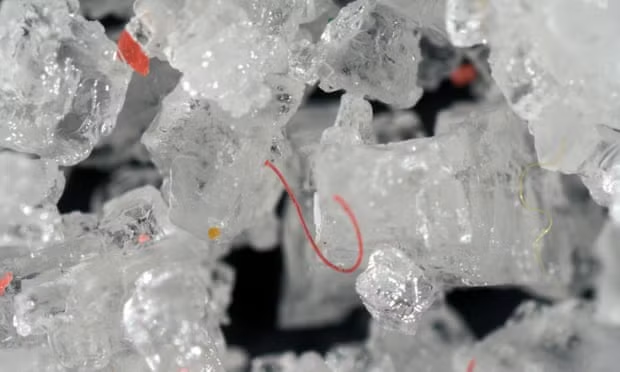
Tiny fragments and filaments of plastic in table salt crystals. Photograph: Paulo Oliveira/Alamy
 Tiny fragments and filaments of plastic in table salt crystals. Photograph: Paulo Oliveira/Alamy

They have been detected in tap and bottled water, seafood and beer. They were also found in human stool samples for the first time in October, confirming that people ingest the particles.

The new research, published in the journal Environmental Science and Technology, took the data from 26 previous studies that measure the amounts of microplastic particles in fish, shellfish, sugar, salt, beer and water, as well as in the air in cities.

The scientists then used US government dietary guidelines to calculate how many particles people would eat in a year. Adults eat about 50,000 microplastic particles a year and children about 40,000, they estimated.

Most food and drink types have not been tested, however, meaning the study only assessed 15% of calorie intake. “We don’t know a huge amount. There are some major data gaps that need to get filled,” said Kieran Cox, at the University of Victoria in Canada, who led the research.

Other foods, such as bread, processed products, meat, dairy and vegetables, may well contain just as much plastic, he said. “It is really highly likely there is going to be large amounts of plastic particles in these. You could be heading into the hundreds of thousands.”

Some of the best available data is on water, with bottled water containing 22 times more microplastic than tap water on average. A person who only drank bottled water would consume 130,000 particles per year from that source alone, the researchers said, compared with 4,000 from tap water.

Scientists do not know what happens when microplastics are inhaled, but the new study speculates that “most inhaled particles will be ingested” rather than coughed or sneezed out. The researchers also estimated that microplastic particles settling on to a single meal per day could add a further tens of thousands to the annual amount consumed.

Cox was clear that there are no known health effects as yet, but he said the ingested particles are “a high exposure risk in terms of numbers. It could be a potential alarm call for sure”.

Stephanie Wright, at King’s College London, who was not involved in the research, said: “These current estimates suggest microplastic exposure is relatively low compared to other particles. For example, it has been estimated that the average western diet exposes consumers to billions of titanium dioxide microparticles, a common additive, each day. However, what comparatively low microplastic exposures mean for health is unknown.”

The European commission’s chief scientific advisers said in a report that: “The evidence [on the environmental and health risks of microplastics] provides grounds for genuine concern and for precaution to be exercised.”

They concluded: “Growing scientific evidence on the hazards of uncontrolled microplastic pollution, combined with its long-term persistence and irreversibility, suggests that reasonable and proportional measures should be taken to prevent the release of microplastics.”

Cox said his research had changed his own behaviour. “I definitely steer away from plastic packaging and try to avoid bottled water as much as possible,” he said.

“Removing single-use plastic from your life and supporting companies that are moving away from plastic packaging is going to have a non-trivial impact,” Cox said. “The facts are simple. We are producing a lot of plastic and it is ending up in the ecosystems, which we are a part of.”
The Guardian

Other News

SK Group partners to build AI ecosystem in Vietnam

SK Group partners to build AI ecosystem in Vietnam

SK Innovation and SK Telecom signed MoUs with Nghe An province and the National Innovation Centre of Vietnam to advance AI ecosystem development and support the country’s long-term growth strategy.

Vietnam Research Excellence Fellowship for 2026-2030 approved

Vietnam Research Excellence Fellowship for 2026-2030 approved

Under the Vietnam Research Excellence Fellowship (VREF) for the 2026–2030 period, PhD students are identified as a core research force directly contributing to breakthroughs in sci-tech and innovation. Investing in top-tier doctoral candidates is more than workforce development, but a high-stakes strategic bet to forge a cohort of world-class scientists and technologists who can power Vietnam’s long-term economic ambitions.

Strategic tech must address practical challenges: PM

Strategic tech must address practical challenges: PM

Prime Minister Pham Minh Chinh on March 28 said strategic technologies must tackle Vietnam’s practical challenges, while chairing a meeting of the Government’s Steering Committee for science and technology, innovation, digital transformation, and Project 06.

Ho Chi Minh City sets sights on becoming semiconductor hub

Ho Chi Minh City sets sights on becoming semiconductor hub

Ho Chi Minh City is stepping up efforts to attract investment from global leading groups and companies in the fields of electronic components, semiconductors and chip manufacturing as it seeks to position itself as a leading semiconductor industry hub in both the region and the world. 

Ho Chi Minh City launches upgraded technology exchange platform

Ho Chi Minh City launches upgraded technology exchange platform

The upgraded platform represents a comprehensive shift from a simple information-sharing model to a managed online technology trading system, enabling monitoring and measurement of real transaction outcomes. It is built on three pillars, namely new tradable technology products, a modern digital platform, and an improved operational model.

AI – unmissable opportunity for Vietnam: Experts

AI – unmissable opportunity for Vietnam: Experts

AI also emerges as a key enabler for Vietnam's ambition to build financial and technology hubs. Applications can boost efficiency, automate workflows, cut costs, and sharpen data analytics, which are essential pillars of a modern financial system.

PM calls for accelerated space technology development in Vietnam

PM calls for accelerated space technology development in Vietnam

Vietnam aims by 2030 to achieve a mid-level position in space science and technology development within Southeast Asia, and after 2030 to build national capabilities to independently develop satellite technologies and apply space data to address global challenges and national security needs.

High-level forum advances Vietnam–US technological cooperation

High-level forum advances Vietnam–US technological cooperation

A high-level executive leadership forum focusing on strengthening Vietnam - US relations through technology cooperation was jointly held in Washington D.C. on March 11 by the Embassy of Vietnam in the US, the Weatherhead East Asian Institute of Columbia University, and the US -ASEAN Business Council (USABC). 

AI Law takes effect, anchors national governance framework

AI Law takes effect, anchors national governance framework

While many countries are still drafting policy blueprints or issuing non-binding guidance, Vietnam has moved ahead with a standalone Law on Artificial Intelligence (AI), effective from March 1, placing it among a select group of nations to adopt dedicated AI legislation at the parliamentary level. 

Vietnam International Defence Expo 2026 preparations move into high gear

Vietnam International Defence Expo 2026 preparations move into high gear

Vietnam International Defence Expo 2026, themed “Peace, Friendship, Cooperation and Development,” will be organised on a larger scale, featuring a wide array of weapons and technical equipment alongside product exhibitions, seminars and panel discussions, drills, live field demonstrations, and business networking activities.

Ministry requests urgent measures to counter UAVs threatening aviation safety

Ministry requests urgent measures to counter UAVs threatening aviation safety

Ministry of Construction requested the Ministry of National Defence, the Ministry of Public Security and provincial and municipal steering committees for counter-terrorism to strengthen the management, inspection and supervision of UAVs and other aerial devices, ensuring strict compliance with Decree No. 288/2025/ND-CP and relevant legal regulations.