Potential origin of universe's earliest black holes discovered

The earliest, biggest black holes may have been big to start with, scientists have discovered, helping explain the recent detection of several such hulking brutes within a billion years of the Big Bang.

Supermassive black holes take a phenomenally long time to develop, so scientists should expect to only detect a few when exploring the early universe. However, the more that are found, the less likely scientists believe they all germinated in the manner modern black holes do, by devouring dust and gas. 

Astronomers at Durham and Southampton universities in the UK have combined forces with NASA to discover supermassive black holes hidden deep inside the galaxy in January.

While it's been observed that black holes can accrete at the maximum possible rate for a very long time, this does not apply to all black holes, merely a select few. Moreover, in principle, stars can gain mass faster than black holes. 

Joseph Smidt at the Los Alamos National Laboratory in New Mexico and his colleagues, said this may explain the presence of supermassive black holes at the very beginnings of the known universe.
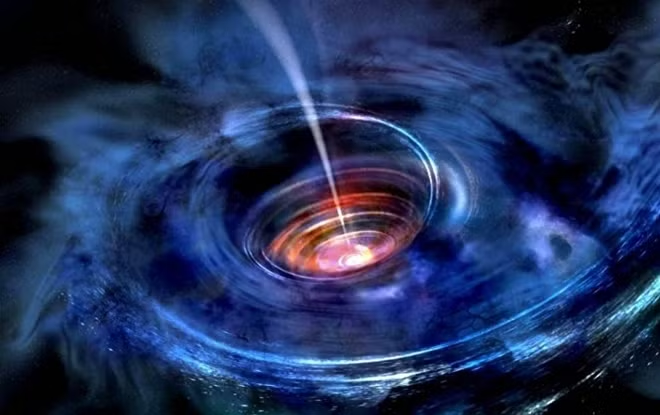
In this artist's rendering, a thick accretion disk has formed around a supermassive black hole following the tidal disruption of a star that wandered too close. Photo: NASA

If a star of around 100,000 solar masses collapses, it can form a substantial black hole right away. Nourished by streams of cold gas, such a black hole could grow to reach a billion solar masses within the first billion years of the universe.

Smidt and his colleagues performed the most detailed simulation yet of this "direct-collapse" hypothesis, which produced the black holes we observe, as well as the ionized gas around them and the star formation rate in their host galaxies. Nonetheless, other theories could explain their presence too, such as mergers of smaller black holes.

To date, astronomers have not identified supergiant stars in the early universe, although the James Webb Space Telescope will be able to confirm whether such beasts did exist, if and when it launches in 2018.
In photographic terms, black holes have remained elusive ever since their discovery in 1971. Stellar observatories have remained unable to secure a snap of one because they are so dark, but researchers are due to make the attempt by activating a telescope network in April.
Sputnik

Other News

Vietnam targets at least 10 large strategic technology firms by 2030

Vietnam targets at least 10 large strategic technology firms by 2030

Deputy Prime Minister Ho Quoc Dung has signed a decision approving a plan to develop large domestic strategic technology enterprises in the 2026–2030 period, aimed at advancing digital infrastructure, digital human resources, digital data, strategic technologies and cybersecurity.

Protecting users crucial in building digital trust: Experts

Protecting users crucial in building digital trust: Experts

In Vietnam, digital transformation in the finance and banking sector is accelerating cashless payments, expanding access to financial services, improving market transparency and supporting economic growth and macroeconomic management.

Fostering skilled workforce for innovation era: experts

Fostering skilled workforce for innovation era: experts

Experts said close coordination among State management agencies, research institutes, universities, and businesses will improve training quality and serve the dual goals of quality education and practical research application.

Startup forum bridges Silicon Valley and local innovation ecosystem

Startup forum bridges Silicon Valley and local innovation ecosystem

The University of Economics Ho Chi Minh City (UEH), Saigon Asset Management (SAM), and Plug and Play Tech Centre co-hosted the “From Vietnam to Silicon Valley” forum, exploring AI innovation, venture capital, and pathways to integrate Vietnam’s startup ecosystem with Silicon Valley and global markets.

Experts call for stronger action against fake news online

Experts call for stronger action against fake news online

Experts have warned that fake news, misinformation and harmful online content are increasingly shaping public perceptions, particularly among young people, and stressed the need for stronger legal safeguards, technology tools and wider dissemination of credible information to tackle the problem effectively.

Protecting digital future in post-quantum, AI era

Protecting digital future in post-quantum, AI era

Participants highlighted the importance of building a proactive, synchronised and sustainable national cybersecurity ecosystem through closer cooperation among regulators, technology firms, research institutions and cybersecurity experts.

Vietnam attends SAHA 2026 defence, aerospace exhibition in Türkiye

Vietnam attends SAHA 2026 defence, aerospace exhibition in Türkiye

Vietnam’s participation in SAHA 2026 International Defence & Aerospace Exhibition in Istanbul reflects the country’s consistent policy of enhancing international defence integration and promoting defence industry cooperation towards self-reliance, self-strengthening, modernisation and dual-use development.

SK Group partners to build AI ecosystem in Vietnam

SK Group partners to build AI ecosystem in Vietnam

SK Innovation and SK Telecom signed MoUs with Nghe An province and the National Innovation Centre of Vietnam to advance AI ecosystem development and support the country’s long-term growth strategy.

Vietnam Research Excellence Fellowship for 2026-2030 approved

Vietnam Research Excellence Fellowship for 2026-2030 approved

Under the Vietnam Research Excellence Fellowship (VREF) for the 2026–2030 period, PhD students are identified as a core research force directly contributing to breakthroughs in sci-tech and innovation. Investing in top-tier doctoral candidates is more than workforce development, but a high-stakes strategic bet to forge a cohort of world-class scientists and technologists who can power Vietnam’s long-term economic ambitions.