 |
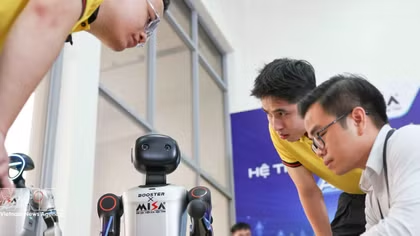
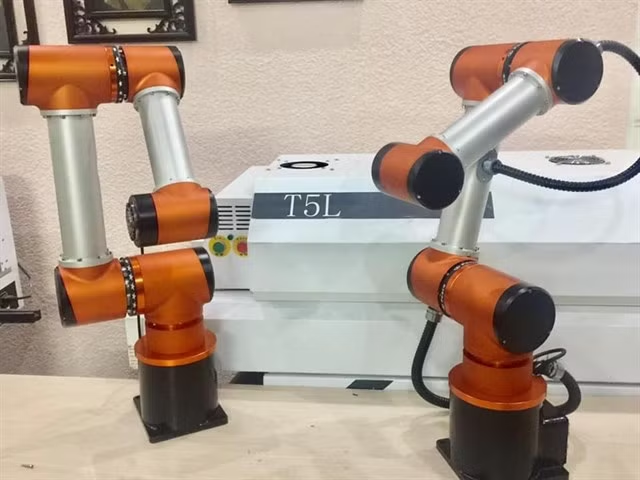
| An industrial robot made by Robot3T Group in HCM City. In recent years there has been a wave of tech start-ups in the city, especially in the use of technology platforms to modernise the traditional business landscape. (Photo courtesy of Robot3T) |
Truong Trong Toai, a graduate of the HCM City University of Technology, started Robot3T at the end of 2014 to turn the dream of a “Made in Vietnam robot” into reality.
He said many SMEs want to use robotic technologies in manufacturing but find the prices of imported robots unaffordable.
“Besides, many imported technologies with their multi-purpose tasks are not compatible with certain production processes.
“Many local SMEs are still at the level of Industry 2.0 in terms of manufacturing technologies. Therefore, they encounter difficulties when leapfrogging to Industry 4.0 technologies and smart factories.”
To resolve the problems faced by SMEs, the Robot3T team has focused on building specific robots with simple structures, high efficiency and low costs that are easy to operate for SMEs.
For instance, a Robot3T part-feeding robot for pressing machines is priced at 3,000-5,000 USD compared to 15,000-30,000 USD for imported ones.
The company has put in place a comprehensive robotic eco-system not only for manufacturing facilities but also for the services sector and military use. It has completed more than 500 commercial projects in industrial automation and robotics.
Expanding rapidly in both domestic and global markets, Robot3T is now serving over 500 customers from 60 countries and territories, with exports accounting for half its revenues, Toai said.
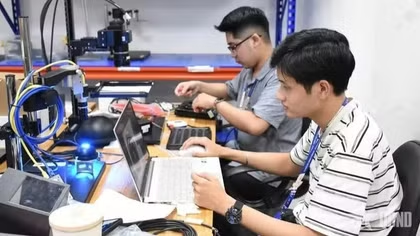
Nguyen Minh Vu, technology director of Live Group, one of Australia's leading payment service providers, last year hired Robot3T to test his company’s new point of sale integrated EFTPOS terminal. With the terminal inspection system needing to be fully automated and operating 24/7, manually testing a high number of terminals was not a possibility.
Using Robot3T’s expertise, Live Group utilised robots to test various aspects of the terminal’s functionality. Robot3T’s testing makes use of the latest Industry 4.0 manufacturing technologies incorporating data analysis, evaluation and cyber-physical systems.
Live Group plans to utilise 10-20 robots to continue the work that has been implemented, he said.
Nguyen Thi Dieu Hang, deputy director of the Business Start-up Support Centre, said: “We have provided consulting and support for a few start-ups developing automation technology, especially robotics, to replace people in dangerous jobs and for sectors requiring a high degree of sophistication.
“I believe in their capabilities. I don’t think their level is inferior to that of their counterparts in other countries.”
Vu Anh Tuan, director of the Quang Trung Software Business Incubator (QTSC Incubator), said understanding that digital transformation would change each industry, the HCM City start-up community has come up with digital transformation solutions that are appropriate for each segment – large, medium, small or micro -- which are expected to help businesses compete with foreign counterparts not only at home but also globally.
In addition to manufacturing sector, start-up companies have also developed innovative solutions to other sectors.
Tuan said: “Start-up projects have contributed or will contribute increasingly to HCM City, especially to its master plan for developing into a smart city, through applications serving administrative reform, solutions used in traffic (to reduce traffic congestion, intelligent traffic supervision/co-ordination systems), education (with education 4.0), health (reducing overload at hospitals), environmental monitoring and processing, and hi-tech agriculture to improve productivity and quality.”
Winsoft Vietnam Co., Ltd in District 12’s Quang Trung Software City has developed Emedi Clinic (eMedical), general management software for general clinics, which helps patients reduce the time needed for medical examination and treatment, easily look up the history of the examination and support recurrent visits.
It also helps doctors eliminate almost all paperwork and clinics with managing the overall process, monitoring staff productivity, managing financial resources, minimising errors related to health insurance payouts, and better managing patients’ medical records.
Explaining why he developed eMedical, Pham Van Dong, the company’s director, said: “With economic growth, people of all ages and classes tend to pay more attention to healthcare services.
“However, not all can access quality healthcare services. Winsoft made its debut because of our desire to develop an interactive app for patients and doctors to talk directly to each other about the symptoms of a disease before visiting a clinic or hospital.”
The software is used by clinics in many cities and provinces like HCM City, Hanoi, Binh Duong, Kien Giang, Long An, An Giang, Dong Thap, Dong Nai, Lam Dong, Dak Nong, and Binh Phuoc.
Talking about future plans, Dong said: “Winsoft would this year complete its eMedi app and connect with teledoctors delivering health checks and treatment.”
Another startup in QTSC, Development Software JSC (Incomsoft), has researched and developed management and customer care solutions for SMEs, shops, kiosks, and organisations.
Pham Thanh Hau, Incomsoft director, said the company’s goal is to bring world-class incomSoft solutions to Vietnamese enterprises at costs that are affordable to Vietnamese businesses.
“Our sales are very good. We plan to expand its presence to all provinces and cities across the country by 2030 and enter foreign markets by 2035.”
HCM City is known as a hub of technology start-ups and software programmers with more than 800 in operation, accounting for 42 percent of the country’s total number.
The city has launched many programmes over the years to support start-up activities.
Tuan said: “In order to help the start-up community develop rapidly, the Government needs to have more specific policies.
“Besides, it is necessary to enhance communications about the results achieved by start-ups in the past, the city’s guidelines and policies for supporting innovative start-ups and the eco-system in place to support start-ups.”
Hang said: “To succeed, start-ups need to carefully study the market to develop products in line with market demand and at reasonable prices.
“Large domestic enterprises should be more supportive of and willing to use the technologies of Vietnamese start-ups to give them wings to become large enterprises in future.”