Robots learn to work together by chatting in new language they created

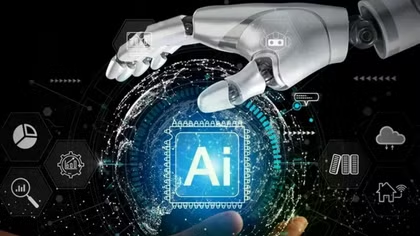
Robots have learned how to communicate with each other by creating their own language, a new report explains.

Experts at artificial intelligence research group OpenAI conducted an experiment that challenged software bots to complete a series of tasks, such as moving to a specific location, in a simple, two-dimensional virtual world.

The team used a technique called reinforcement learning, presenting the challenges as cooperative rather than competitive, and rewarding the robots for completing them.
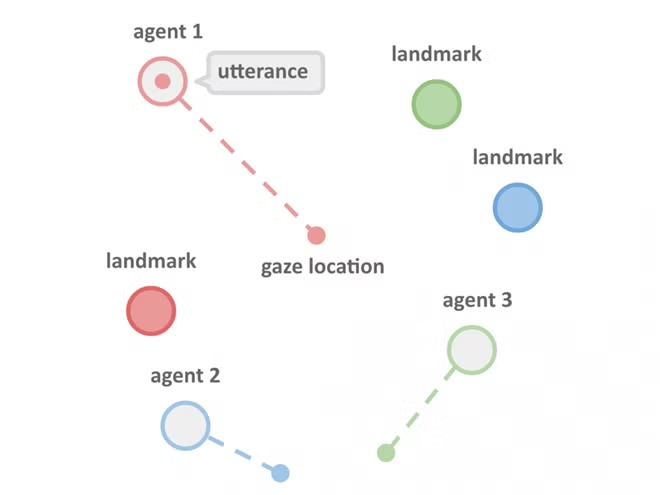
The robots learned to collaborate and communicate through trial and error Photo: OpenAI
The robots learned to collaborate and communicate through trial and error Photo: OpenAI

“We've just released initial results in which we teach AI agents to create language by dropping them into a set of simple worlds, giving them the ability to communicate, and then giving them goals that can be best achieved by communicating with other agents,” wrote the OpenAI team in a blog post. 

“If they achieve a goal, then they get rewarded.”

The robots learned to collaborate and communicate through trial and error, remembering the symbols, words and signals that helped them to achieve a goal and storing them in a private recurrent neural network. 

“If one agent realizes that it could have performed a task better if a second agent had sent different information, the first agent can tell the second exactly how to modify its messages to make them as useful as possible,” it continues. 

“In other words, agents ask the question: 'how should I modify my communication output to get the most communal reward in the future?'”
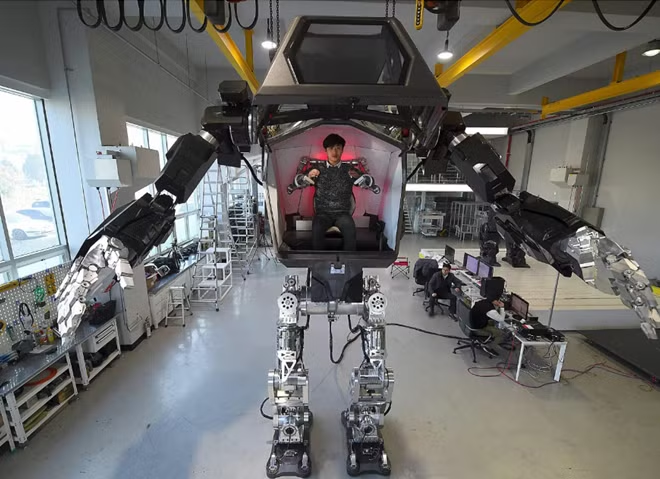
Engineers test a four-metre-tall humanoid manned robot dubbed Method-2 in a lab of the Hankook Mirae Technology in Gunpo, south of Seoul, South Korea. Photo: Jung Yeon-Je/AFP/Getty Images

Engineers test a four-metre-tall humanoid manned robot dubbed Method-2 in a lab of the Hankook Mirae Technology in Gunpo, south of Seoul, South Korea. Photo: Jung Yeon-Je/AFP/Getty Images

The language evolved as the researchers introduced tougher tasks, with the robots eventually learning to work together by composing sentences comprising multiple words. 

As the language continues to develop and grow more and more complex, the researchers hope to build a translator bot capable of translating their communications for humans. 

“We hope that this research into growing a language will let us develop machines that have their own language tied to their own lived experience,” concludes the OpenAI post. 

“We think that if we slowly increase the complexity of their environment, and the range of actions the agents themselves are allowed to take, it’s possible they’ll create an expressive language which contains concepts beyond the basic verbs and nouns that evolved here.”
Independent

Other News

Vietnam targets at least 10 large strategic technology firms by 2030

Vietnam targets at least 10 large strategic technology firms by 2030

Deputy Prime Minister Ho Quoc Dung has signed a decision approving a plan to develop large domestic strategic technology enterprises in the 2026–2030 period, aimed at advancing digital infrastructure, digital human resources, digital data, strategic technologies and cybersecurity.

Protecting users crucial in building digital trust: Experts

Protecting users crucial in building digital trust: Experts

In Vietnam, digital transformation in the finance and banking sector is accelerating cashless payments, expanding access to financial services, improving market transparency and supporting economic growth and macroeconomic management.

Fostering skilled workforce for innovation era: experts

Fostering skilled workforce for innovation era: experts

Experts said close coordination among State management agencies, research institutes, universities, and businesses will improve training quality and serve the dual goals of quality education and practical research application.

Startup forum bridges Silicon Valley and local innovation ecosystem

Startup forum bridges Silicon Valley and local innovation ecosystem

The University of Economics Ho Chi Minh City (UEH), Saigon Asset Management (SAM), and Plug and Play Tech Centre co-hosted the “From Vietnam to Silicon Valley” forum, exploring AI innovation, venture capital, and pathways to integrate Vietnam’s startup ecosystem with Silicon Valley and global markets.

Experts call for stronger action against fake news online

Experts call for stronger action against fake news online

Experts have warned that fake news, misinformation and harmful online content are increasingly shaping public perceptions, particularly among young people, and stressed the need for stronger legal safeguards, technology tools and wider dissemination of credible information to tackle the problem effectively.

Protecting digital future in post-quantum, AI era

Protecting digital future in post-quantum, AI era

Participants highlighted the importance of building a proactive, synchronised and sustainable national cybersecurity ecosystem through closer cooperation among regulators, technology firms, research institutions and cybersecurity experts.

Vietnam attends SAHA 2026 defence, aerospace exhibition in Türkiye

Vietnam attends SAHA 2026 defence, aerospace exhibition in Türkiye

Vietnam’s participation in SAHA 2026 International Defence & Aerospace Exhibition in Istanbul reflects the country’s consistent policy of enhancing international defence integration and promoting defence industry cooperation towards self-reliance, self-strengthening, modernisation and dual-use development.

SK Group partners to build AI ecosystem in Vietnam

SK Group partners to build AI ecosystem in Vietnam

SK Innovation and SK Telecom signed MoUs with Nghe An province and the National Innovation Centre of Vietnam to advance AI ecosystem development and support the country’s long-term growth strategy.

Vietnam Research Excellence Fellowship for 2026-2030 approved

Vietnam Research Excellence Fellowship for 2026-2030 approved

Under the Vietnam Research Excellence Fellowship (VREF) for the 2026–2030 period, PhD students are identified as a core research force directly contributing to breakthroughs in sci-tech and innovation. Investing in top-tier doctoral candidates is more than workforce development, but a high-stakes strategic bet to forge a cohort of world-class scientists and technologists who can power Vietnam’s long-term economic ambitions.