Russian Su-35 may be last fighter jet imported by China as Beijing bets on J-20

On December 25, China received the first shipment of Russian-made Su-35 fighter jets, as part of a deal between Moscow and Beijing on delivering a total of 24 aircraft.
Russia and China signed a contract on the delivery of 24 Russian Sukhoi Su-35 aircraft, estimated to be worth $2 billion, in 2015.
The S-35 is a 4++ generation, twin-engine, highly maneuverable multirole fighter jet. It has a maximum speed of 1,553 mph (2,500 kmh) with advanced dry thrust and afterburner capabilities that enhance the aircraft’s dogfighting maneuverability and semi-stealth design that makes it possibly the most lethal fighter jet in the sky. The fighter jet is an upgraded version of the Su-27 multirole fighter. It was first introduced to a foreign audience at the 2013 Paris Air Show.

The Su-35 is Russia’s top air-superiority fighter, until the fifth-generation PAK-FA stealth fighter comes into production.

According to the Chinese newspaper The People’s Daily, the reason for such smooth procurement of the Su-35 for the Chinese military is the recent debut of the domestic-designed J-20 fifth-generation fighter.

Of course, the deal on delivering Su-35 jets to China was a result of close military and technical cooperation between Moscow and Beijing.

China unveiled two Chengdu J-20 stealth fighters at the Airshow China-2016 in Zhuhai in early-November. The aircraft was developed by Chengdu Aircraft Industry Corporation. The J-20 conducted its first test flight in early 2011.
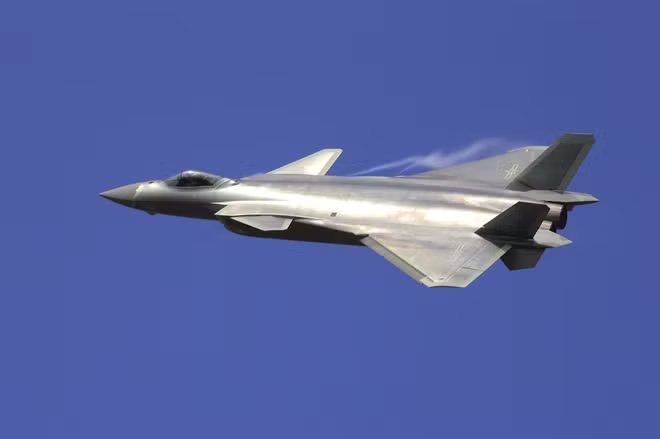
In this photo provided by China's Xinhua News Agency, the J-20 stealth fighter jet flies at the China's International Aviation and Aerospace Exhibition in Zhuhai on Tuesday, Nov. 1, 2016. Photo: Xinhua
According to Air Force Commander General Ma Xiaotian, China will not put the J-20 on the global market.
However, military experts noted that another possible reason behind China’s interest for the Su-35 is its engine, the AL-117S turbofan.
China has put much effort in developing its own turbofan akin to the Su-35’s, known as the WS-10 turbofan, but it continues to underperform the Russian-made AL-117S. If Chinese engineers manage to reverse engineer the Russian technology they may be able to narrow the technological gap with Russia and the West.
Sputnik

Other News

AI offers both opportunities, challenges for Vietnam's growth

AI offers both opportunities, challenges for Vietnam's growth

Dr. Ho Duc Thang, a full-time member of the National Assembly’s Committee for Cultural and Educational, said productivity is the key to sustaining double-digit economic growth, and AI has greater potential to improve productivity than any previous technology.

Top leader unveils people-centred vision for new development model

Top leader unveils people-centred vision for new development model

Vietnam's growth model, long fueled by low-cost labour, resource extraction, contract manufacturing, expanded investment, and capital accumulation, has run out of road. The country now needs a sweeping reform agenda to shift from extensive growth to a model driven by productivity, knowledge, science and technology, innovation, and digital transformation.

First national semiconductor chip prototyping support centre makes debut

First national semiconductor chip prototyping support centre makes debut

Vietnam's semiconductor ecosystem now comprises around 60 chip design companies, some 7,000 chip design engineers and 166 universities offering semiconductor-related training programmes. Initial registrations from 12 organisations indicate demand for the prototyping of approximately 30,000 chips.

Vietnam targets at least 10 large strategic technology firms by 2030

Vietnam targets at least 10 large strategic technology firms by 2030

Deputy Prime Minister Ho Quoc Dung has signed a decision approving a plan to develop large domestic strategic technology enterprises in the 2026–2030 period, aimed at advancing digital infrastructure, digital human resources, digital data, strategic technologies and cybersecurity.

Protecting users crucial in building digital trust: Experts

Protecting users crucial in building digital trust: Experts

In Vietnam, digital transformation in the finance and banking sector is accelerating cashless payments, expanding access to financial services, improving market transparency and supporting economic growth and macroeconomic management.

Fostering skilled workforce for innovation era: experts

Fostering skilled workforce for innovation era: experts

Experts said close coordination among State management agencies, research institutes, universities, and businesses will improve training quality and serve the dual goals of quality education and practical research application.

Startup forum bridges Silicon Valley and local innovation ecosystem

Startup forum bridges Silicon Valley and local innovation ecosystem

The University of Economics Ho Chi Minh City (UEH), Saigon Asset Management (SAM), and Plug and Play Tech Centre co-hosted the “From Vietnam to Silicon Valley” forum, exploring AI innovation, venture capital, and pathways to integrate Vietnam’s startup ecosystem with Silicon Valley and global markets.