The new phones’ most eye-catching feature is an almost completely bezel-free display, running the full width of the device, even curving around the edge (akin to the screen on Samsung’s Galazy S7 Edge), and shrinking the chin and forehead of the front screen to tiny slivers. Samsung’s calls this the “infinity display”, and even the home button has been removed, replaced with a pressure-sensitive section at the bottom of the screen.
Launching on 28 April (though pre-order customers will receive theirs a week early), the Galaxy S8 will retail at £689 and the S8+ at £779. Those prices are £10 and £40 cheaper than the respective iPhone models Samsung is competing with, but leave the S8 £120 more than the S7 and the S8+ £140 more expensive than the S7 Edge. Two colours will hit Britain, “Midnight Black” and “Orchid Grey”, and Samsung is still decided whether to launch a third colour, “Arctic Silver”.
That allows the two devices, with screens of 5.8in and 6.2in respectively, to occupy the body of a phone with a much smaller display. The Galaxy S8, for instance, has dimensions of 148.9 x 68.1 x 8mm, roughly a centimetre shorter and narrower (though 0.7mm thicker) than an iPhone 7 Plus, despite having a screen 0.3in larger.
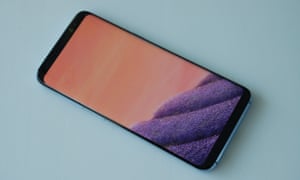
The screen, with a resolution of 2960 x 1440 pixels on both models, is also the first on a mobile phone to be rated as Mobile HDR Premium, certifying it as meeting a certain standard for high dynamic range content – showing blacker blacks, brighter whites and a generally larger range of brightness than most phones.
Inside the devices is an octacore chip (with four cores clocked at 2.3Ghz and four at 1.7Ghz), the first in a smartphone to be made in a 0.1 micron production process, along with 4GB of Ram and 64GB of flash storage. Also present an expansion slot for microSD cards: while Samsung removed the slot for the Galaxy S6, from the S7 onwards, owners have been able to slot in an SD card for extra storage.
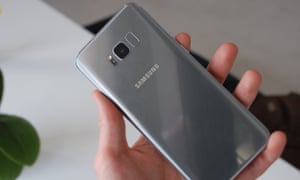
The back of the Galaxy S8. Photograph: Alex Hern for the Guardian
Although largely similar apart from their screens, the two sizes do have one other difference: a larger battery in the larger model, rated at 3,500mAh, while the smaller phone has storage of 3,000mAh.
The Galaxy S8 will ship with Android 7, Nougat, which is currently the most recent version of Android. It is due to be superseded in the third quarter of 2017 by Android O.
The cameras on the two devices remain largely similar to those in the Galaxy S7: A 12MP rear-facing camera, with optical image stabilisation, and an 8MP selfie camera, both with an F1.7 aperture. Also included is a fingerprint sensor on the back of the device, next to the camera, and a face unlock feature.
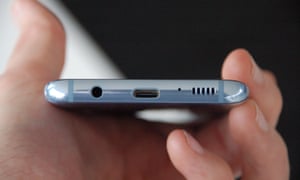
The base of the Galaxy S8, with headphone jack. Photograph: Alex Hern for the Guardian
One thing that’s survived the upgrade is the headphone jack. Six months after Apple took the heat for shipping the iPhone 7 without a standard 3.5mm plug, the Galaxy S8 still has room for the old port.
The release comes at a crucial time for Samsung. Following the Note 7 disaster, which saw devices recalled after a number spontaneously caught fire, the company embarked on a period of retrenchment, releasing adverts trumpeting its reputation for safety and attempting to limit the wider damage to its brand.
“The brand lost prestige and consumer trust with the debacle of the Galaxy Note 7,” says Thomas Husson, vice president and principal analyst at Forrester. Additionally, “Samsung only has a window of opportunity of several months before the launch of the 10th anniversary iPhone,” currently expected to arrive in September with a similarly bezel-free design.
“The launch of Samsung’s new flagship smartphone is thus key for the brand, even though it has managed to reduce its business dependency on smartphones, contrary to Apple,” Husson said. “The launch of the new device must be perfectly executed for Samsung to gain innovation leadership and to gain market share in the high-end smartphone segment.”
Alongside the new phones, Samsung is releasing or updating a number of related products. Its Gear VR headset, a co-production with Facebook’s Oculus division, gains a wireless gesture-based remote control, while the Gear 360 camera is upgraded with the ability to live-stream 360˚ video, something the company claims could be “one of the tipping points” for widespread adoption of virtual reality.