Samsung recalls 2.8m washing machines after reports of explosions

First it was phones, now washing machines – US consumer safety regulator ordered the recall after more than 700 complaints and several injuries

Samsung and US safety officials announced a recall on Friday of nearly 3m washing machines after reports that the appliances – just like the company’s Note 7 smartphones – are exploding and injuring people.

The Consumer Product Safety Commission said on Friday that Samsung has received 733 reports of washing machines “experiencing excessive vibration or the top detaching from the washing machine chassis”.

Injuries in the reports include a broken jaw, an injured shoulder, and bruises and blunt force injuries, the agency said. The recall will affect 34 models of washing machines, about 2.8m machines in total, sold since 2011. Customers can either have a free repair and one-year warranty, an exchange rebate on a new washing machine (with “loyalty incentive up to $150”) for a Samsung purchase), or a full refund for eligible new customers.
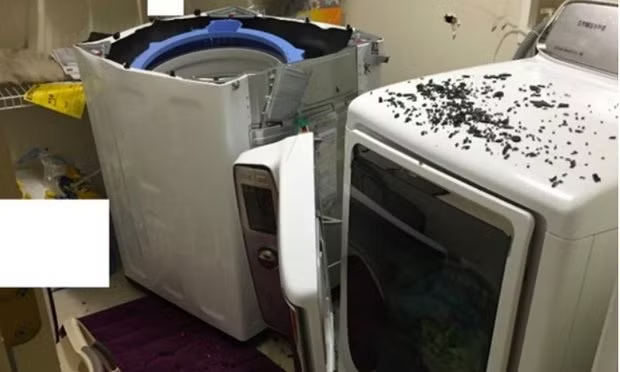
‘Our priority is to minimize any safety risk and address the conditions that lead to the rare instance when the top of the washer unexpectedly separates from the unit,’ the company said in a statement. Photograph: District court for the district of New Jersey

The CPSC also said that customers will receive a safety kit and instructions until their machines can be repaired, and they should be warned to use slower spin settings for bulky items until then. In its own statement, Samsung said the recall does not affect models sold outside North America.

“Our priority is to minimize any safety risk and address the conditions that lead to the rare instance when the top of the washer unexpectedly separates from the unit,” the electronics and appliance company said in a statement.

“We apologize for the inconvenience this is creating to our loyal customers. We have worked closely with the CPSC to offer a consumer friendly recall that is safe, easy and complete with choices suited to the needs of anyone who may own a recalled machine.”

The recall follows a lawsuit filed earlier this year by two consumers, Suzann Moore and Michelle Soto Fielder, who alleged that the washing machines were “defectively designed and imposed an unreasonable risk to person and property”.

“There is no reasonable or acceptable rate for washing machines to explode,” they wrote in their complaint. “Michelle’s washing machine exploded with such ferocity that it penetrated the interior wall of her garage, where it was located. The dent left at the washing machine’s point of impact was so deep that it pushed through into Michelle’s living room, which shares a wall with her garage.”

In 2013 Samsung ordered a recall of about 150,000 washing machines in Australia, fearing that the machines could cause fires.

And in September, US officials and Samsung ordered a recall of the company's Galaxy Note 7 smartphone following reports that the devices caught fire. Last month the company ended production of the phones, and it was sued in California court  by a woman who said the phone problems extended beyond the Note 7 model.

The South Korean firm’s profits fell by 30% in the third quarter of 2016.
The Guardian

Other News

Hanoi approves controlled pilot of two technology projects

Hanoi approves controlled pilot of two technology projects

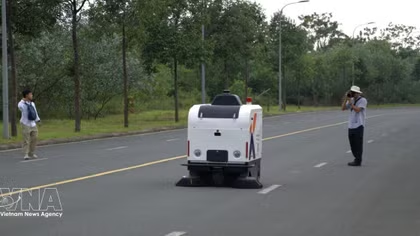
The two projects involve an intelligent autonomous transportation system developed by Phenikaa-X JSC and a technology for producing mixed rare-earth oxides with a purity of over 95% on a semi-industrial scale developed by the Mining Technology and Construction Consultancy JSC.

Banking industry in AI era: When data becomes competitive advantage

Banking industry in AI era: When data becomes competitive advantage

In just a few years, AI has evolved from an experimental technology into an “assistant” for many banks, supporting everything from customer service, credit approval, and fraud detection to risk management. However, as the technological gap between institutions narrows, a new question is emerging: What will determine banks' competitive advantage in the AI era?

Bac Ninh considers establishing AI centre of excellence

Bac Ninh considers establishing AI centre of excellence

A meeting has been held in Bac Ninh to discuss potential cooperation with Plug and Play in developing the northern province’s innovation ecosystem and establishing an artificial intelligence (AI) centre of excellence, with Standing Vice Chairman of the provincial People’s Committee Mai Son receiving a delegation from the global innovation platform.

Hanoi allows 24-month trial of autonomous vehicles at Hoa Lac

Hanoi allows 24-month trial of autonomous vehicles at Hoa Lac

The project aims to assess the safety, reliability and readiness of autonomous vehicles under real traffic conditions, as well as the effectiveness of autonomous public transport and compatibility with existing systems. Its results will contribute to developing technical standards, operating procedures and management models suited to Hanoi’s traffic conditions.

Singapore's experience suggests solutions to Vietnam's human resources challenge in AI era

Singapore's experience suggests solutions to Vietnam's human resources challenge in AI era

As Vietnam accelerates digital transformation and high-tech development, Singapore’s experience and the engagement of global technology companies demonstrate that human resources preparation must stay ahead of the curve. The ability to filter knowledge, collaborate, innovate and effectively use AI will increasingly become essential to helping workers adapt to a changing labour market and strengthening the competitiveness of Vietnam’s economy in the new era.

Protecting national security amid digital transformation, cyberspace

Protecting national security amid digital transformation, cyberspace

Cybersecurity, information security and data security risks must be identified and addressed early and from afar, with appropriate defensive measures ready to neutralise threats and protect national interests in cyberspace, said Lieutenant General Le Xuan Minh, Director of the Ministry of Public Security’s Department of Cybersecurity and Hi-tech Crime Prevention (A05).

Mekong Delta launches first robotics, AI research institute

Mekong Delta launches first robotics, AI research institute

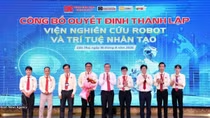
Dr. Nguyen Van Quang, Rector of Nam Can Tho University, said the university is developing a value chain covering training, research, technology development, testing, technology transfer and commercialisation. The model is designed to link research more closely with practical needs, ensuring that technologies generate products and products create value for society.

Vietnam positioned to harness AI wave, World Bank report says

Vietnam positioned to harness AI wave, World Bank report says

The WB report identifies Vietnam as one of the few economies outside the European Union (EU) to have adopted a comprehensive AI regulatory framework as early as 2025. Vietnam applies a risk-tiered approach similar to that of the EU AI Act, imposing different obligations depending on whether an AI system poses “unacceptable,” “high,” “low” or “minimal” risks. The approach is viewed as a strategic step towards ensuring safe and transparent AI governance.

AI offers both opportunities, challenges for Vietnam's growth

AI offers both opportunities, challenges for Vietnam's growth

Dr. Ho Duc Thang, a full-time member of the National Assembly’s Committee for Cultural and Educational, said productivity is the key to sustaining double-digit economic growth, and AI has greater potential to improve productivity than any previous technology.

Top leader unveils people-centred vision for new development model

Top leader unveils people-centred vision for new development model

Vietnam's growth model, long fueled by low-cost labour, resource extraction, contract manufacturing, expanded investment, and capital accumulation, has run out of road. The country now needs a sweeping reform agenda to shift from extensive growth to a model driven by productivity, knowledge, science and technology, innovation, and digital transformation.