 |
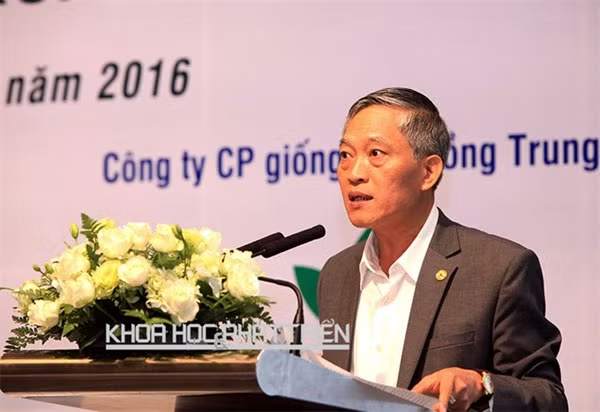
| Deputy Minister of Science and Technology Tran Van Tung |
Could you describe a key research programme applying science and technology in environmental protection and natural disaster prevention?
Since 2000, the Ministry of Science and Technology (MoST) has worked with relevant ministries and agencies to develop key science and technology programmes that cover a wide range of areas, including the prevention and mitigation of natural disasters and their impacts.
Among such programmes is KC08 national science and technology programne built in five-year periods.
During the 2001-05, it was called "Programme for Environmental Protection and Disaster Prevention."
From 2006 to 2010, it was entitled "Science and Technology Programme for Environmental Protection, Disaster Prevention and Rational Use of Natural Resources".
For the period 2011-15, the MoST decided to change the theme to "Science and Technology Research Programme for Environmental Protection, Natural Disaster prevention and Rational Use of Natural Resources". The 2016-20 period is titled "Scientific Research Programme for Environmental Protection and Natural Disaster Prevention."
During the implementation of the KC08 programme, various solutions, initiatives and new technologies have been proposed and applied to prevent natural disasters and minimise damages.
Those include the application of technologies to improve dam safety of small and medium reservoirs in areas prone to flash floods and landslides by building walls and bentonite trench walls for waterproofing and preventing surface and foundation overflow.
It also includes applying high technology in the construction of warning systems for overflowing clusters in case of flash floods in northern and central mountainous provinces, providing early warning to local authorities and people in flood-hit areas; installing and applying geographic information system (GIS) and remote sensing technology in building a mapping system for flash floods and landslides warning, monitoring and detecting.
How does the programme help boost environmental protection and natural disaster prevention and what are the challenges in applying it?
Many technologies have been applied in recent years to minimise damages caused by natural disasters.
Thanks to this research programme, the Ministry of Natural Resources and Environment (MoNRE) has developed a system of zoning maps and warnings of the risk of flash floods and landslides.
The ministry has step by step handed the system over to local use.
However, given that natural disasters due to impacts of climate change tend to be more extreme and unpredictable in terms of frequency and intensity, the programme must be accelerated.
A continuous strange weather phenomenon in the past three years including heavy rains resulted in serious damages.
The rains in the northern coastal Quang Ninh Province in August, 2015, northern mountain Sa Pa Town in 2016 and northern mountain Yen Bai and Lao Cai provinces in 2017 were clear proof.
How can scientific and technological research programmes be more effective in environmental protection and disaster prevention?
The implementation of disaster mitigation activities cannot be implemented individually. It should be integrated with others activities in the context of ensuring effective sustainable development. Scientific and technological solutions for environmental protection and natural disaster prevention should also be integrated with others activities.
Scientific and technology achievements should be transferred and applied to localities particularly those in mountain remote areas.
New initiatives or proposals should also be focused to provide information and warning at the right time.
A list of high risk flash flood and landslide points would contribute greatly to population evacuation plans in response to natural disasters.